Oaks of Glory
  • Home
  • Halley Faville
  • Jeff Faville
  • Oaks Canyon Youth
    • Youth Sign-Up/Forms
    • How You Can Help!
  • Beth Bearden
  • About
  • Contact
  • Resources
  • Recommended Blogs

40 Days with Goliath Part 2

5/26/2021

1 Comment


For forty days the Philistine came forward
every morning and evening and 
​
took his stand.

Picture
​     My husband is very athletic.  As he wraps up his long, wearying day on multiple jobsites, he keeps going with the thought that when he gets home, he will get to exercise.  The longer the hours of sitting in the car, the more intense the workout that he wants to pound out.  For him, the thought of increasing strength and endurance, of being ready for any emergency and need, is what drives him on. 
     Goodness, it's not mine.  
     My motivation looks more like a hot cappuccino in a pretty mug just to get out of bed in the morning.  The longer the day, the more I look forward to sitting with a warm blanket and a good book.
      But when we are in the thick of it, when our day isn't just a normal, messy craziness, but there is an extra weight to it, a deprivation, an urgency and trauma, a vulnerability and testing--and these are the markers that come back day after day unresolved, then we need to recognize that we are facing a goliath--and that there are exciting things ahead.  
       In ​Part 1, we studied the place and stance of our fight, and who our goliaths are.  In today's study, let's look at some of the first problems David encountered before he even had to stand up to his Goliath, and how he rooted himself firmly in his identity and future.  These are problems that are unavoidable in every life of victorious faith for a believer in Christ, and yet are embued with the presence, power and promise of the Holy Spirit to deliver and reward!  


12Now David was the son of that Ephrathite of Bethlehem Judah, whose name was Jesse, and who had eight sons. And the man was old, advanced in years, in the days of Saul. 13The three oldest sons of Jesse had gone to follow Saul to the battle. The names of his three sons who went to the battle were Eliab the firstborn, next to him Abinadab, and the third Shammah. 14David was the youngest. And the three oldest followed Saul.
​15But David occasionally went and returned from Saul [ministering to Saul with the lyre\ to feed his father’s sheep at Bethlehem.
1 Sam. 17:12-15

     As background, we need to understand why we are given the information about David’s brothers. Earlier, in chapter 16, when David was about to be anointed by Samuel.  In front of the entire village and its elders, David had been neglected—uninvited--at the feast for which he himself would be the guest of honor, known only to God. His father and brothers had not considered him worth calling. Of course, they presumed, Samuel would choose one of Jesse’s oldest sons: they were the strongest, handsomest and most charismatic.
     God, however, did not see it that way. Instead, in front of the whole village, God told Samuel to tell them that Eliab was not chosen by God, but rather rejected, because God could see his heart. Down the line went Samuel, through the six sons of Jesse, each in turn, rejected by the Lord because their hearts were not right.
     Samuel got to the end of the line. Turning to Jesse, he asked him if he had any other sons. “There remains yet the youngest,” Jesse replied, “and there he is, keeping the sheep.” (1 Sam. 16:11). After bringing his youngest son, David was anointed by Samuel “in the midst of his brothers. And the Spirit of the Lord came upon David from that day forward.” This anointing and pronouncement was followed by a feast, given in David’s honor.
     After this event, David was given a job in the palace playing his lyre, an instrument similar to a harp, for an unsuspecting and now replaced King Saul, for whenever Saul would be distressed by an evil spirit (1 Sam. 16:16).
     So here was David, still in charge of keeping his father’s sheep, but also in Saul’s employ as a musician, traveling regularly back and forth to keep up with his responsibilities. David was anointed by God as the king-elect, so to speak, close to the throne in proximity, but with many lessons to learn before receiving it physically.
     Just as Jesus was anointed with the Holy Spirit at His baptism in the presence of His brothers and then led by the Holy Spirit into the desert to be tempted by the devil, so would David start his public ministry—with a 40 day test in the wilderness:
          

"For forty days the Philistine came forward
every morning and evening and took his stand."
1 Sam. 17:16​

      Here, we see Goliath coming out every single day to mock, revile, and test the Israelites. Both morning and evening the entire armies of the Israelites and Philistines would gather on their respective hills, face off across the valley, and hear the challenge and mockery yet again: “And all the men of Israel, when they saw the man, fled from him and were dreadfully afraid.” v. 24
      Now in the Bible we see a pattern of 40 days. The rain fell for 40 days while Noah waited in the ark; the people of Israel traveled 40 years in the wilderness, 1 year for each day the spies spied out Canaan; Moses stayed for two sets of 40 days on Mt. Sinai, fasting, and receiving the commandments of God; Joshua, who waited partway down the mountain for Moses, also fasted; Aaron, simultaneously, waited the 40 days down in the desert with the people, followed by creating the idolatrous golden calf for them to worship; Elijah fasted for 40 days while he went through the wilderness, Ezekiel lay on his right side for 40 days, bearing the iniquity of the people; and Jesus was led by the Spirit for 40 days in the wilderness, fasting, to be tested by the devil.
     Each of these 40 day periods was a time of extreme testing, deprivation and temptation. It would involve feelings of weakness, shame, vulnerability, fear, exposure, worthlessness, wastedness, and futility. These feelings would come, whether the person gave into the temptation or not. The feelings would assault them, even if they refused to sin.
     For those who gave themselves over to the temptation, as in the case of Aaron and the people of Israel, there were sad and painful consequences as they became enslaved to the desires for which they lusted.
                        
When we remain faithful in the testing,
​there is the promise of an increase of the power of the Holy Spirit in our lives.

     ​
 
     The scriptures say of Moses that, after enduring his time of fasting on Mt. Sinai with the Lord, “when Moses came down from Mount Sinai….Moses did not know that the skin of his face shone while he talked with Him. So when Aaron and all the children of Israel saw Moses, behold, the skin of his face shone, and they were afraid to come near him.” (Ex. 34:29-30) Furthermore, the scriptures say of Jesus, that after he returned from his fasting and temptations, that “he returned in the power of the spirit,” (Luke 4:14) for further and effective ministry.
     A time of testing, a time of temptation, a constant barrage of accusations, lies and enticement to do evil: these are not sin. Rather, they are a common occurrence in the spiritual journey of every believer. There will be Goliaths in our lives. There will be those 40 days of suffering and deprivation. There will be times when we wait and wait for the Lord to deliver us, wondering when this season will be over.
     Sometimes we are tempted to believe there must be something wrong with us that we would even be in the middle of such a difficult test of our faith and commitment to self-control. Sometimes we can feel like we must already be guilty because of the temptations and accusations that the enemy calls out to us.
      In reality, though, it may simply be the effect of a calling or anointing on your life by God. These ministries must be preceded by an encounter with the enemy, for which you must solely depend by faith on the deliverance through the blood of Christ. It is in the crucible of your wilderness with Goliath that you come to understand intimately how deeply the blood of Jesus can deliver you from every sin, temptation and evil.
       God is faithful. He has always and will always be faithful to deliver us from “every evil work and to preserve [us] for His heavenly kingdom” (2 Tim. 4:18). Listen and meditate on the promise of God for these seasons of our goliaths:

     
  “No temptation has seized you except what is common to man. But God is faithful. He will not let you be tempted beyond what you can bear. But when you are tempted, He will also provide a way out so that you can stand up under it” 1 Cor. 10:13

     There is nothing—no emotion, no temptation, no terror-- that isn’t common to us all in some way or fashion. As children of God, He is just to discipline His children—not in the same way, but to the same end: to bring each of us to a full maturity in Christ.
     It is these Goliath seasons that provide the discipline and hardship that bring us into that state of maturity. 

It is our goliaths that take the theory of our theology
​into the intimacy and power of relationship.
​

17Then Jesse said to his son David, “Take now for your brothers an ephah of this dried grain and these ten loaves, and run to your brothers at the camp. 18And carry these ten cheeses to the captain of their thousand, and see how your brothers fare, and bring back news of them.” 19Now Saul and they and all the men of Israel were in the Valley of Elah, fighting with the Philistines. 20So David rose early in the morning, left the sheep with a keeper, and took the things and went as Jesse had commanded him. And he came to the camp as the army was going out to the fight and shouting for the battle. 21For Israel and the Philistines had drawn up in battle array, army against army. 22And David left his supplies in the hand of the supply keeper, ran to the army, and came and greeted his brothers. 23Then as he talked with them, there was the champion, the Philistine of Gath, Goliath by name, coming up from the armies of the Philistines; and he spoke according to the same words. So David heard them. 24And all the men of Israel, when they saw the man, fled from him and were dreadfully afraid. 25So the men of Israel said, “Have you seen this man who has come up? Surely he has come up to defy Israel; and it shall be that the man who kills him the king will enrich with great riches, will give him his daughter, and give his father’s house exemption from taxes in Israel.”26Then David spoke to the men who stood by him, saying, “What shall be done for the man who kills this Philistine and takes away the reproach from Israel? For who is this uncircumcised Philistine, that he should defy the armies of the living God?” 27And the people answered him in this manner, saying, “So shall it be done for the man who kills him.”
​1 Sam. 17:7-27

​

​     Notice David’s response. He questions their fear, their terror, at a mere man, when the people have the very living God on their side. “What shall be done,” David asks again and again, “for the man who kill this Philistine and takes away the reproach (the mockery, the shame) from Israel?”
​
     As servants of our King, we have the “armies of the living God” waiting to go out to battle with us. Armies that do not quake with fear or run, afraid of the voice of the giants. Armies that are supernatural; hosts of heaven waiting on the King’s command.
​
      What shall be done for the man or woman who fights for their King, defeats the giants who come against them, and takes away the shame from God’s people? This is Jesus, your King, says to you: “He who overcomes, and keeps My works until the end, to him I will give authority over the nations—….and I will give him the morning star” (Rev. 2:26-28).
   Sometimes when we are fighting our goliaths, we are only considering escaping the severity of slavery or of death.  Seeing past the battle to the victory, and even to the reward, can seem presumptuous and perhaps past what our minds can seem to take in in the moment. 
    In our story, though, David shows us how to live faith in the testing:  Focus on the reward.  Not on the giant.  Not on the fearful soldiers.  Not on the valley of depression.  Not on the escape.  The reward.  We see the same outcome with Jesus when He focused on the reward set before Him:  

   
​
 
​1Therefore we also, since we are surrounded by so great a cloud of witnesses, let us lay aside every weight, and the sin which so easily ensnares us, and let us run with endurance the race that is set before us, 2looking unto Jesus, the author and finisher of our faith,
who for the joy that was set before Him endured the cross,
​despising the shame, and has sat down at the right hand of the throne of God.
The Discipline of God3For consider Him who endured such hostility from sinners against Himself, lest you become weary and discouraged in your souls. 4You have not yet resisted to bloodshed, striving against sin.
Hebrews 12:1-4   

     When the reward is great enough, and we truly believe that it is waiting at the end of our pain, our actions will reflect that faith in endurance. 
      In all of David’s bold and courageous questioning, though, there was one man who was not impressed with his assertiveness---Eliab:

​

28Now Eliab his oldest brother heard when he spoke to the men; and Eliab’s anger was aroused against David, and he said, “Why did you come down here? And with whom have you left those few sheep in the wilderness? I know your pride and the insolence of your heart, for you have come down to see the battle.”
​1 Sam. 17:28

​     Eliab turns against his brother, and, seething in rage, jealously and vindictiveness, accuses David's faith and courage of being really a presumptive pride and an evil desire to watch a battle that was none of his business.
     Eliab burned with anger—because he himself had failed to step up to defeat the giants in his life. Anger is often a response of guilt in our lives, especially when directed at someone who is suggesting that there is a way to not sin—to live in victory. He had already in his heart given himself over to the slavery of the fear, lies, and shame. As indicated by God’s rejection of Eliab as king, Eliab had heart issues with which he had not dealt.
     In fact, the very two accusations he leveled at David were a few of his own pitfalls—pride and wickedness. It had been his pride that had been injured when he was refused as king. It was he who had presumed that God would validate him, without the righteous obedience that accompanies a clear conscience and loving heart. It was the wickedness of his own heart that now sought to accuse God’s Anointed.
     He was angry that David would imply that there was another choice. People who have given themselves into obedience to slavery want to feel and believe and be validated in the belief that they had no choice: it just happened to them. They “couldn't help it.” It was a “disorder”. It was their “personality.” They choose to believe that God never had another way for them to choose.
     When others successfully choose to live in victory, it only serves to make them feel the shame of their choice, and their response can be to lash out at those who have success in the area, accusing, trying to make it seem like it is nothing more than pride and evil to assume that there is a better way that God will make victorious. Even when it is those very people who are offering them a better way to live, a rescue from their own enslavement.
      Just as David was implying that each one of them could have chosen to defeat Goliath--could still choose to defeat him, each one of us continues to have a choice in our lives. None of them were helpless, they were simply choosing to let Goliath take control through their lack of faith in God. None of us are helpless, either. We have a constant choice about our actions, thoughts, and even feelings.
       Friends, like David we should be declaring God’s absolute power to free and deliver us from the Goliath’s. From pride, bitterness, hatred, greed, lust, jealousy, gossip, destructive criticisms, addictions, immorality, and depression. But know for sure that when you declare this, your Eliabs--perhaps family members or other Christians, perhaps unbelievers or co-workers, perhaps even your church leadership and yes, your own thoughts--your Eliabs will try to shut down and oppose the idea that there is deliverance and victory with God over the giants that we face.
      But how did David respond to Eliab? Did he accuse back? Justify his position? Declare the anointing and calling that God had on his life? No. He simply asks some questions, and turns away:


29And David said, “What have I done now? Is there not a cause?” 30Then he turned from him toward another and said the same thing; and these people answered him as the first ones did.” 1Sam. 17:29-30

     ​Like David, when we are confronted and opposed about the truth of God’s deliverance, by ourselves or someone else, we can simply ask the question: “What is exactly wrong with saying that this giant (insert: lust, deceit, depression, etc.) has no right to mock our God by claiming that He is too small to give us victory in this area? Isn’t this a big enough deal that we should talk about what God can do?”
     Secondly, rather than argue, debate, or convince, turn away from those who maintain their anger...keep declaring our God's power to deliver over these things. You may never convince your Eliabs, but you can keep declaring God’s faithfulness to the next person…and the next…

​...and the next.


1 Comment

40 Days with Goliath -Part 1

5/12/2021

0 Comments


For forty days the Philistine came forward
every morning and evening and 
​
took his stand.

Picture
       Have you ever found yourself in a place where frustrations are mounting, tensions are building, and the desire to fix your situation in a less than God-honoring way seems more and more appealing?  Many times we come to spiritual battles where victory and relief seem distant.
          We have prayed, sacrificed and suffered. We have done all that we know to do, but the pressure keeps on us day after day.  The unique elements of our situation come up as reminders morning and evening, flaunting their continued presence in our lives, and mocking the faith and trust we have in a God who can deliver us. 
         They tell us that since He hasn’t gotten rid of that problem, that debt, that desire for drugs, that vindictive urge, that propensity to criticize, that it is just our personality, our genetics, our particular weakness.  We may see victory in other areas, but this one defeat is ours to keep.

          While many of us see David’s fight with Goliath as a one day event, it was not.  The victory he would ultimately have against this particular enemy of his soul was preceded by a series of choices that ultimately led, not only to his own victory, but victory for his family and nation as well.  His choices during his 40 days with Goliath would set a foundation for a life of victory—not only against one giant, but against them all. 
          It may seem like our story starts with David, a man who trusted God, but it does not:  it starts with a place.  A position:       
​    
​

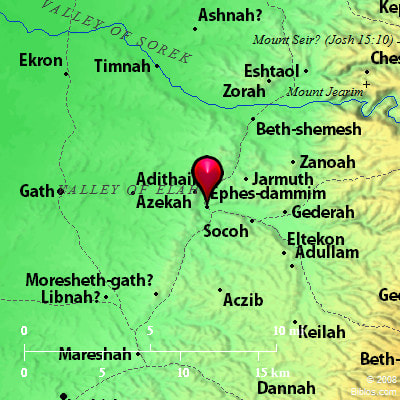
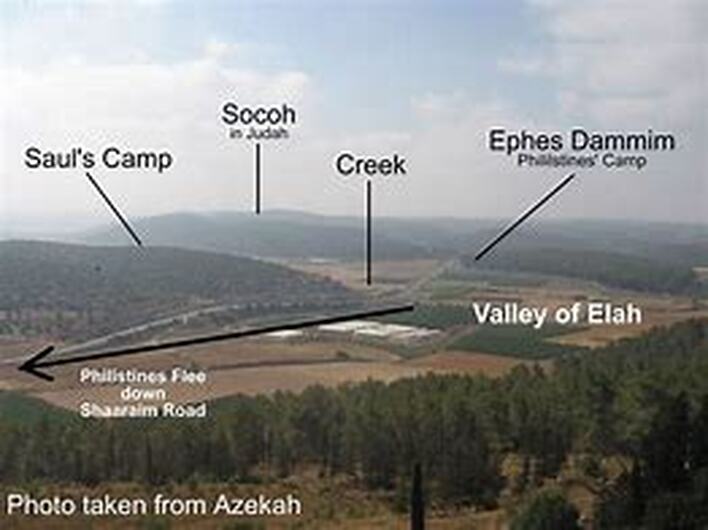
Now the Philistines gathered their armies together to battle, and were gathered at Sochoh, which belongs to Judah; they encamped between Sochoh and Azekah, in Ephes Dammim. 2And Saul and the men of Israel were gathered together, and they encamped in the Valley of Elah, and drew up in battle array against the Philistines. 3The Philistines stood on a mountain on one side, and Israel stood on a mountain on the other side, with a valley between them. 1 Sam. 17:1-3
​

Picture
        Before we can even look at decisions and choices that may affect the outcome of our battles with our giants, the first thing for us to be aware of is our position.  Our place. 
        The first location named was a place village called Sochoh, which referred to a hedge, as one might plant around a vineyard so as to protect it from destructive animals or people.  These hedges were often thorny, and enclosed the vineyard completely. 
   The next location, Azekah, referred to digging about, or tilling, as a preparation for planting, perhaps a vineyard or another crop.
          The Israelites were encamped in the Valley of Elah, which means "low," or, literally "valley."  But its root word means to make low, humble, humiliated, dejected.  They lived temporarily in a place of depression.  Every morning they would have to climb out of their camp and go take their stand on the hill opposite Ephes Dammim in their battle array.  
           The fourth location, on which the Philistines were encamped, was called Ephes Dammin:  

            Boundary of the Bloods.          


Picture
       Israel was God’s chosen people.  Jesus likened them to a vineyard, which the master had tilled, planted, and hedged about, and from whom He expected to receive fruit. (Matt 21:33) The vineyard owner would plant a tall, thorny hedge around the vineyard property, in order to keep out animals who would ruin the vines or steal the fruit.  The spike-laden bushes would prevent chewing through, and the density would mitigate crawling between. 
      For the Israelites, encamped in the Valley of Elah, the depression, degradation and humiliation in which they were living day after day was only serving to make them feel like there was nothing left for them but defeat.
  They would get up every day, take their stand for a few moments, and then run away back to their camp---in the depressed lowlands. 
           As Christians, “grafted in” as God’s chosen people, we are also His vineyard.  Jesus has a loving, watchcare over us as His people, and a hedge of protection against the enemy, both in a spiritual sense, as well as in a physical sense.  In Job’s case, Satan could do nothing to hurt Job without getting express permission from God:
​

Have not you made an hedge about him, and about his house, and about all that he has on every side? you have blessed the work of his hands, and his substance is increased in the land.  Job 1:10
​

       Most importantly, there is a “boundary of bloods,” poured out for us by Jesus’ death on the cross.  When Jesus gave Himself as a sacrifice for our sins, he laid an impenetrable boundary across which no thief, enemy or captor had any right or ability to cross.  Only our choice to walk over and hand ourselves into the captivity of the enemy yelling across the boundary could ever enable him to gain mastery over us. 
      
          It never stops him from trying, of course.  
​

4And a champion went out from the camp of the Philistines, named Goliath, from Gath, whose height was six cubits and a span. 5He had a bronze helmet on his head, and he was armed with a coat of mail, and the weight of the coat was five thousand shekels of bronze. 6And he had bronze armor on his legs and a bronze javelin between his shoulders. 7Now the staff of his spear was like a weaver’s beam, and his iron spearhead weighed six hundred shekels; and a shield-bearer went before him. 1 Sam. 17:4-7


​      In modern terms, Goliath was approximately 9 feet, 9 inches tall, with a coat of mail that weighed between 126-200 pounds, bronze armor that weighed around 30 pounds, and even an iron spearhead that alone weighed between 15-25 pounds.  In all, Goliath would have been carrying from 170 to 255 pounds of armor or more! 
 
          To all watching, Goliath looked impervious, indomitable, and invincible.
 
        Don’t our giants look that way?  Giants of lust, pride, lies, addictions, disrespect, depression, rebellion, bitterness….the list goes on and on.  They rear up, and our necks crane back painfully as realize just how large they are.  
      We are reminded of our failures by our children, spouses, friends, and co-workers.  Our own thoughts race, in a circular pattern, down through the long night hours.  They spiral down when there is nothing left to distract us, no one to contradict them.  We haven’t beaten that giant in the past; by all experience and evidence it is unbeatable.  
          In a sense our goliaths gain a type of victory over us when we simply stay in the depression.  When we live, day after day, with that sense of defeat and impending failure.  Sometimes it is all we can do to put on our armor and walk up the hill for a few minutes--long enough to hear him shouting out his taunts---before we run back to our place of humiliation.       
          Satan would always rather we give up without a fight. He knows that if we are in Jesus he no longer possesses the ability to control, enslave or defeat us by force. Instead, his chief weapons against us are fear, intimidation, deceit and manipulation. 
          Nearing the cross, Jesus acknowledged three things to His disciples:  1) Satan temporarily had a princely rule and domination over the world; 2) Because of Christ’s sinless perfection, Satan had absolutely no claim or authority over Christ; and 3) through Jesus’ sinless sacrifice on the cross, Satan, the reigning prince over the world, would be cast out, disarmed, and triumphed over:  


I will not speak with you much longer, for the prince of this world is coming, and he has no claim on Me. John 14:30
 
Now is the judgment of this world: now shall the prince of this world be cast out. John 12:31
 
And having disarmed the powers and authorities, he made a public spectacle of them, triumphing over them by the cross. Col. 2:15
​

​          Because of Jesus’ blood, we are planted, nurtured and protected from the Evil One.  As long as we remain in Jesus, in His vineyard, the enemy cannot force us to submit to him any longer.
  
          However, the enemy does not fight fair.  Not only does he try to impress us with his great strength, but he also has another tactic. 
 
          Shame. 
 
        Goliath’s name means to uncover, strip naked, make exiled, and make captive.  It is a picture of the captivity and exile of slaves who were conquered, stripped naked, tied, and led away as slaves from their homeland into a foreign land.  It denotes abject shame, mockery, helplessness, hopelessness, despair and lifetime enslavement. 
 
          Hear the mockery in his voice as he shout to them across the valley:

 “Why have you come out to line up for battle? Am I not a Philistine, and you the servants of Saul? Choose a man for yourselves, and let him come down to me. 9If he is able to fight with me and kill me, then we will be your servants. But if I prevail against him and kill him, then you shall be our servants and serve us.” 10And the Philistine said, “I defy the armies of Israel this day; give me a man, that we may fight together.” 11When Saul and all Israel heard these words of the Philistine, they were dismayed and greatly afraid. 1 Sam. 17:8-11
​

      Now what is really interesting is that the Hebrew word for “Defy” means to reproach, blaspheme, shame, mock, make naked, expose.  It is the same word used for winter, denoting the time after crops and leaves stripped bare.   In this context, it has the idea of a reproach, a mocking, because of a vulnerability, helplessness and weakness due to nakedness.  It implies shame and mockery heaped upon an already defeated captive.  Does this sound familiar?  It is the very purpose of Goliath's name. It is who he is and what he does.  
    Goliath was mocking the armies of Israel.  He was declaring their shame, vulnerability, helpless and inevitable enslavement, and he was mocking them for it as if it was already true.  He was declaring that their God, the living God, could have no power to save them from his strength and ability.  
         The enemy does this to us.  Our giants say that we are too weak, too vulnerable, to stand a chance.  They declare that we are naked, ashamed and entirely too guilty to win.  They seek our absolute and utter enslavement along with our obedience to whatever evil desire comes up as a temptation. 
         
       The goliaths in our lives come to us as impressive, terrifying addictions, problems, and sin-issues that seem impossible to defeat.  They make us feel ashamed, even in the temptation, as if we have already become their slave.  
 
          They tell us that we can never defeat them, that we are destined for a life of defeat, and that there is absolutely nothing that we can do about it.  To fight would only be worse.  They say we might as well give up and accept the inevitable, because it will be less terrible than the destruction they would inflict if we fight.   
          Their goal is our enslaved obedience.  That whatever lust or pride or selfishness that we are tempted with, we would follow, helpless to control our thoughts, appetites, emotions and actions.   
          However, the truth is that through repentance and faith in Jesus, we are clothed in His own, perfect righteousness.  There is a beautiful word picture of this transaction in Zechariah that I love:


“And he shewed me Joshua the high priest standing before the angel of the Lord and Satan was standing at Joshua’s right side to accuse him. The LORD said to Satan, “The Lord rebuke thee, O Satan; even the Lord that hath chosen Jerusalem rebuke thee: is not this a brand plucked out of the fire?” Now Joshua was clothed with filthy garments, and stood before the angel. And he answered and spake unto those that stood before him, saying, Take away the filthy garments from him. And unto him he said, Behold, I have caused thine iniquity to pass from thee, and I will clothe thee with change of raiment.” (Zechariah 3:1-4 KJV)

       It may seem like there is only a negative when our goliaths come against us.  Without the giants, it seems "normal."  That getting rid of the giants brings us back to "normal."  This is not how Jesus views each victory that we have, though!  With each goliath that we gain victory over, there is an increase in power, in abundant life, in joy, that we never had before. 
       R
ather than view this opposition with terror and dread, if we are living in obedience to Christ as our king we can know that not only does He have a plan, but that He is positioning us for a victory through His blood that will result in an increase of freedom for our families, churches, communities and nations. 
         As we walk through the story of David's victory of the Goliath of their time, we will see exactly how David conquered him and brought freedom and joy back to his people. 

       But for now, realize your position: 

      You are a child of God, loved, protected, watched over.  There is a hedge, a boundary of Jesus' blood that no enemy can cross over.  Position yourself on your hilltop with an expectation that He has a plan for your victory.


               Because of the Boundary of Blood.
0 Comments

A New Thing

5/3/2021

0 Comments

 
Picture
,     ​For my birthday I always love to receive flowering plants.  Growing up we had a beautifully landscaped yard, filled with Egyptian iris, roses, and many other pickable, long-stemmed flowers.  I looked forward to going out in the yard to see what kind of flower arrangement I could come up with for the house.  Each one was unique; every week a new creation of beauty.
     At our new home, however, I have to start over.  To be sure, it is a beautiful setting with the woods and mountains, but it started out with very few flowers.  So for my birthdays I ask my family for flowers and more flowers to plant.  Yesterday they brought me home a beautifully variegated dapple willow, sunset and white roses, along with a Japanese plum tree.  I couldn’t be happier! 
  

Picture
    Right now they are sitting in my living room, awaiting their new home. That home, though, is my next issue.  It is all clay and highly acidic soil here.  With clay, the plant roots become encased in a sun-baked pot of dirt which doesn’t drain or receive the water well.  When watering, the water streams off and doesn’t sink into the ground.

      The hard soil rejects the life-giving water.

     In order to survive and thrive, I will need to dig out the old clay dirt and start over with fresh, nutrient rich topsoil that can receive the nurture and care necessary for the plants to thrive and rebloom. 

Picture
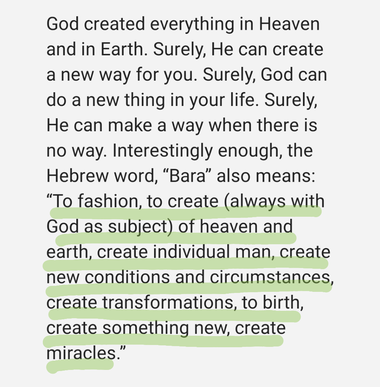
     I was encouraged by my Bible app devotional for today, as it explained that the Hebrew word, “bara,” means to fashion or create (always with God as the subject) of heaven and earth, of man, of new circumstances of conditions, transformations, birth, something new, miracles.​
     Our God was and is and shall always be a creating God.  It is why we, as His image-bearers, find joy and pride in our gifts of creativity, whether that’s art, music, writing, building, gardening, or any number of work or hobbies. But while we always must use something He created to reform something of our design, He always makes something new and entirely good.
     From the beginning of our relationship with Jesus, He recreates us into a new and entirely good creation…completely NEW dirt from which to grow and bear fruit:


“I will give you a NEW heart and put a NEW spirit in you!
I will remove from you your heart of stone
and give you a heart of flesh.”
Ezekiel 36:26
 
“Therefore, if anyone is in Christ,
the new creation has come: The old has gone,
The NEW is here!”
2 Corinthians 5:17
​

     When we come to Jesus, we are broken, defeated and enslaved by our choices and past.  Our lives are a mess.  For too long we have rejected the life-giving Water that Jesus freely gives. Without Him and His transformation, the goodness of God hits our lives and runs off, unable to penetrate and bring healing and refreshment from the harshness of life.
     When we repent and put our faith and trust in Jesus, our lives are reset, rebirthed. We start to drink in that Water of Life, and we see immediate transformation!  The inward change is dramatic, but the outer actions and habits take more time...a lifetime. 
     Even after receiving Jesus as our Savior, we sometimes find ourselves sinking into habits that have been formed in every area of our lives, old habits that don't fit the new lifestyle of freedom and joy and love. In those habits we at times continue to follow ruts back to old lifestyle choices that only brought pain and destruction. 

     But Jesus, He makes all things new. 

     Every part of our lives.  He starts with our very foundational spirit, and makes it alive with all the essential ingredients necessary. He starts with our dirt.  But then?  Then He creates new habits, new ways of thinking.  Here he reforms our actions of service with a new and intimate knowledge of Him as our humble Servant.  Over there He transforms our words of habitual criticism to life-giving words with our knowledge of Him as our Life-creating Word.  In this section of our garden, He renews our hope to rise up again in a new day, because He is “The Sun of Righteousness [who arises] with healing in His wings,” Malachi 4:2.

     It can be difficult not to think on all our mistakes, failures and regrets, and to trust that God is yet even forming new life in our future.  The enemy would like nothing better than to cause us to halt and wallow in our past failures and broken rhythms.  By focusing backward, he knows that we will re-choose the choices that hurt us and others before. The enemy doesn't want us to live in the reality that Christ has set us free from those and given us the power and grace to make new and good choices through His death and resurrection to new life! 

     Praise God, we can look forward to a New Day in Jesus today!

​​

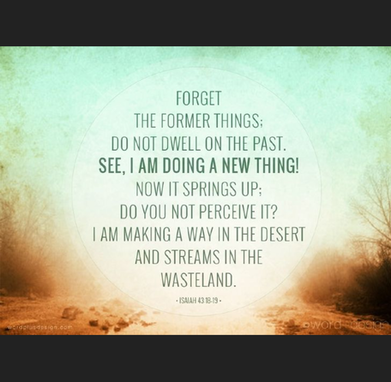
​"Forget the former things; do not dwell on the past.
Behold!
I am doing a NEW thing!
Now it springs up; do you not perceive it?
I am making a Way​ in the wilderness and streams in the wasteland.” Isaiah 43:18-19

Picture

     If what you are facing in your life seems like a wasteland---wasted choices, wasted relationships, wasted finances, wasted health,  wasted time---

     Look to Jesus! 

     Behold our God!

   He is creating a NEW thing today!


​“Behold! I am making all things NEW!”

Rev. 21:5

0 Comments
    Picture

    Author

    Halley Faville lives with her husband and children in their mountain home in Oregon. 

    ​As a homeschooling mother of 7 children, she enjoys spending her free time in  language arts, music, art, and outdoor activities.  

    Archives

    August 2025
    August 2024
    May 2024
    April 2024
    February 2024
    October 2023
    June 2023
    December 2022
    October 2022
    June 2022
    April 2022
    March 2022
    December 2021
    November 2021
    October 2021
    September 2021
    August 2021
    July 2021
    June 2021
    May 2021
    April 2021
    March 2021
    January 2021
    December 2020
    November 2020
    October 2020
    August 2020

    Categories

    All
    1 Samuel
    2 Chronicles
    40 Days Of Goliath
    Abraham
    Acts
    Children
    Christmas
    Cross
    David
    Deliverance
    Ecclesiastes
    Eph 5:22-23
    Exodus
    Faith
    Faithfulness
    Fall
    Favor
    Feasts
    Focus
    Fruit Of The Spirit
    Generosity
    Genesis
    Gentleness
    Gideon
    Goodness
    Gospel
    Hannah
    Harvest
    Healing
    Homeschool
    Isaac
    Jehoshaphat
    John
    Joy
    Judges
    Justice
    Kindness
    Kingdom
    Listen
    Live
    Love
    Luke
    Ministry
    Multiplication
    Nativity
    Parenting
    Passover
    Patience
    Peace
    Perseverence
    Power
    Praise
    Prayer
    Promise
    Redeemer
    Relationship
    Repentance
    Resolution
    Reward
    Salvation
    Sanctification
    School
    Strength
    Submission
    Suffering
    Transformation
    Trust
    Truth
    Victory

    RSS Feed

Photos from bangorvineyardshedmedia, JamesInDigital, wildrosetn39
  • Home
  • Halley Faville
  • Jeff Faville
  • Oaks Canyon Youth
    • Youth Sign-Up/Forms
    • How You Can Help!
  • Beth Bearden
  • About
  • Contact
  • Resources
  • Recommended Blogs