Oaks of Glory
  • Home
  • Halley Faville
  • Jeff Faville
  • Oaks Canyon Youth
    • Youth Sign-Up/Forms
    • How You Can Help!
  • Beth Bearden
  • About
  • Contact
  • Resources
  • Recommended Blogs

I Have Seen My Redeemer!

12/18/2022

2 Comments

 
Picture

There was also a prophetess named Anna, the daughter of Phanuel, of the tribe of Asher, who was well along in years. She had been married for seven years, and then was a widow to the age of eighty-four. She never left the temple, but worshiped night and day, fasting and praying. Coming forward at that moment, she gave thanks to God and spoke about the Child to all who were waiting for the redemption of Jerusalem. Luke 2:36-38 ​

      “Daddy’s home!” the high-pitched, jubilant cry of my little sister rent through the air of our larger, middle-class home. Pulling her nose and hands off the panes of the bay window overlooking our driveway, her cry was echoed by less than jubilation. The repeated phrase bore more the sound of a panic-stricken, pubescent middle-school boy. While the fun began with the advent of my father, so did the ensuing scramble of “pick-up time.” It was a time that Mom had tried to instill in us, and was supposed to initiate at 4pm so that my dad could come home to a clean house, a warm dinner, and an excited family waiting to welcome him, grateful for the long hours he had put in at the office. Quite honestly, it was a time that rarely began until we heard the familiar sound of his car in the driveway.  
      Beth reached as high as she could with her chubby fingers and swung the door open toward herself, backing up with it until the opening was wide enough to run through. She rushed out to greet him, heedless of the door standing open, the cold air springing to take advantage of osmosis, or the rush of adrenaline and activity behind her to make preparations. Legs and duplos must we swept off the floor, laundry and toys on the stairs taken up to the rooms, schoolbooks stuffed haphazardly into shelves, sometimes never to be found again, and a multitude of small items that no one knew where they belonged and would find their home in any stray crack or cranny, couch cushion or basket. If the item was too large, it would find its way to the basement ping-pong table, which was conveniently large enough to hold a massive amount of confused items. It is not always beneficial when kids are “helping” to clean, after all.  
      The fun would begin when Dad was home and all the boring work of the day was over. Perhaps he would play games with us, hide and seek in the dark, cards, or wrestle in a tickle battle on the floor. Surely he would read us a missionary story and a chapter from a fiction novel, using all the right voices and sound effects. Undoubtedly, he would pick out his stack of books to read and try to eat his cheerios in peace before bed. That was my favorite time. When everyone was else was gone, it was my turn to find any questions I could come up with to spark a conversation and gain one-on-one attention.  
     My mom used to say that she loved it when Dad would come home, because he would chase the demons away. All the frustration of dealing with us, all the mess and the work, the bad attitudes and the arguments—Dad would come home and make it all better. Every day we waited. Every day we listened for the sounds that meant life would be great again.  
     I imagine that in a very small way, this is a bit of the expectancy of the time in which Anna lived. While our difficulties were vastly more bearable with the love we experienced in our family, the darkness of the oppression that Anna lived under with the Roman occupation and extreme abuse of her rights she likely suffered because of her gender, her social status and her ethnicity would have greatly intensified the longing she and her fellow Israelites would have felt for the coming Redeemer.  
     Here we see a repeat of a name that we may be familiar with from the Old Testament—that of Hannah, the mother of Samuel. In Hebrew, her name is “Channah,” and in Greek it is “Anna.” Her name means to be favored by grace.  A more literal picture of the Hebrew word is that of a benefactor leaning toward someone who is coming with a humble request in order to bless and give to them their needs.  
     Anna’s name is meant to bring to mind the story of her namesake, Hannah, in 1 Samuel 1, who was bereft of children. In her grief, she fasted, prayed, and shed tears with loud groanings “to the one who could rescue” her in her situation, and she “was heard because of her obedience (Heb. 5:7).” Asking for a child, she vowed to dedicated him for a lifetime service as a Nazirite if the Lord would hear her request. Together with her husband, Elkanah, “God is Redeemer,” they kept their vow and dedicated their young son, Samuel, “Heard of God,” for a lifetime of Nazir, or sacred and set apart service to the Lord.  
     Luke tells us that Anna was the daughter of Phanuel, and does not list her husband. Phanuel’s (Peniel) name means “the face of God,” and is meant to bring to mind the story of Jacob wrestling all night with the angel of the Lord in order to blessed by God. At daybreak, Jacob is blessed and given a new name. Realizing at once that he had in fact been wrestling with the Lord Himself, Jacob “called the place Peniel, saying, “It is because I saw God face to face, and yet my life was spared. The sun rose above him as he passed Peniel....(Gen. 32:30-31).” 
     Anna came from the tribe of Asher, which means “happy/blessed,” and “level/straight,” which refers us back to the story of Leah and her wrestling (Gen. 30:8) with her sister for her husband’s love and the favor of God. After giving birth to Asher, Leah named him “happy” or “blessed” because she believed that her happiness would be guaranteed now because she had been given children.  
     Luke informs us further that Anna was “χήρα,” which is to be bereft, sterile, barren, or stripped of inhabitants or riches. While she was a widow in our common vernacular, this word was also used of those who had no provision or protection for themselves, but relied solely on God’s provision for them. It also included women who were single and without family support, or those who had been set apart under a Nazir vow and were, therefore, bereft and dependent upon God for their needs (Ex. 38:8, 1 Sam 2:22). 
      Anna very well may also have served in the same capacity as a ministering woman at the tent of meeting, which likely included Nazirites as well as Kohathite Levitical women serving and ministering (Ezra 2:65-70, Neh. 7:66-73, 1 Chron. 25:5-6). This group of ministering women would have depicted an early form of what would later become the ministering women serving in the church in the order of the “χήρα,” mentioned in Acts 6 and 1 Timothy 5 with its lists of qualifications that rival that of the presbyteroi just mentioned in the book, as well as concluding with the payment given to them, or to those ministering in the word of God, that of double payment. Acts 6 men who were appointed to be sure to wait on tables were likely given the responsibility of administering the payments of currency to these ministering women, since the word for table also carried the idea of banking, and since the Hebraic law and current culture of the day dictated that those who served were to be paid daily.  
     Anna was married for seven years, the Biblical number of completeness. Since she was married a complete amount of time, one would assume that it was surely enough time to have had children of her own. The text, however, shares nothing with us of any children, but rather of her day and night living and ministering in the temple. This indicates that she was childless—bereft in more ways than one. Though the Luke’s account in chapters 1 and 2 show us two other bereft and childless women whom God impossibly blesses with children, one in her old age (Elizabeth) and the other in her youthful virginity (Mary), Anna, whose name would have constantly reminded her of her own hope for children, remained childless.  
     Additionally, being bereft of children after her husband’s death likely would have qualified her for the Levirate law (Deut. 25:5-10), where her deceased spouse’s brother would have been required to redeem her monetarily and then taken her and raised up children for her husband by her. This would ensure that both the widow and the deceased husband would maintain a portion in the land of the Promise. Their name would not be cut off from their people. We find an example of this law as Boaz acted in this capacity as a kinsman-redeemer in the story of Ruth. If Anna had consented to this Levirate arrangement, she would not have remained a widow or bereft, and it may be that though that was available, she instead devoted herself as a Nazirite to wait for her redemption from God, instead. 
 

We must prepare the way for our Redeemer! ​

Picture
     Anna must have thought of the children her namesake had asked for and been given by God. Hannah was “heard of God.” No doubt Anna’s own lifestyle of fasting and prayer included not a few tears for her own lack.  She may not have felt “heard,” and given the fact that she remained single until old age, she likely had no more hope for being “heard of God” in this capacity. So where was God’s favor? Where was His grace on her life? Without children and as a widow, she would have been presumed by others to be cursed for sin of which perhaps only God knew.  And yet Luke makes it plain that she is a godly woman, ministering in the same way we see the apostles “ministering before the Lord” in Acts 13:2 in a liturgical sense.    
     However, just as her predecessor Hannah did not drown herself in sinful pleasures or addictions, but rather poured out her soul in faithful service and ministry to the Lord, we see Anna so doing. We don’t see her remain idle in her sorrow.  
     Instead, we see her invest in others and allow herself to be so filled with God that she regularly prophesied. We see her dedicating herself to the ministry, and spending her days and nights fasting and praying and proclaiming God’s Word. It is highly likely that the very people to whom she had prophesied regularly were many of the very ones whose hearts were waiting expectantly for the “redemption” to come. Just as her descendance from Asher suggests, we see her “preparing the way for the Lord, and making “straight paths for Him.  
     We may find ourselves in a situation similar to Anna.  Do you find a lack somewhere, a bereftness? A removal or stripping of your resources?  Does this cause you pain and grief?   
     What do we do when our resources are removed?  Do we spend our energies out in self-pity, “look anxiously about” us, or desperately search for ourselves the resources we think we must have in order to find ourselves rescued? Or do we start waiting upon the Lord as his servants, with praise, worship, fasting and prophesying the divine message of expectancy to a dark and waiting world? 
 

We must wait expectantly on the Lord!  ​

Picture
     Familiar with her own need and lack of a redeemer for her bereft state, attuned and practiced to the voice of the Holy Spirit, Anna was ready to recognize the Redeemer when she saw Him through the power of the Holy Spirit. Anna knew that God gives his people a more lasting portion eternally, and she was happy to trade physical redemption for spiritual redemption by her Redeemer.  In the midst of Anna’s day-to-day service, she experienced a favor far greater than that for which she may have longed—that of seeing the face of her God and living to tell of it!  
     While this was true of Anna, it is also true of us. As we go about our daily ministry in our homes, our churches and our communities and most especially in our day and night ministry to the Lord Himself, He meets us in our day-to-day with His Living Presence. As we practice listening to the voice of the Spirit and walking in obedience, we become more and more attuned to the words that direct us into the situations He wants to use to bring us favor: 
 

Yet the Lord longs to be gracious to you; therefore, he will rise up to show you compassion. For the Lord is a God of justice. Blessed are all who wait for him! People of Zion, who live in Jerusalem, you will weep no more. How gracious he will be when you cry for help! As soon as he hears, he will answer you. Although the Lord gives you the bread of adversity and the water of affliction, your teachers will be hidden no more; with your own eyes you will see them. Whether you turn to the right or to the left, your ears will hear a voice behind you, saying, “This is the way; walk in it.” Isaiah 30:18-21 
​  

     Through His Word, His Spirit, the spiritual understanding He imparts to us and our situations, He enables us to “see Him” and live to tell about our experiences of His presence! He reveals Himself to us, and gives us the opportunity to participate with Anna in preparing the way of the Lord, of making straight paths for Him! 
    We are never too late, and never too old. As long as we are serving God right where we are, the Divine appointments and opportunities for sharing the good news of the Light of the World will be brought to us.  
     What about us? How can we practice listening and obeying the voice of the Holy Spirit in our daily lives? How have you noticed the encounters becoming sweet and divinely appointed in your day-to-day?  

We must tell the good news! ​

Picture
     After a lifetime of “wrestling” with God night and day, as her father’s name suggests, Anna receives the blessing that showed the favor and grace God had extended to her—that of seeing her Redeemer with her own eyes and living to tell the story! Just as Hannah was enabled to prophesy of the future Messiah’s redemption (1 Sam 2) because she came to the Lord in her bereftness and ministered to the Lord in it, so Anna was enabled to prophesy of her present Messiah’s redemption because she came to the Lord in her bereftness, emptiness, and lack, and ministered to the Lord in it. In the process of their emptiness, God filled them with His Spirit.  God, who is rich in mercy, gave Anna the joyous opportunity to tell all who were waiting for their Redeemer that she had seen Him, and their long wait was over! 
     As we anticipate Christmas morning, we have a red Farmer’s truck with the numbers 1-25 on it. There is a little magnetic snowflake that marks off the days til Christmas has arrived. Above it are filled their stockings, the curvature of candy canes spilling out of the edges and mysterious and some no-so-mysterious bulges sticking out begging to be squeezed and guessed at. A little distance away, misshapen packages lay under our tree. Although the kids are not allowed to handle them, they do seem to keep realigning in strange and different piles. While they each are understandably excited to receive the unknown gifts, their anticipation is greatly increased by the fact that they each also earn and purchase gifts for one another, and they love to watch their siblings open the gifts they themselves have given. They are not only anticipating their own joy, but the joy that comes from bringing joy to people they love.  
      Anna shared the good news of the Redeemer to “all who were waiting for the redemption of Jerusalem.”   In the Greek, the word for waiting is most often used in the “middle” voice, meaning the subject is doing the action herself as well as receiving the benefit of the action. It carries the strong idea of waiting actively, expectantly, “ready and willing to receive all that is hoped for....” Those to whom Anna shared the good news of their redemption were anticipating in an active and eager readiness His long-awaited arrival.  
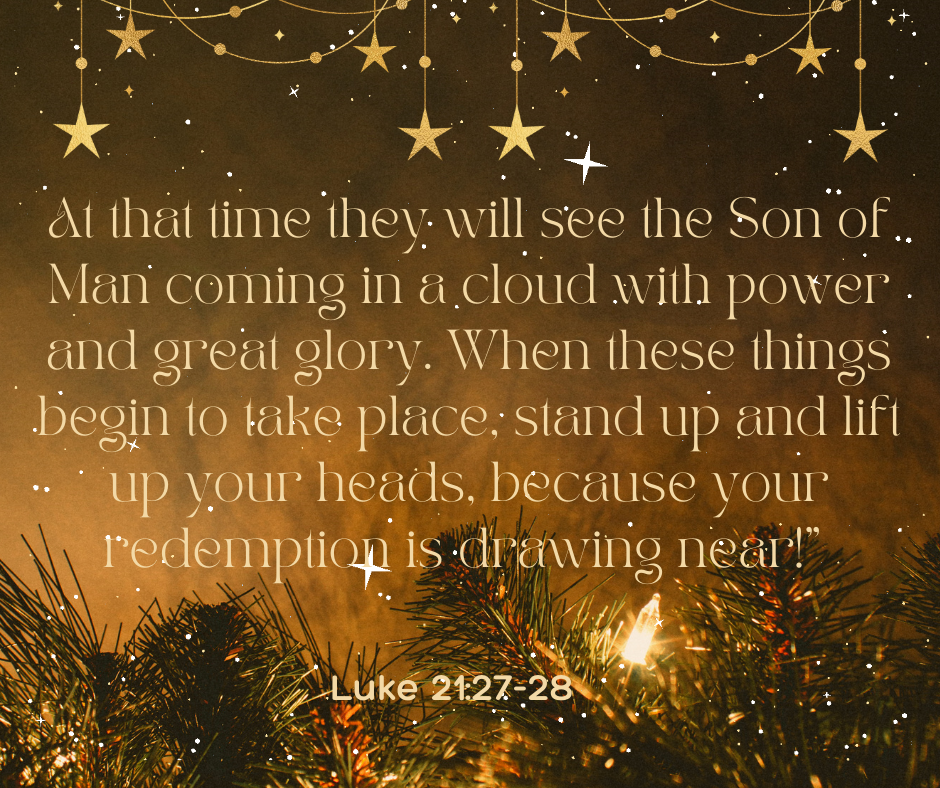
     While Anna spoke to those actively waiting for their Redeemer to come at the beginning of Luke, Jesus our Redeemer speaks to us at the end of the book, telling us to actively and eagerly wait for His return!  

Picture
     Are we waiting for redemption? What can we be doing today that increases our anticipation and joy? What can we do for others that changes their outlook on what their tomorrow may hold for them? How can we find ways to share the unfailing hope and joy that we have with those who have none? 
     As you anticipate the joy and the sorrows of this Christmas season, with its good and painful memories, its bereavements and its abundance, I pray that you will find joy and delight in the grace and favor that God has given to you through the gift of His Son, Jesus.  As you learn to see the many ways in which He leans toward you in order to bless and give you every "good and perfect gift," may you overflow with a joy that radiates that goodness to the lives you touch!  


2 Comments

The Completing Work of Patience

8/26/2021

0 Comments

 
Picture

     King Belshazzar stood trembling violently, his face ashen, his finger pointing eerily to the wall. He stared at the handwriting where, just moments ago the letters, large and imposing, had been etched into the plaster. 
     All night long they had feasted, Belshazzar with his nobles, his wives and concubines. A thousand and more, drinking, celebrating the vastness of the empire over which he ruled.  As they drank, it had come to him…he should toast the gods who had given him this success! He could earn their continued favor, and what better way to do that than with the goblets from the temple of the God they had conquered! 
     He had ordered that they bring out the golden goblets, and he and his thousand nobles had praised the gods of gold, silver, bronze, iron, wood and stone, and offered them tribute—perhaps they would receive this work and grant him more favor and complete his kingdom.

    Suddenly, the fingers of a hand had appeared and written on the wall while Belshazzar watched, his stomach churning and his face draining of its blood. 
     No one could tell him what the words even meant.  The queen had suggested a man, Daniel, a Jew.  She said he had the spirit of the holy gods residing in him.  She said he was insightful, intelligent, and wise as the gods.  That he possessed the power to understand deep puzzles and riddles, and to interpret dreams. 
     And now, there the man stood: confident, quiet, and filled with the wisdom of the aged.  Then Daniel answered the king, “You may keep your gifts for yourself and give your rewards to someone else. Nevertheless, I will read the writing for the king and tell him what it means.
  “Your Majesty, the Most High God gave your father Nebuchadnezzar sovereignty and greatness and glory and splendor. Because of the high position he gave him, all the nations and peoples of every language dreaded and feared him. Those the king wanted to put to death, he put to death; those he wanted to spare, he spared; those he wanted to promote, he promoted; and those he wanted to humble, he humbled. But when his heart became arrogant and hardened with pride, he was deposed from his royal throne and stripped of his glory. He was driven away from people and given the mind of an animal; he lived with the wild donkeys and ate grass like the ox; and his body was drenched with the dew of heaven, until he acknowledged that the Most High God is sovereign over all kingdoms on earth and sets over them anyone he wishes.
      “But you, Belshazzar, his son, have not humbled yourself, though you knew all this. Instead, you have set yourself up against the Lord of heaven. You had the goblets from his temple brought to you, and you and your nobles, your wives and your concubines drank wine from them. You praised the gods of silver and gold, of bronze, iron, wood and stone, which cannot see or hear or understand. But you did not honor the God who holds in his hand your very breath and owns all your ways. Therefore he sent the hand that wrote the inscription.

 “This is the inscription that was written:

                   MENE, MENE, TEKEL, PARSIN

 “Here is what these words mean:

     Mene: God has numbered the days of your reign and brought it to an end.

     Tekel: You have been weighed on the scales and found wanting.
      Peres: Your kingdom is divided and given to the Medes and Persians.”


     “Mene.”  It was fifty shekels. Fifty shekels on one side of the balances, and fifty on the other side.  “Tekel,” a shekel on the first side, but yet on the other side of the scale only an “upharsin”-divided, split—a mere half shekel.  He had come up short by just a half shekel.  No matter what he had done to please the gods, no matter the tribute he had brought, the victories he had won, the amassed wealth, power, fame and women, Belshazzar knew in that moment that he had come up short in the only test that would ever matter, in the eyes of the only One who could ever truly judge. 

    That very night Belshazzar, king of the Babylonians, was slain.   

​ὑπομονή:
A steadfast remaining in obedience under the authority of God. 
 
TThe Greek word for patience (G5281 hypomonḗ) is sometimes translated as perseverance, or endurance.  It is a cognate of two Greek words: "hypo," meaning under, often meaning "under authority" of someone working directly as a subordinate; and "Mone," which means to remain, abide, dwell, live. Together, and in a Biblical context, it means to remain or abide under the authority of God in obedience.  

​
       In the final analysis of his life, it didn’t matter how much Belshazzar worked to get favor, without Jesus he had fallen short. 
     While this is tragic, the good news is that it doesn't have to end this way!  Through the Holy Spirit that God gives us when we receive Jesus as our Savior and Lord, we can receive a precious gift that enables us to always measure up. 

     This gift is patience. 

     Patience is not merely speaking nicely to my kids when they are grabbing at my legs during dinner time.  It’s not a mere politeness of talking, or even merely waiting for something longer than I'd like. 

      Let’s take a deeper look at a passage in Scripture that tell us what it really does mean, and about the beautiful end result of this gift of patience: 
​
“Consider it pure joy, my brothers and sisters, whenever you face trials of many kinds, because you know that the testing of your faith produces patience. Let patience finish its work so that you may be mature and complete,
​not lacking anything.”

​ James 1:2-4

     Now, when we study translated passages, we must understand that while it is convenient and helpful to translate an ancient language word for word in English, the translation process is not and cannot be that simple.  Languages do not have a perfect word scope and definition for each word in an original language.  Instead, the range of meaning in the original word may be substituted for a range of words within the English, which is ultimately better understood with a deeper study into the meaning behind each word. 
     For instance, the Greek meaning of the word “testing” in this passage has more of the idea of a testing of the genuineness of something, perhaps of gold, or a precious stone, to see if it is real or a substituted fake, in order to obtain the approval of the expert. 
    Similarly, the words for mature and complete used in this passage, can seem repetitive or redundant in English, but a look into their Greek counterparts is anything but: “mature” comes from the same root word that we use for telescopic, and indicates a stage by stage lengthening or developing until at full capacity for usefulness, while the word for “complete” indicates a divinely appointed wholeness by allotment (the casting of the lot: used in ancient times to divide generational inheritance lands or to determine the will of God). 
     Finally, the word for “lack” denotes the idea of making choices, such as leaving behind, or abandonment, that cause one to fall short of a standard.  It applies to a race that was never completed, as well as the self-choice of an abandonment of a goal. 
​ 
Picture
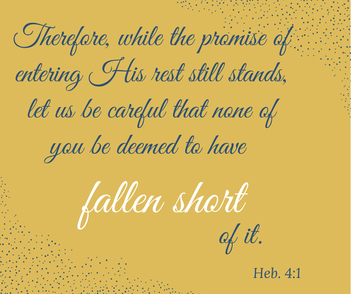
     Without Christ we fall short.  When tested, we cannot meet the standards and requirements of holiness and submission to God.         With Christ, we will be found in Him, with nothing lacking in our patience endurance  sovereignty of the Lord God as we remain in submissive obedience!  

     Something that I find intriguing in my study of ancient literature, is that in ancient writings the authors did not follow a linear outline like we do in western or modern cultures.  Rather, they followed a chiastic structure, that is, a structure that makes a point, and then illustrates that point in a sort of V pattern (think of the flight structure of geese), with the main crux of the argument or message being in the center, and then backtracking its steps of logic through to the beginning again.  Chiasm is a fascinating study, but more importantly, it is an aid to see better the flow of thought and emphasis that the author originally intended:
   
  1. Joy—Rejoicing in God’s favor toward us
    1. Trials 
      1. Testing/proving of our faith
        1. Produces through a finished work
          1. Patience—Abiding submission under God’s authority
          2. Patience-- Abiding submission under God’s authority
        2. Produces through a finished work
      2. A finished maturity of character and usefulness
      3. A whole restored person in God’s will and inheritance
    2. Believer's faith fully approved!

    
Picture
   From the chiastic structure of the verses outlined below, what is the at the point of the V?  Patience!  And the end result is a faith in the finished work of Christ that is so genuine that God, our Creator and Judge, approves and delights in it!
     But you know, God never left us with just a command.  

     Instead, He Himself demonstrated to us what remaining in submission, the action of patience, looks like: 

​

During the days of Jesus’ life on earth, he offered up prayers and petitions with fervent cries and tears to the one who could save him from death, and he was heard because of his reverent submission. Son though he was, he learned obedience from what he suffered and, once made perfect [mature], he became the source of eternal salvation for all who obey him....”
​Heb. 5:7-9
​

     Even though Jesus had the rights of a Son, that did not exempt Him from testing and hardship as a Son. Because Jesus demonstrated patience, because He made Himself entirely submissive to the will of His Father, he became both the source of salvation for all who submit themselves to His Lordship and the source of power and grace to submit in patience to His Lordship
   
      Without Jesus, we cannot measure up.  Our works will never balance the scales.

     Through faith in Jesus, the Holy Spirit uses trials—tests of temptation to go outside of obeying God’s authority in our lives—to do the WORK for us, with a full, complete, finished, end point. 
     The end point is patience---perseverence—endurance.  It is living in submission to the will of God and remaining under his authority—all the way until we meet Jesus face to face. 
   In turn, this patience produces (works) with the same finishing, completing properties to fully and completely bring us to maturity in Christ, from stage to stage, ever growing into the image of Jesus until we are at optimum capacity for usefulness to share God’s love with the world. 
     Patience ALSO produces (works) to bring our spirit, our soul, and our body into complete wholeness and healing until we are restored completely in God’s will and the inheritance He has marked out for us. 
  

Picture
And the joyous end result?     
    
​     Because of the completing work of God's gift of patience, we will not fail or fall short of God's approval. 


     As we are tested, we will “come forth as gold,” (Job 23:10) fulfilling the entire standard of obedience and submission, and finding ourselves both proved and approved as God's children!


                                               May your faith come forth as gold! 

     I want to invite you to join me in this personalized prayer:
​

 “Father, I choose to consider it a happy experience that You so favor and delight in me whenever I have hard tests of submission!  Why? Because I know that these tests will prove the genuineness of my faith so that I may be approved by You at the end!  I ask in Jesus' Name that this proving of my faith would work in me a definite and absolute patience that remains in constant submission to Your authority in my life. 
     I now choose to let this patience finish doing that work in me, so that I may go through the necessary stages of maturity in order to be fully mature, phase by phase, stage by stage, until I can function at a full-strength capacity and effectiveness as I serve You, Lord.  As I choose to allow patience to  finish its work in me, I ask that You would cause me to be completely whole--fully everything that You created me to be and in line to fully receive my allotted inheritance with Christ in heaven.  With these two qualities that you are giving me, maturity and completeness, I thank you that I will not come short in any way of meeting Your standard or in failing the test of my faith’s genuineness, but will rather be fully approved by God through the atoning blood of Jesus.” 
 

0 Comments
    Picture

    Author

    Halley Faville lives with her husband and children in their mountain home in Oregon. 

    ​As a homeschooling mother of 7 children, she enjoys spending her free time in  language arts, music, art, and outdoor activities.  

    Archives

    August 2025
    August 2024
    May 2024
    April 2024
    February 2024
    October 2023
    June 2023
    December 2022
    October 2022
    June 2022
    April 2022
    March 2022
    December 2021
    November 2021
    October 2021
    September 2021
    August 2021
    July 2021
    June 2021
    May 2021
    April 2021
    March 2021
    January 2021
    December 2020
    November 2020
    October 2020
    August 2020

    Categories

    All
    1 Samuel
    2 Chronicles
    40 Days Of Goliath
    Abraham
    Acts
    Children
    Christmas
    Cross
    David
    Deliverance
    Ecclesiastes
    Eph 5:22-23
    Exodus
    Faith
    Faithfulness
    Fall
    Favor
    Feasts
    Focus
    Fruit Of The Spirit
    Generosity
    Genesis
    Gentleness
    Gideon
    Goodness
    Gospel
    Hannah
    Harvest
    Healing
    Homeschool
    Isaac
    Jehoshaphat
    John
    Joy
    Judges
    Justice
    Kindness
    Kingdom
    Listen
    Live
    Love
    Luke
    Ministry
    Multiplication
    Nativity
    Parenting
    Passover
    Patience
    Peace
    Perseverence
    Power
    Praise
    Prayer
    Promise
    Redeemer
    Relationship
    Repentance
    Resolution
    Reward
    Salvation
    Sanctification
    School
    Strength
    Submission
    Suffering
    Transformation
    Trust
    Truth
    Victory

    RSS Feed

Photos from bangorvineyardshedmedia, JamesInDigital, wildrosetn39
  • Home
  • Halley Faville
  • Jeff Faville
  • Oaks Canyon Youth
    • Youth Sign-Up/Forms
    • How You Can Help!
  • Beth Bearden
  • About
  • Contact
  • Resources
  • Recommended Blogs