Oaks of Glory
  • Home
  • Halley Faville
  • Jeff Faville
  • Oaks Canyon Youth
    • Youth Sign-Up/Forms
    • How You Can Help!
  • Beth Bearden
  • About
  • Contact
  • Resources
  • Recommended Blogs

The Battle Belongs to God!

2/4/2024

0 Comments

 
Picture
    Have you ever felt hopeless?   
   Have you ever watched helplessly as a dear friend or child, or even your spouse walked into damaging choices, and felt like the enemy was simply too powerful and too strong? 
    Have you ever watched as people around you start dividing, fighting, arguing and treating one another as enemies?   
    Have you ever felt like you wanted to fight, but you're not sure who to fight, and you don't seem to have any effective weapons or skills?   
     Have you ever just felt like hiding in a hole, and waiting until it all blows over?   
   What do we do when we are faced with impossible odds, failing leadership, aching needs, horrible oppressions, and a fight that is being forced on us, whether we can handle it or not?   
     A number of years ago Jeff and I faced a business crisis.  We had just completed our taxes, a project I look forward to with a bit of dread and procrastination, and we found that we owed a sum of money that we did not have saved up --$10,000.  With our large family and many pressing needs, saving for an unknown amount throughout the year can be very difficult at times.  We were concerned and looked through out Quickbooks to find any account still owing that we could see if they could pay sooner--but there was nothing.  The days ran into one another continuously until April 15th was upon us, and still there was no money available.  We had waited and prayed and waited again.   
     This is the story we have today.  In 1 Samuel 13, Saul, the new king of Israel, was scared.  As he sat there with his son Jonathan, he was pondering all that he had...and all that he didn't. 
   He had only three thousand men following him, and the people of Israel had been oppressed by the Philistines for many years.  The Philistines would regularly raid Israel's villages, carrying of women and children as slaves and killing their men.  Their enemy would take everything they had worked hard for, loved deeply, and fought like a drowning man to keep alive.  Every time they would come up for air, they would be pushed back down.   They felt like they were struggling just to survive each day, waiting to hear news of another family member or friend who had been taken down by their relentless enemy.   
     In fact, the Philistines were shrewd about their oppression.  They had gone through the land of Israel, killing all the blacksmiths who could create weapons.  Year after year, in order to even have their harvesting tools sharpened, the men of Israel were forced to travel into the land of their enemies to have their tools sharpened—the enemy controlled their harvest, their defenses and their lives. 
    The oppression had carried on for so many years, that the people had lost the concept of freedom. 
   
     
The men that were left, trembled.   
   
     And Saul, he had made the wrong choice
.  He had thought it made sense at the time.  He had thought it would fix it.  But it only made things much, much worse.  
 
     The prophet Samuel had told him to wait for him seven days, and Samuel would offer a sacrifice to the Lord asking for his help and deliverance.  But as Saul had watched the men's confidence wane day after day, so had the men themselves.  Saul had noticed fewer and fewer men in the camp, and his captains had reported that more of the men had gone into hiding—holes, thickets, pits, wells...anywhere to hang out until the Philistines went away.   
      But the Philistines weren't going away.  They had crowded day after day into the valley of Michmash until it seemed an impossible number---30,000 chariots, 6000 horsemen, and so many foot soldiers and people that it was like the sand on the seashore, way too many to count.   
   Their enemies started sending raiding parties, three groups of them, toward the Northeast, west and southeast.  Saul knew it was intended to draw him and his men out, but there was no way he could stop them all. 
     So on the seventh Saul had made a decision.  Samuel hadn't come yet, and there was a political crisis.  He would offer the sacrifice himself.   
     But it backfired.  Samuel had come up just as he had finished offering the sacrifice, and had told him that God would no longer establish his kingdom...that God would give his kingdom to a man after God's own heart, and that he, this nameless man, would be commanded by God to be a Commander over His people.  And then he left.   
     Saul was frustrated.  He looked around at the men who had watched his public humiliation, and saw the last vestiges of confidence evaporate from their eyes, leaving only a hopeless despair and terror.  One by one, he watched them slip away from the camp.  By the end of the day, there were only 600 men.  600 weaponless, defenseless, hopeless men.   
     Often in our lives our spiritual enemy, satan, seems to have us cornered.  He attacks and pillages, he goes after our jobs, our income, our homes, our children, our marriages, our churches, our country, and our dreams.  He steals and kills and destroys everywhere he goes.  We often notice how attacks often seem to come against multiple sides at a time.  Perhaps your kid is struggling with bitterness, at the same time as you are diagnosed with a health problem.  Perhaps your boss has laid you off, and you find that your best friend betrayed you.  Maybe your spouse has left you and you're in a losing custody battle.   
     Satan attacks our pastors and church leadership to take them out so that we won't know where to find our spiritual weapons, how to be trained to fight against him to protect our spirits and families from his constant and relentless attacks. He lies to us and convinces that his army is so vast, so numerous, so strong and so completely invincible that we haven't a hope.   
     
He goes after our weapons. The Philistines had murdered the blacksmiths, those who were skilled at crafting the weapons. The Bible tells us that the weapons of our warfare are mighty in God to the pulling down of strongholds, to make every thought captive to the obedience of Christ.
     What is our number one weapon? The Sword of the Spirit, the Word of God! The enemy goes after our time in the Word. He convinces us that knowing God’s Word is not all that important. He interrupts our quiet time with the Lord, the time when we have space to listen to the voice of the Spirit. He convinces us that sports, tv, work, yard work—everything that demands our attention—is more important than investing in knowing God’s Word with our families. He does everything he can to take out those who would teach the Word of God, to discourage, to steal their time, their
finances and their health. All because the Word of God is powerful. It is a mighty weapon that advances against his agenda and pushes back on the gates of hell.
 
    Samuel seemed late. The enemy tries to point out that even God is late to this battle because God doesn't care and won't make time to help us.  We wait, and wait, and wait...and when we don’t see God coming, we panic.  
    We don't know what to do, so we try to fix it ourselves.  Saul had an identity problem.  His courage, morale and obedience to God's word would go up with the people's approval--and down with their disapproval.  More than anything--more than God Himself, Saul wanted people to think well of him.  To like him.  To support him.  And when he saw that they were scattering, he chose to directly disobey God to win back people's approval.  The Apostle Paul addresses this in the New Testament, "Am I now," Paul asks, "trying to win the approval of men, or of God? Or am I trying to please people? If I were still trying to please people, I would not be a servant of Christ!" (Gal. 1:10).  If we only do what it is right because other people will validate it, then when the time comes when it is crucial for our marriages, our families, our own spiritual relationship with God, we will sell out what is most important for what can never please God or give us victory over our enemy!
     We don't know what to do, so we hide
.  We hide in our streaming movies, we hide in our video games, we hide in our alcohol, our drugs, our fleeting friendships or intimate relationships.  We hide in our sports, jobs, ambitions and goals.  We hide in a monumental list of tasks that we hope will make us feel like we are going somewhere good.  We hide in the praise and popularity of people who don't even know the real us hurting inside. We do these things to distract ourselves from facing the enemies that are amassing.  

     But God sees us hiding.  He knows our pain, he sees what the enemy is doing, and he hears our crying at night when we think nobody can see our break down.   
     And not only does God see, know and hear, but He also has a plan and people who will fully follow Him!   
​

Now it happened one day that Jonathan the son of Saul said to the young man who bore his armor, 'come, let us go over to the Philistines' garrison that is on the other side.' But he did not tell his father.  And Saul was sitting in the outskirts of Gibeah under a pomegranate tree which is in Migron.  The people who were with him were about six hundred men.  Abijah the son of Ahitub, Ichabod's brother, the son of Phinehas, the son of Eli, the Lord's priest in Shiloh, was wearing an ephod.  But the people did not know that Jonathan had gone.  1 Samuel 14:1-3 ​

 
    Now I want us to notice what it's saying in this passage.  Prince Jonathan knows that his dad is not dealing with the situation.  In fact, in our story, only Jonathan and Saul have weapons. They know God’s Word! They both have power to fight. But Saul sits still, apathetically refusing to use what God has given him to restore the kingdom of God to His people. Jonathan has seen the way his dad appealed to his own fleeting popularity and charisma with the people instead of to God, and the result of that disaster.  And now his King Saul is just sitting.  He has no plan, he has no defense, no attack, and no direction from God because he has lost favor.  The priest he is using to gain insight and direction from God is from Priest Eli's house, whom God had already rejected due to the embraced violence and immorality in the priest's household.  So the priest isn't hearing from God, and neither is Saul.  So when Jonathan and his armorbearer sneak out, they are going without a plan, without public, family or royal approval.   
 
     But Jonathan sees the need and values his own life less than the protection of his people.  He values his own reputation less than the reputation of God.   
 ​

'Between the passes, by which Jonathan sought to go over to the Philistines' garrison, there was a sharp rock on one side and a sharp rock on the other side.  And the name of one was Bozez {slippery|, and the name of the other Seneh {Thorny| Then Jonathan said to the young man who bore his armor, 'Come, let us go over to the garrison of these uncircumcised; it may be that the Lord will work for us; For nothing restrains the Lord from saving by many or by few.' v. 4-6   ​

Picture
     Jonathan and his armorbearer are facing this very deep and craggy ravine.  On the other side is the Philistines' garrison.  They have heavy armor and a sword and shield, and Jonathan is proposing to mountain climb.  On one side, it was very slippery, and the other side hurtful.  In order to get to the Philistines, they will have to be in pain, carry everything they have while perhaps painfully climbing down one side and risking a slippery fall up the other.  There is nothing about this situation that speaks of human wisdom, experience or expertise.   
 
     But Jonathan's focus is not on the challenges and impossibilities, it is on the need and the great God who can fill it.  You have to notice his wording here to his armorbearer—he doesn't say that God told him to do this.  He doesn't say that God gave him this plan.  He doesn't say that God has told him He would help him. 
 
     He just knows His God.   
 
    He knows how merciful and powerful God is.  He knows that God's favor rests on the righteous.  He knows God's deep compassion for those who are broken, hurting and oppressed.  He knows that God is so vast and His power so unlimited that it makes absolutely no difference how much “help” God receives on our end, it is enough.  And he knows the inheritance that he had already received as a gift from God to God’s people. The land of promise was theirs already. 
     So he says, “It may be that the Lord will work for us.  For nothing restrains the Lord from saving by many or by few.”   
     Is there a ravine in your life?  Do you see an enemy stronghold, an impregnable fortress?  Does the enemy taunt from across the chasm, “Look, this chasm is too deep, you are too clumsy, you aren't strong enough, you don't have the right equipment, you don't have enough people, you don't have enough experience, you don't have a plan, you haven't heard that God will help you this time!   
     If you cross that chasm, you can see that you risk falling.  You can see that it will be painful.  And you can clearly see that the enemy's fortress is indestructible to you.   
     But where is your focus?  Is it on your failings?  Is it on your weakness?  When the enemy taunts his lies in your head, do you look at yourself and say, “yes, I'm puny.  I'm weak.  There's no way I can cross that chasm.  There's no way I can have victory over that sin.  It's too hard.  It's too deep.  I'm going back to my hole.”   
 
     Or is your focus on the strength and character of your God?   
 ​

“So his armorbearer said to him, 'Do all that is in your heart.  Go then; here I am with you, according to your heart.'  Then Jonathan said, 'Very well, let us cross over to these men, and we will show ourselves to them.  If they say thus to us, 'Wait until we come to you,' then we will stand still in our place and not go up to them.  But if they say thus, 'Come up to us,' then we will go up. For the Lord has delivered them into our hand, and this will be a sign to us.”  v. 7-10   ​

Picture
     So here's Jonathan's plan.  Because he doesn't know if God's going to help them, he has decided that the best way for God to give him a sign that they will have victory is to go all the way to the bottom of the ravine, stand there, and make sure the Philistines can see them.  They are losing the element of surprise.  They are giving their enemy the hilltop advantage.  Jonathan is basically turning their situation into the worst military move you can make and giving God the opportunity to gain as much glory as possible out of the situation.  And if the Philistines respond with a desire to fight with their advantage, that's God's sign that He is going to give the Philistines into their hand.   
      And while it seems that Jonathan is going into this without any promise at all, there is one promise that is hidden to us, but fully present with him.  He walks with this promise.  The whole meaning of his name is infused with this promise:   
 
     Jonathan.  “The Lord has given.” 
 
    It is a statement of fact.  Jonathan knew the inheritance that God had given him, and the Philistines had no right to be on their land. God had given them this inheritance, God had given the responsibility to His people to protect and guard it, and it was God’s job to establish His kingdom.  Jonathan knew intimately and walked in his identity as a child of God, a Prince of Kingdom that could never be taken away or revoked.  His kingship had been revoked by the actions of his father.  But his place in the kingship of God could never be revoked.  
     Jonathan walked in faith positioning himself on the free gift of God already and irrevocably granted him.  The gift of God, the inheritance given to the people of God had nothing to do with their ability, strength, or worth in comparison to others. It had everything to do with God’s glory and love for all of mankind. 
 
     
There is a free gift of God that has been given for you.   
 
    The Bible says that “while we yet sinners, Christ died for us.”  It says that the consequences of our sin are eternal death and bondage to an evil and oppressive enemy, but that “the free gift of God is eternal life in Christ Jesus our Lord.    
    When Jesus died on the cross, he set you free from the power of the enemy.  The Bible says that if we repent and turn away from practicing sin, declare “with our mouth Jesus is Lord and believe in our hearts that God has raised Him from the dead, we shall be saved.”   
     It says that God showed His own love for us by giving us His very own son to rescue us from the power and bondage of sin and give us an indestructible and eternal inheritance in God's family forever! 

     When we walk in faith by positioning ourselves on the free gift of God in Christ, we can claim back the strongholds of sin and destruction in our lives.   “Sin no more has dominion over us.”  (Rom. 6:14)    

     Not only that, but God has a plan for the world to see His glory, for our families, our workspaces, our communities and neighbors to see His glory and to come to the free gift of Christ! 
 
     Let's go back to our story and we what God does with a person who stands on God's character and inheritance:

“So both of them showed themselves to the garrison of the Philistines.  And the Philistines said, 'Look, the Hebrews are coming out of the holes where they have hidden!.'  Then the men of the garrison called to Jonathan and his armorbearer, and said 'Come up to us, and we will show you something!' Jonathan said to his armorbearer, 'Come up after me, for the Lord has given them into the hand of Israel.  And Jonathan climbed up on his hands and knees with his armorbearer after him; and they fell before Jonathan.  And as he came after him, his armorbearer killed them.  That first slaughter which Jonathan and his armorbearer made was about twenty men within half an acre of land.  And there was terror in the camp, in the field, and among all the people.  The garrison and the raiders also trembled; and the earth quaked, so that it was a very great trembling.  Now the watchmen of Saul in Gibeah of Benjamin looked, and there was the multitude, melting away; and they went here and there. Then Saul said to the people who were with him, 'Now call the roll and see who has gone from us.' And when they had called the roll, surprisingly, Jonathan and his armorbearer were not there.  And Saul said to Ahijah, 'Bring the ark of God here (for at that time the ark of God was with the children of Israel).  Now it happened, while Saul talked to the priest, that the noise which was in the camp of the Philistines continued to increase; so Saul said to the priest, 'Withdraw your hand.' Then Saul and all the people who were with him assembled, and they went to the battle; and indeed every man's sword was against his neighbor, and there was very great confusion.  Moreover the Hebrews (Israelites) who were with the Philistines before that time, who went up with them into the camp from the surrounding country, they also joined the Israelites who were with Saul and Jonathan.  Likewise all the men of Israel who had hidden in the mountains of Ephraim, when they heard that the Philistines fled, they also followed hard after them in the battle.  So the Lord saved Israel that day....” v. 11-23a   ​

     God gives Jonathan and his armor-bearer great strength to battle, and then sends an earthquake, terror and confusion to their enemies!  No longer is it God's people who are trembling, it is their enemies.   
    All the terrified Israelites jump out of their hiding spots.  All the Israelites who are in the Philistines' camps, whether traitors or captives, join in to fight on the Lord's side!  Everyone can see that the battle has been decided.   
     And what about them being weaponless and unskilled in war?  God has that covered too!  He causes the enemy to use their own swords against one another in their great confusion and terror. 

     God doesn't need what you don't have—he wants you to give everything you've got.   
 
     The battle against our enemy is already decided.  There is already victory that has been decided in your favor.  God's Word tells us that we as believers in Christ have already been given everything that has to do with life and godliness (2 Peter 1:3).  
     We don't wrestle against flesh and blood---people aren't our enemies, the devil is.  Evil is.  Sin is.  It says in 2 Cor 10:3, that though we walk in our bodies, the weapons that we fight with in this war aren't physical weapons.  They aren't fighting words.  They aren't manipulations.   
    They are spiritual weapons and armor---truth, salvation, the Word of God, prayer, the gospel, Jesus' righteousness.  It says that these tools of our warfare are “mighty in God for the purpose of pulling down strongholds, casting down arguments and every high thing that exalts itself against the knowledge of God by taking every thought captive to make it obedient to Christ.”   
     The battle is to win our minds, thoughts, and hearts.  It is to win the minds thoughts and hearts of our families, of our spouses, of our friends and neighbors.  
     When we were facing our business crisis, when we owed money we could never raise in time, God came in time.  As the date approached, I felt in my spirit that we were to pay the money anyway.  We wrote out our checks to the state and the IRS for $10,000, addressed and stamped them, and sent them in the mail, praying as we let them go into the blue, mail slot.  
     On April 15th, I walked to our post office and input the vintage combination lock into our slot, reached in and pulled out a check, written out to our company, for $10,000.  It had never been in our accounts because it was a retention check---one that would be retained for an extra length of time, in our case, for a year.  For whatever reason, it had not been entered into our books or billed out. 
    God is not slow concerning his promises, as some counter slowness, but He is patient toward us (2 Peter 3:9).  If he seems to wait, wait for Him.  If He seems absent, cry out to Him.  Examine your heart, walk in obedient faithfulness!  He will come.  God always keeps His promises.  


​    
What do we do when we are faced with impossible odds, failing leadership, aching needs, horrible oppressions, and a fight that is being forced on us, whether we can handle it or not?   

We...
     Know our God 
     Focus on the Size and Character of our God 
     Give Everything We Have 
     Position Ourselves on the Free Gift of Jesus Christ and our Inheritance with His people 
     Pull Down the Strongholds so We Can Walk in Freedom! 


 ​
0 Comments

I Have Seen My Redeemer!

12/18/2022

2 Comments

 
Picture

There was also a prophetess named Anna, the daughter of Phanuel, of the tribe of Asher, who was well along in years. She had been married for seven years, and then was a widow to the age of eighty-four. She never left the temple, but worshiped night and day, fasting and praying. Coming forward at that moment, she gave thanks to God and spoke about the Child to all who were waiting for the redemption of Jerusalem. Luke 2:36-38 ​

      “Daddy’s home!” the high-pitched, jubilant cry of my little sister rent through the air of our larger, middle-class home. Pulling her nose and hands off the panes of the bay window overlooking our driveway, her cry was echoed by less than jubilation. The repeated phrase bore more the sound of a panic-stricken, pubescent middle-school boy. While the fun began with the advent of my father, so did the ensuing scramble of “pick-up time.” It was a time that Mom had tried to instill in us, and was supposed to initiate at 4pm so that my dad could come home to a clean house, a warm dinner, and an excited family waiting to welcome him, grateful for the long hours he had put in at the office. Quite honestly, it was a time that rarely began until we heard the familiar sound of his car in the driveway.  
      Beth reached as high as she could with her chubby fingers and swung the door open toward herself, backing up with it until the opening was wide enough to run through. She rushed out to greet him, heedless of the door standing open, the cold air springing to take advantage of osmosis, or the rush of adrenaline and activity behind her to make preparations. Legs and duplos must we swept off the floor, laundry and toys on the stairs taken up to the rooms, schoolbooks stuffed haphazardly into shelves, sometimes never to be found again, and a multitude of small items that no one knew where they belonged and would find their home in any stray crack or cranny, couch cushion or basket. If the item was too large, it would find its way to the basement ping-pong table, which was conveniently large enough to hold a massive amount of confused items. It is not always beneficial when kids are “helping” to clean, after all.  
      The fun would begin when Dad was home and all the boring work of the day was over. Perhaps he would play games with us, hide and seek in the dark, cards, or wrestle in a tickle battle on the floor. Surely he would read us a missionary story and a chapter from a fiction novel, using all the right voices and sound effects. Undoubtedly, he would pick out his stack of books to read and try to eat his cheerios in peace before bed. That was my favorite time. When everyone was else was gone, it was my turn to find any questions I could come up with to spark a conversation and gain one-on-one attention.  
     My mom used to say that she loved it when Dad would come home, because he would chase the demons away. All the frustration of dealing with us, all the mess and the work, the bad attitudes and the arguments—Dad would come home and make it all better. Every day we waited. Every day we listened for the sounds that meant life would be great again.  
     I imagine that in a very small way, this is a bit of the expectancy of the time in which Anna lived. While our difficulties were vastly more bearable with the love we experienced in our family, the darkness of the oppression that Anna lived under with the Roman occupation and extreme abuse of her rights she likely suffered because of her gender, her social status and her ethnicity would have greatly intensified the longing she and her fellow Israelites would have felt for the coming Redeemer.  
     Here we see a repeat of a name that we may be familiar with from the Old Testament—that of Hannah, the mother of Samuel. In Hebrew, her name is “Channah,” and in Greek it is “Anna.” Her name means to be favored by grace.  A more literal picture of the Hebrew word is that of a benefactor leaning toward someone who is coming with a humble request in order to bless and give to them their needs.  
     Anna’s name is meant to bring to mind the story of her namesake, Hannah, in 1 Samuel 1, who was bereft of children. In her grief, she fasted, prayed, and shed tears with loud groanings “to the one who could rescue” her in her situation, and she “was heard because of her obedience (Heb. 5:7).” Asking for a child, she vowed to dedicated him for a lifetime service as a Nazirite if the Lord would hear her request. Together with her husband, Elkanah, “God is Redeemer,” they kept their vow and dedicated their young son, Samuel, “Heard of God,” for a lifetime of Nazir, or sacred and set apart service to the Lord.  
     Luke tells us that Anna was the daughter of Phanuel, and does not list her husband. Phanuel’s (Peniel) name means “the face of God,” and is meant to bring to mind the story of Jacob wrestling all night with the angel of the Lord in order to blessed by God. At daybreak, Jacob is blessed and given a new name. Realizing at once that he had in fact been wrestling with the Lord Himself, Jacob “called the place Peniel, saying, “It is because I saw God face to face, and yet my life was spared. The sun rose above him as he passed Peniel....(Gen. 32:30-31).” 
     Anna came from the tribe of Asher, which means “happy/blessed,” and “level/straight,” which refers us back to the story of Leah and her wrestling (Gen. 30:8) with her sister for her husband’s love and the favor of God. After giving birth to Asher, Leah named him “happy” or “blessed” because she believed that her happiness would be guaranteed now because she had been given children.  
     Luke informs us further that Anna was “χήρα,” which is to be bereft, sterile, barren, or stripped of inhabitants or riches. While she was a widow in our common vernacular, this word was also used of those who had no provision or protection for themselves, but relied solely on God’s provision for them. It also included women who were single and without family support, or those who had been set apart under a Nazir vow and were, therefore, bereft and dependent upon God for their needs (Ex. 38:8, 1 Sam 2:22). 
      Anna very well may also have served in the same capacity as a ministering woman at the tent of meeting, which likely included Nazirites as well as Kohathite Levitical women serving and ministering (Ezra 2:65-70, Neh. 7:66-73, 1 Chron. 25:5-6). This group of ministering women would have depicted an early form of what would later become the ministering women serving in the church in the order of the “χήρα,” mentioned in Acts 6 and 1 Timothy 5 with its lists of qualifications that rival that of the presbyteroi just mentioned in the book, as well as concluding with the payment given to them, or to those ministering in the word of God, that of double payment. Acts 6 men who were appointed to be sure to wait on tables were likely given the responsibility of administering the payments of currency to these ministering women, since the word for table also carried the idea of banking, and since the Hebraic law and current culture of the day dictated that those who served were to be paid daily.  
     Anna was married for seven years, the Biblical number of completeness. Since she was married a complete amount of time, one would assume that it was surely enough time to have had children of her own. The text, however, shares nothing with us of any children, but rather of her day and night living and ministering in the temple. This indicates that she was childless—bereft in more ways than one. Though the Luke’s account in chapters 1 and 2 show us two other bereft and childless women whom God impossibly blesses with children, one in her old age (Elizabeth) and the other in her youthful virginity (Mary), Anna, whose name would have constantly reminded her of her own hope for children, remained childless.  
     Additionally, being bereft of children after her husband’s death likely would have qualified her for the Levirate law (Deut. 25:5-10), where her deceased spouse’s brother would have been required to redeem her monetarily and then taken her and raised up children for her husband by her. This would ensure that both the widow and the deceased husband would maintain a portion in the land of the Promise. Their name would not be cut off from their people. We find an example of this law as Boaz acted in this capacity as a kinsman-redeemer in the story of Ruth. If Anna had consented to this Levirate arrangement, she would not have remained a widow or bereft, and it may be that though that was available, she instead devoted herself as a Nazirite to wait for her redemption from God, instead. 
 

We must prepare the way for our Redeemer! ​

Picture
     Anna must have thought of the children her namesake had asked for and been given by God. Hannah was “heard of God.” No doubt Anna’s own lifestyle of fasting and prayer included not a few tears for her own lack.  She may not have felt “heard,” and given the fact that she remained single until old age, she likely had no more hope for being “heard of God” in this capacity. So where was God’s favor? Where was His grace on her life? Without children and as a widow, she would have been presumed by others to be cursed for sin of which perhaps only God knew.  And yet Luke makes it plain that she is a godly woman, ministering in the same way we see the apostles “ministering before the Lord” in Acts 13:2 in a liturgical sense.    
     However, just as her predecessor Hannah did not drown herself in sinful pleasures or addictions, but rather poured out her soul in faithful service and ministry to the Lord, we see Anna so doing. We don’t see her remain idle in her sorrow.  
     Instead, we see her invest in others and allow herself to be so filled with God that she regularly prophesied. We see her dedicating herself to the ministry, and spending her days and nights fasting and praying and proclaiming God’s Word. It is highly likely that the very people to whom she had prophesied regularly were many of the very ones whose hearts were waiting expectantly for the “redemption” to come. Just as her descendance from Asher suggests, we see her “preparing the way for the Lord, and making “straight paths for Him.  
     We may find ourselves in a situation similar to Anna.  Do you find a lack somewhere, a bereftness? A removal or stripping of your resources?  Does this cause you pain and grief?   
     What do we do when our resources are removed?  Do we spend our energies out in self-pity, “look anxiously about” us, or desperately search for ourselves the resources we think we must have in order to find ourselves rescued? Or do we start waiting upon the Lord as his servants, with praise, worship, fasting and prophesying the divine message of expectancy to a dark and waiting world? 
 

We must wait expectantly on the Lord!  ​

Picture
     Familiar with her own need and lack of a redeemer for her bereft state, attuned and practiced to the voice of the Holy Spirit, Anna was ready to recognize the Redeemer when she saw Him through the power of the Holy Spirit. Anna knew that God gives his people a more lasting portion eternally, and she was happy to trade physical redemption for spiritual redemption by her Redeemer.  In the midst of Anna’s day-to-day service, she experienced a favor far greater than that for which she may have longed—that of seeing the face of her God and living to tell of it!  
     While this was true of Anna, it is also true of us. As we go about our daily ministry in our homes, our churches and our communities and most especially in our day and night ministry to the Lord Himself, He meets us in our day-to-day with His Living Presence. As we practice listening to the voice of the Spirit and walking in obedience, we become more and more attuned to the words that direct us into the situations He wants to use to bring us favor: 
 

Yet the Lord longs to be gracious to you; therefore, he will rise up to show you compassion. For the Lord is a God of justice. Blessed are all who wait for him! People of Zion, who live in Jerusalem, you will weep no more. How gracious he will be when you cry for help! As soon as he hears, he will answer you. Although the Lord gives you the bread of adversity and the water of affliction, your teachers will be hidden no more; with your own eyes you will see them. Whether you turn to the right or to the left, your ears will hear a voice behind you, saying, “This is the way; walk in it.” Isaiah 30:18-21 
​  

     Through His Word, His Spirit, the spiritual understanding He imparts to us and our situations, He enables us to “see Him” and live to tell about our experiences of His presence! He reveals Himself to us, and gives us the opportunity to participate with Anna in preparing the way of the Lord, of making straight paths for Him! 
    We are never too late, and never too old. As long as we are serving God right where we are, the Divine appointments and opportunities for sharing the good news of the Light of the World will be brought to us.  
     What about us? How can we practice listening and obeying the voice of the Holy Spirit in our daily lives? How have you noticed the encounters becoming sweet and divinely appointed in your day-to-day?  

We must tell the good news! ​

Picture
     After a lifetime of “wrestling” with God night and day, as her father’s name suggests, Anna receives the blessing that showed the favor and grace God had extended to her—that of seeing her Redeemer with her own eyes and living to tell the story! Just as Hannah was enabled to prophesy of the future Messiah’s redemption (1 Sam 2) because she came to the Lord in her bereftness and ministered to the Lord in it, so Anna was enabled to prophesy of her present Messiah’s redemption because she came to the Lord in her bereftness, emptiness, and lack, and ministered to the Lord in it. In the process of their emptiness, God filled them with His Spirit.  God, who is rich in mercy, gave Anna the joyous opportunity to tell all who were waiting for their Redeemer that she had seen Him, and their long wait was over! 
     As we anticipate Christmas morning, we have a red Farmer’s truck with the numbers 1-25 on it. There is a little magnetic snowflake that marks off the days til Christmas has arrived. Above it are filled their stockings, the curvature of candy canes spilling out of the edges and mysterious and some no-so-mysterious bulges sticking out begging to be squeezed and guessed at. A little distance away, misshapen packages lay under our tree. Although the kids are not allowed to handle them, they do seem to keep realigning in strange and different piles. While they each are understandably excited to receive the unknown gifts, their anticipation is greatly increased by the fact that they each also earn and purchase gifts for one another, and they love to watch their siblings open the gifts they themselves have given. They are not only anticipating their own joy, but the joy that comes from bringing joy to people they love.  
      Anna shared the good news of the Redeemer to “all who were waiting for the redemption of Jerusalem.”   In the Greek, the word for waiting is most often used in the “middle” voice, meaning the subject is doing the action herself as well as receiving the benefit of the action. It carries the strong idea of waiting actively, expectantly, “ready and willing to receive all that is hoped for....” Those to whom Anna shared the good news of their redemption were anticipating in an active and eager readiness His long-awaited arrival.  
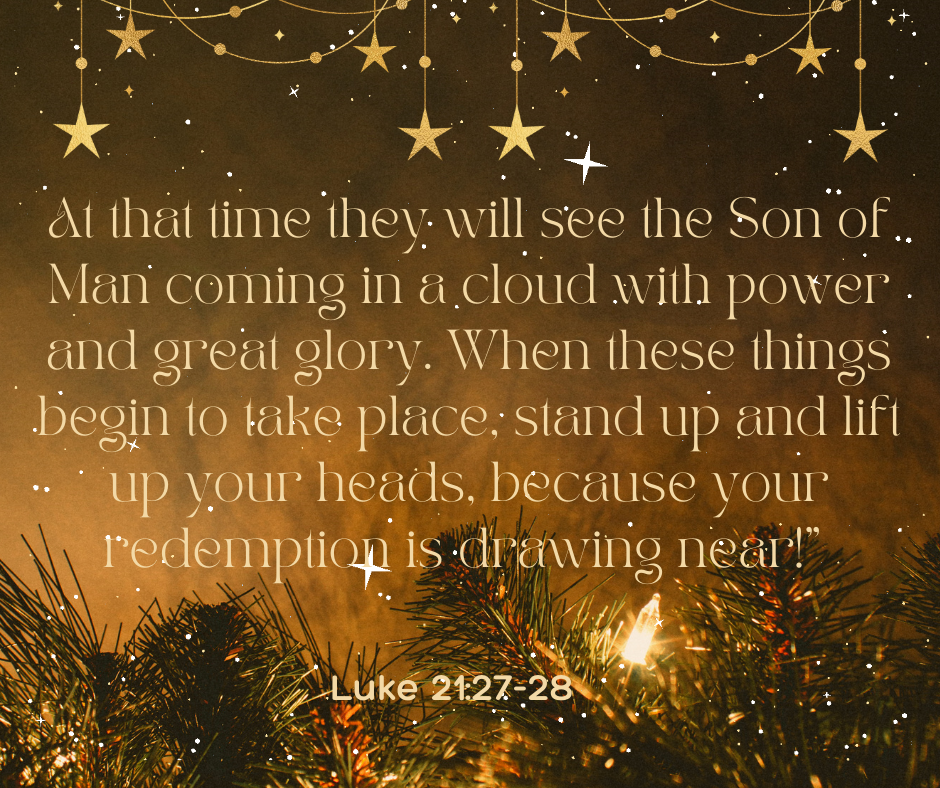
     While Anna spoke to those actively waiting for their Redeemer to come at the beginning of Luke, Jesus our Redeemer speaks to us at the end of the book, telling us to actively and eagerly wait for His return!  

Picture
     Are we waiting for redemption? What can we be doing today that increases our anticipation and joy? What can we do for others that changes their outlook on what their tomorrow may hold for them? How can we find ways to share the unfailing hope and joy that we have with those who have none? 
     As you anticipate the joy and the sorrows of this Christmas season, with its good and painful memories, its bereavements and its abundance, I pray that you will find joy and delight in the grace and favor that God has given to you through the gift of His Son, Jesus.  As you learn to see the many ways in which He leans toward you in order to bless and give you every "good and perfect gift," may you overflow with a joy that radiates that goodness to the lives you touch!  


2 Comments

The Favor of Self-Control (Part 1)

3/3/2022

0 Comments

 
Picture

     Daniel stared down at the plate of meats in front of him, its steam wafting enticingly.  His mouth began to salivate, and his stomach tightened uncontrollably.  Looking up, Daniel stared around him at the other young nobility, conflicting thoughts racing through his head. Surveying the room, he saw each of them reaching hungrily for the plentiful varieties of cheeses, meats, fruits and wine. 
     The richest of the king’s food, from the king’s own table, would now be provided for each of the captives.  Royal heirs of each of their distinct yet conquered lands, they had been hand-selected to serve the great King Nebuchadnezzar of Babylon, the ruling emperor of the farthest reaches of the known world. 
     They had just begun their three-year training period, where they would be trained in all wisdom, magic arts, and languages.  Only those eminently qualified to learn, those without any physical or mental defect, would be qualified to serve the king personally. 
     Daniel’s eyes stopped as he caught the agonized stares of his relatives, Hananiah, Mishael and Azariah.  They too, he thought, must be wondering the same thing he was.  In a land far from home, with false worship, false gods, and cultures that could not conform to all-encompassing worship of Hashem, the one true God, they had each been given new and idolatrous names to reflect what was decided by others to be their new allegiance to Babylon.  His own, Belteshazzar, was meant to change his identity from “God is my judge” to “Bel will protect him.” 
     Daniel looked down again, pondering the effect of his next choice. They had so very little control.  Their time, their food, their career training—it was all decided for them.  Even the possibility of spousal relationships had been removed from their control.  The control over their lives extended to worship, clothing, and even their very lives.  There wasn’t a choice left for them to make, it would seem.
     It was understood that they were to forget their homelands, gods, cultures and families, and become one with the diversity of the melting pot of the world.  Eating from the king’s table, consuming the meat sacrificed to the idols of Babylon, would, in effect, be their own, individual entering the rituals of the pagan rites and becoming one with them through that worship.
In a moment, Daniel knew what he must do. 
     He was Daniel: a worshiper of YHWH, a son of Abraham.  It was a value and identity worth more than any life he could have in Babylon.  He resolved that he would never defile himself with the idols of the nations.  Praying quickly for Hashem’s protection and wisdom, Daniel got up and approached the head of the eunuchs. 
   Smiling at Daniel’s approach, Ashpenaz greeted Daniel warmly, “Belteshazzar!  How can I be of service to you?” 
“Ashpenaz, I appreciate all that you do for us!  We wish to serve you and King Nebuchadnezzar with the best of our abilities, according to what Hashem, God Most High, has given to us.  But as followers of Hashem, we will not have His blessing or wisdom in order to bless the King if we participate in the sacrifice to other gods.  King Nebuchadnezzar will only benefit from Hashem’s wisdom through us in his court if we keep ourselves from other sacrificial worship according to Hashem’s law.”
    As Daniel spoke, he watched Ashpenaz’ face. The smile faded, and anxious creases formed above his eyes.  As Ashpenaz absorbed the information, a look of panic swept over him as he realized both the enormity and impossibility of this situation.  For the king must have the wisdom of all the gods!  But if Belteshazzar and the others refused to eat from the king’s table and grew weak, he, Ashpenaz, would be blamed.  His punishment would be unmerciful and unnegotiable.  He would be killed for dereliction of duty.
    His face ashen, Ashpenaz turned pleading eyes to Daniel, “I am afraid of my lord the king, who has assigned your food and drink. Why should he see you looking worse than the other young men your age? The king would then have my head because of you!”
    Daniel’s face softened with compassion. This man, as much as he seemed to control every aspect of Daniel’s life, was himself a pawn in a much broader and destructive game.  He himself was controlled, not by his own choices, but of that of another. 
     Surely Hashem would not value ceremonial laws above one of His own created people! There must be a way to walk in obedient worship while still caring for others.
     An idea came to Daniel.  “Ashpenaz, Hashem values you and your life and family as well as the king and our people.  He will make a way to bless all of us through our worship of Him.  Please test your servants for ten days: Give us nothing but plant food to eat and water to drink.  Then compare our appearance with that of the young men who eat the royal food and treat your servants in accordance with what you see.” 
    A look of relief spread over Ashpenaz’ features. Smiling again, his eyes gratefully acknowledging the wisdom and care Daniel had shown, he nodded vigorously and agreed to the arrangement. 
 
Excerpt Fictionalized from Daniel 1


ἐγκράτεια 
egkráteia --en, "in the sphere of" and krátos, "dominion, mastery") – properly, dominion within. "Self-control" – proceeding out from within oneself, but not by oneself. True mastery from within. 1
​

Love Resolves in Self-Control

Picture
    As we conclude our series on Galatians 3:22-23, self-control is perhaps, more than any other fruit of the Spirit, the quality I find most difficult to practice. In my mind, it often seems unachievable, illusive, and unquantifiable. 
     Studying the book of Daniel, I found myself really drawn to the principles that the Holy Spirit began to uncover. For me, I think sometimes my struggle with self-control may be in jumping straight to a resolution but neglecting the first two principles that Daniel displays in this passage:  remembering and recognizing.   
     Remember.  One of the fundamental elements of battle over control over our hearts and lives is this issue of identity--who we are.  It is the key to unlocking our God-given heritage and freedom in Christ (Rom. 6).  Daniel was given wisdom by God to understand the nature of using this key to exercise self-control in his choices, but from the very beginning of time, the enemy has called our identities into question. 
    In the garden, the battle over self-control was one of identity—Eve had already been created to be the “mother of all the living--” (Gen. 3:20)  in God’s own image, in His likeness, as His own daughter (Gen. 1:27).  She had been created to reign and have dominion over all of God’s kingdom as nobility (Gen. 1:28). 
    As such, Eve had been given everything she needed for “life and godliness” (2 Pet. 1:3, Gen. 1:29).  Every single fruit-bearing tree was just as desirable and good as was the one tree that could harm her (Gen. 2:9). 
    From the beginning of our creation, we find the elements of our God-given identity and what He has lovingly provided for us in Christ Jesus.  We were created to:
 
Be loved (1 John 1:1-4, 3:1)
Be known by God (Gen. 3:8, 2:22)
Know God (Gen. 3:8)
Resemble God in our spirits (Gen. 1:27)
Reign as kings and queens over God’s creatures (Gen. 1:28
Be blessed (Gen. 1:28)
Multiply (Gen. 1:28)
Have everything good for our needs (Gen. 1:29, 2:9, 2:18)
Be very good in Him (Gen. 1:31)
Be complete in Him (Gen. 1:31, Gen. 2:1-2)
Be favored (1 John 3:21-22, 5:14-15)
 
     It was this identity that the enemy attacked while claiming that Eve was incomplete, insufficient, improperly provided for and unlike God. It was only when her identity and God’s care as being sufficient was put into question that she coveted the wrong tree.  
     In contrast to Eve, the first thing that Daniel did in his love for God was to remember his identity in God.  Though his enemies had tried to remove his identity and to give him a new name, new culture, new worship and new loyalty, Daniel remembered who he was.  Daniel remembered who God had made him to be.  When Daniel chose to retain his Hebrew name, Daniel, or “God is my judge,” 5 he chose faith in God as his king and rewarder above all earthly monarchs.
     Unlike Eve, when Daniel chose to revert to plant-based foods I believe he was returning to the idea of complete dependence upon and provision by God for all his needs.  It was a lifestyle statement that there was nothing lacking in what God had provided.  He had no need for anything more that could be offered, because his relationship with God completed him in his identity and satisfied him fully. 
     This characteristic of satisfaction in God alone reverberated through his entire life and character and permeated his choices in other areas as well.  As we see throughout his story in the book of Daniel, he had no personal craving for ambition or power.  When offered, he declined the prestige, wealth, authority and honor (Dan. 5:17) when it was not in the service of love. 

Picture
     Recognize. There were many things in Daniel’s life that he could not control.  Scholars surmise that it is possible or even likely that he was physically made into a eunuch. 6 Regardless, since there is no record of his being married, we may at least conclude that he was a eunuch in some capacity, even if it was through a commitment to a single life of celibacy. 
     At this juncture in Daniel 1, Daniel had no control over his time, his education, his food, clothing, or even life itself (demonstrated through the dangerous encounters he had, see Dan. 3, 6).  A virtual slave, though an elevated one in the king’s palace, he may easily have felt that self-control was simply not an option for him.           
     Instead, Daniel evaluated what he could control: Firstly, how he self-identified:  throughout the book of Daniel, we always see Daniel self-identifying with the name and identity he had been given by God; his responses; his attitudes; his respectful appeals to authority; his worship; and especially the way he treated others in love (Gal. 5:22-23). None of these were without risk, but they were under his own control.
     Regardless of what we do NOT control, there are always areas we do control. The distinction of Spirit-led self-control in those areas lies in whether we are controlled by sin (Gen. 4:7, Rom. 6:12-16) or choose to follow the Spirit’s leading.  You see, sin will master and control us if we allow it (Gen. 4:7), but the Spirit will never force us.  The Spirit of God is gentle and constraining (2 Cor. 5:14), but since the beginning of Creation He has never been forceful (Gen. 2:9, Deut. 30:19).
     Sometimes the things we think are “self-control” are not as important as the things we don’t realize are included in “self-control.”  We typically think of self-control as diet and exercise.  Sometimes we may extend our thoughts to holding our temper when someone makes us angry, or even not purchasing that new blouse that we would like but know is not in the budget. But self-control really starts with much smaller things. 
     Perhaps income is not under our control to earn, but how we spend what comes in is.  Maybe our health is suffering, and we must spend more time resting than we would like—but our brain is still active.  We can’t always choose who we live with, but how we respond to them is our choice.  Perhaps life is full of suffering on many fronts, but we can still choose to praise and obey God. 
     All day, every day, we have the opportunity to exercise this gift in order to grow in it.  If we intentionally discern-- with the help of the Holy Spirit-- those areas in which God wants us to choose to exercise obedience, He will guide and empower us to grow in those areas! 

Picture
     Resolve. In Daniel’s story we find him making a very inspiring resolution: “But Daniel resolved not to defile himself with the royal food and wine” (Dan. 1:8a).  I don’t know about you, but for me the daily details and decisions to exercise self-control can be overwhelming at times.  In fact, when I measure my conduct and success without the grace of God added in, I always come up short.
     My father-in-law has a great yearly tradition of setting goals: his “new year’s resolutions.”  Without fail, he asks me what mine are. I smile.  I am a planner, but my goals are lofty and unattainable if they are measurable at all.  When I try to set measurable goals with due dates, I find myself consistently “failing” and wanting to give up.  It has made me shy away from those kinds of yearly resolutions for fear of failure. 
     When I was looking into the Hebrew verb for resolve, however, I was excited to discover something that I felt brought Daniel’s actions into a proper perspective.  In the Hebrew, the word for “resolve” that is used is in a Hebrew grammatical imperfect aspect, 2, 3, 4 meaning that Daniel’s resolution was continuously in the process of being acted upon, and was never a finished process.  Though Daniel’s decision to remain faithful only to his God was certainly made or begun at specific point in time, it was also a continuous decision that he would have needed to readdress time and again throughout the course of his time in Babylon.
     For us, this is good news!  Self-control isn’t a one-time proposition that ends in failure every time we neglect to follow through.  Rather, it is a lifestyle of behavior emanating from a continuous decision to keep going back to that core belief. 
     Because the love of Jesus permeates us as we walk in the Spirit, the lifestyle of choices that we put into practice will increasingly reflect the love of God toward others and even toward ourselves.  As we practice these choices, we grow stronger and more discerning about how to use this Spiritual gift in our daily decisions.  The love of Christ becomes the controlling factor underlying our thoughts, attitudes and desires, and spills out continuously in loving choices toward ourselves and others:    ​​

 For the love of Christ controls us, because we have concluded this: that one has died for all, therefore all have died; and he died for all, that those who live might no longer live for themselves but for him who for their sake died and was raised. 2 Cor. 5:14-15     

​      As we remember our identity in Christ, recognize what we have been given to control and resolve continuously to walk in a lifestyle of love (Part 2, coming soon!) and obedience, the favor of God will rest on our lives (Part 3, coming soon!), and our relationship with Him will grow!  I’m excited to see how God will change my habits and lifestyle as I put these principles into practice.  I would love to hear how the Spirit is giving you grace to walk out self-control in your lives!  
0 Comments

“I Can Smile”

11/5/2020

0 Comments

 
   “You are poison. Everything you've ever done is worthless. Everyone is angry at you. You should stop doing anything, all of it--you're not helping anyone.”
   
   Her words sank deeply into my soul and I went numb. Sitting in the over-crowded restaurant, her voice carried to the other tables. I could barely hold back my tears. I had no words, no response to the accusations. 

   The most difficult part of that conversation was hearing it play back in my mind for months afterward, and wondering...is it true?

   Does God think of me that way?

   Hannah felt that way. She was married to a Godly Israelite, an Ephraimite named Elkanah. But whereas I could get up from that table and walk out to my husband to be consoled, Hannah could not escape her rival. Peninnah was her husband's second wife, and all of their blended family's kids belonged to Peninnah.

   Though Elkanah loved Hannah, her inability to conceive was a constant grief to her:

  This man went up from his city yearly to worship and sacrifice to the Lord of hosts in Shiloh. Also the two sons of Eli, Hophni and Phinehas, the priests of the Lord, were there. And whenever the time came for Elkanah to make an offering, he would give portions to Peninnah his wife and to all her sons and daughters. But to Hannah he would give a double portion, for he loved Hannah, although the Lord had closed her womb. And her rival also provoked her severely, to make her miserable, because the Lord had closed her womb. So it was, year by year, when she went up to the house of the Lord, that she provoked her; therefore she wept and did not eat. Then Elkanah her husband said to her, “Hannah, why do you weep? Why do you not eat? And why is your heart grieved? Am I not better to you than ten sons?” 1 Sam. 1:3-8

   In our culture it can be difficult to identify with Hannah's need to have children. Many times children are seen as a hindrance to the pinterest-perfect lives we desire for ourselves. But in Hannah's culture, they were highly valued and represented lineage, perpetuation of inheritances, and the favor of God. This had some verification in the Judaic law: God had made it clear that there would be the blessing of children for their people if they obeyed the law, and the curse of barrenness if they didn't (Deut. 28:18).

   Even though this was a general blessing or curse upon the nation in generalities, rather than for specific individuals and their individual obedience, it was still seen as an evidence of ungodliness in a woman.

   Peninnah had the reputation and physical evidence, her children, of being blessed and favored by God. However, even with that, she most likely was subject to jealousy of Hannah's favor with Elkanah. Personally, I can't imagine having to live with a rival wife without the struggle of pain and jealousy. But in Peninnah's case, she allowed her pain to produce a bitterness that wanted to inflict more pain on the subject of her bitterness—Hannah.

   Additionally, judging by Elkanah's response to Hannah's tears, I expect that Penninah's provocative words were always said in private. No one could know what kind of a woman Peninnah was in secret. To the outside world, she may well have looked like the perfect wife of a great God-fearing man, with the blessings of a home and many children. She looked successful.

   And Peninnah was successful--physically. By using her words, and perhaps other means, to rise to her position, she temporarily obtained what she sought. It seems that Peninnah had learned to place her value on her status as a wife and mother. But because of her abusive and bitter response to her painful circumstances, her character was not what God was looking for in someone he could bless with even greater success than what was physical—spiritual blessings. By the world, and even the church's standards, she would have been valued and honored. But by God's standards, who sees the heart and the hidden actions, she would be held to account.

   At that time period, Israel had slipped into sin, immorality and corruption. Even the priest's own family failed to honor God. Outwardly they still practiced tabernacle worship and sacrifice, but it was so coupled with blatant immorality that God could no longer hear their prayers (Psalm 66:18). Knowing this, God waited for the people to return to Him in repentance so that He could hear them and enter into true relationship with them again.

   So often in these divisive times, Peninnahs abound. Gossip, slander, accusations, fighting, hostile or subversive takeovers, scheming, treachery, fear and suspicion are rampant, and these tactics we find even creeping into the Church.

   You may have found yourself acting like a Peninnah, as an unhealthy response to your own pain and unchecked bitterness or jealousy. Or perhaps you are suffering the abusive pain intentionally inflicted by someone else.

                                                                     We all have pain.
                        What we do with our pain is what determines how God can use us.


   In Hannah's pain, we don't see her retaliate. We don't see that she validated herself by explaining the situation to her husband, which could have potentially further exacerbated the issue. Most critically, we don't see her abandon her faith.

   Instead, we see her turn to the only One who could meet her hidden soul need:

   So Hannah arose after they had finished eating and drinking in Shiloh. Now Eli the priest was sitting on the seat by the doorpost of the tabernacle of the Lord. And she was in bitterness of soul, and prayed to the Lord and wept in anguish. Then she made a vow and said, “O Lord of hosts, if You will indeed look on the affliction of Your maidservant and remember me, and not forget Your maidservant, but will give Your maidservant a male child, then I will give him to the Lord all the days of his life, and no razor shall come upon his head.” 1 Samuel 1:9-11

   Hannah's soul need wasn't children. We see in this passage that she was vowing to give the boy back to the Lord if he were to give her one. Hannah's soul need wasn't a husband—Elkanah already loved her and wished for her happiness and satisfaction in him.

   But Hannah was already learning the painful lesson that physical blessings—a community, a home, a husband, and even children, could not satisfy the inner longing for the favor and relationship of God Himself.


   Hannah needed to know that Peninnah's words were untrue. She needed to know that God saw her heart and was pleased with her.

                    We each have a hidden soul need to know that God is pleased with us.

   In her abandonment, Hannah gave everything she had and would have to God. She surrendered her plans to His Plan. God's Plan then and His Plan now is to call us back to Him in repentance so that He can hear our cries and hold a deep and all-satisfying relationship with us. He looks for those hearts who are willing to surrender all to Him so that He can use us to bring divine relationship and healing to the hurting around us.

   When Hannah was praying, God heard her heart; but the priest, who was corrupt, couldn't. There will always be people who misunderstand our heart's intent, even other Believers. Hannah's response, however, was humble, honoring to the priest, and truthful:

   And it happened, as she continued praying before the Lord, that Eli watched her mouth. Now Hannah spoke in her heart; only her lips moved, but her voice was not heard. Therefore Eli thought she was drunk. So Eli said to her, “How long will you be drunk? Put your wine away from you!” But Hannah answered and said, “No, my lord, I am a woman of sorrowful spirit. I have drunk neither wine nor intoxicating drink, but have poured out my soul before the Lord. Do not consider your maidservant a wicked woman, for out of the abundance of my complaint and grief I have spoken until now.” Then Eli answered and said, “Go in peace, and the God of Israel grant your petition which you have asked of Him.” And she said, “Let your maidservant find favor in your sight.” So the woman went her way and ate, and her face was no longer sad. 1 Samuel 1:12-18

   Once Hannah had received the confirmation of her favor in God's sight, she got up and was happy. There was nothing more with which Peninnah could taunt her. Her heart was healed of the pain of accusation. The God of the universe, her God, was pleased with her.

   In the subsequent days Hannah would find God's promise to her cries fulfilled: A pregnancy, a birth, a baby boy. Hannah named him “Samuel,” meaning “God has heard.”

   Samuel would become the prophet God would use to lead His people back in repentance to Himself. Through Samuel's ministry and righteous judgment, God established righteousness in their hearts through repentance and faith in which God would again hear and have relationship with His people.

             When we rejoice in God's favor and salvation, we can smile even at our enemies.

   It took me a year to work with the Lord through the words that were spoken over my life in someone's bitter pain and jealousy. As King Solomon put it: “Jealousy [is] as cruel as the grave; Its flames are flames of fire, A most vehement flame” Song of Solomon 8:6. As I read through Hannah's story, I could begin to see the pain between the lines of someone who would spend so much effort to put me in such pain. It gave me a different perspective: one that could let go of bitterness and anger and seek my satisfaction in God alone.

   It also gave me a perspective that enabled me to pray for her: to pray that God would bless her; to pray that He would bring healing and fulfillment to those parts of her soul that were insecure and needed satisfaction; to pray that He would show her how her own bitterness and jealousy were causing destruction to her relationships; and to pray that He would bless her with His favor and pleasure as she turned to Him for her security and satisfaction and began to build healthy relationships.

   In that process, I found the pleasure of God. Now when I hear those words echoing from the past, they don't have a hold on me. I can “smile” at her, hoping for the very best for her and those she cares about, knowing that God can sort out all things good and bad in His own time.

   As we see in Hannah's story, if we use the painful situations and people in our lives to push us to the feet of our Savior, He will use it to bring restoration in ever-widening circles to those whose lives we touch. While we may never see here on earth the full and final result how God uses these things, we can be assured that in eternity we will be glad that we gave those things to the Lord:

   And I heard a loud voice from heaven saying, “Behold, the tabernacle of God is with men, and He will dwell with them, and they shall be His people. God Himself will be with them and be their God. And God will wipe away every tear from their eyes; there shall be no more death, nor sorrow, nor crying. There shall be no more pain, for the former things have passed away.” Then He who sat on the throne said, “Behold, I make all things new.” And He said to me, “Write, for these words are true and faithful.”

  With Hannah we can say, “I smile at my enemies, because I rejoice in Your salvation.”


Hannah’s Prayer

“My heart rejoices in the Lord;
My horn is exalted in the Lord.
I smile at my enemies,
Because I rejoice in Your salvation.


“No one is holy like the Lord,
For there is none besides You,
Nor is there any rock like our God.
“Talk no more so very proudly;
Let no arrogance come from your mouth,
For the Lord is the God of knowledge;
And by Him actions are weighed.


“The bows of the mighty men are broken,
And those who stumbled are girded with strength.
Those who were full have hired themselves out for bread,
And the hungry have ceased to hunger.
Even the barren has borne seven,
And she who has many children has become feeble.


“The Lord kills and makes alive;
He brings down to the grave and brings up.
The Lord makes poor and makes rich;
He brings low and lifts up.
He raises the poor from the dust
And lifts the beggar from the ash heap,
To set them among princes
And make them inherit the throne of glory.


“For the pillars of the earth are the Lord’s,
And He has set the world upon them.
He will guard the feet of His saints,
But the wicked shall be silent in darkness.
“For by strength no man shall prevail.


The adversaries of the Lord shall be broken in pieces;
From heaven He will thunder against them.
The Lord will judge the ends of the earth.
“He will give strength to His king,
And exalted the horn of His anointed.”
​
2 Samuel 2


0 Comments
    Picture

    Author

    Halley Faville lives with her husband and children in their mountain home in Oregon. 

    ​As a homeschooling mother of 7 children, she enjoys spending her free time in  language arts, music, art, and outdoor activities.  

    Archives

    August 2025
    August 2024
    May 2024
    April 2024
    February 2024
    October 2023
    June 2023
    December 2022
    October 2022
    June 2022
    April 2022
    March 2022
    December 2021
    November 2021
    October 2021
    September 2021
    August 2021
    July 2021
    June 2021
    May 2021
    April 2021
    March 2021
    January 2021
    December 2020
    November 2020
    October 2020
    August 2020

    Categories

    All
    1 Samuel
    2 Chronicles
    40 Days Of Goliath
    Abraham
    Acts
    Children
    Christmas
    Cross
    David
    Deliverance
    Ecclesiastes
    Eph 5:22-23
    Exodus
    Faith
    Faithfulness
    Fall
    Favor
    Feasts
    Focus
    Fruit Of The Spirit
    Generosity
    Genesis
    Gentleness
    Gideon
    Goodness
    Gospel
    Hannah
    Harvest
    Healing
    Homeschool
    Isaac
    Jehoshaphat
    John
    Joy
    Judges
    Justice
    Kindness
    Kingdom
    Listen
    Live
    Love
    Luke
    Ministry
    Multiplication
    Nativity
    Parenting
    Passover
    Patience
    Peace
    Perseverence
    Power
    Praise
    Prayer
    Promise
    Redeemer
    Relationship
    Repentance
    Resolution
    Reward
    Salvation
    Sanctification
    School
    Strength
    Submission
    Suffering
    Transformation
    Trust
    Truth
    Victory

    RSS Feed

Photos from bangorvineyardshedmedia, JamesInDigital, wildrosetn39
  • Home
  • Halley Faville
  • Jeff Faville
  • Oaks Canyon Youth
    • Youth Sign-Up/Forms
    • How You Can Help!
  • Beth Bearden
  • About
  • Contact
  • Resources
  • Recommended Blogs