Oaks of Glory
  • Home
  • Halley Faville
  • Jeff Faville
  • Oaks Canyon Youth
    • Youth Sign-Up/Forms
    • How You Can Help!
  • Beth Bearden
  • About
  • Contact
  • Resources
  • Recommended Blogs

You, Follow Me!

4/20/2024

0 Comments

 
Picture
We have a lot of kids.  If you might believe it, sometimes it's hard for me to concentrate, get work done, or rest well in our home. :) But I still need to be present and available.  So Jeff built me a little cottage as a retreat. I love going out there and looking at the trees, listening to the wind and the water in the creek.  God restores my soul there. 

For a while my daughters lived in the cottage while our parents were living with us.  After they were able to move into other rooms again, the cottage was left cold, empty and uninviting.  Of the many things needed out there, the top concern I had was heat!  I searched the internet for the perfect heater.  I love to read and have a lot of books, so I wanted it to have bookshelves attached.  After some time, I found a little, white electric fireplace with bookshelves on either side.  It was delightful!  I could go out there with a cup of tea and enjoy watching the fake flames dance around.  It was great-- until two weeks later the fireplace stopped working. 

Oh, the flames still danced, it still looked like it worked, but there was no power to the heat element.  All it could do was look pretty.  It couldn't function in any purposeful way to chase away the cold in that little room.  It needed to be connected to a genuine source of real power.  


So when they had eaten breakfast, Jesus said to Simon Peter, “Simon, son of Jonah, do you love Me more than these?” John 21:15
​

We must hear and 0bey by agape-loving God.


In John 21, John introduces us to Jesus’ commissioning of His disciples on His third appearance to them after His resurrection. The disciples had just gone out fishing, mirroring their original calling by Jesus. Now, after breakfast, Jesus has three questions for Peter, and three questions for us.  "Do you love Me?"

John, the author of this gospel, refers to Peter as Simon Peter. His original name was Simon.  It is the same name as Simeon, and comes from the Hebrew verb, “shama:” to hear and obey.
​
The Shama was the commandment of God which the Israelites would recite first in the morning and last at night every day of their existence, which Jesus claimed to be the Greatest Commandment:
​

“Hear, O Israel: The Lord our God, the Lord is one! You shall love the Lord your God with all your heart, with all your soul, and with all your strength. Deut. 6:4-5


This was Simon’s name.  He carried this around with him daily.  He was to hear and obey God out of gratitude for God hearing his cries for salvation.   

But John reminds us that Simon has another name, “Peter.”  Why? 

​To understand Simon Peter’s second name, we need to go back to the beginning of the book, to John 1:40-42.  Andrew had just been at John the Baptist’s Jordan River baptism, where John the Baptist identified Jesus as the Messiah when the Holy Spirit came upon Jesus as a dove and remained.  He announced Jesus as the Lamb of God who would “take away the sin of the world!” It was then that Andrew went and got Simon and told him that he had found the Messiah and brought him to Jesus.
​

Now when Jesus looked at him, He said, “You are Simon the son of Jonah. You shall be called Cephas (Peter)” (which is translated, A Rock). John 1:40-42

 
But here in this passage Jesus specifically refers only to his original name.  Why?  We will get to that in a bit, but for now we also need to see that Jesus keeps referring to Simon as the son of Jonah. 

Jonah means “Dove.” 

But there is also another story of Jonah.  It is the story of a prophet that God commands to go to his enemies to tell them of God’s pending judgment who wanted God’s grace for himself, but not for his enemies. The story ends with us as the readers not being told whether Jonah ever allows God to change his heart.

Simon is a son of Jonah.  He is frail, weak and full of false bravado.  He hears God, he receives God’s grace for his three times’ denial of Jesus and every other wicked thing he had done—but he still doesn’t want to give God’s grace to the evil Gentiles, like the Romans, who had taken over his country and abused them.

Next Week we will start a series in the Book of Acts, and we will find that twice God uses this story with Jesus in John 21, in the story of the Acts of the Spirit in the birth of the Church.  Simon will truly be Simon son of Jonah, with a redemptive ending!

So Jesus asks the question, “Simon, son of Jonah, do you love Me more than these?”

More specifically, Jesus asks “do you have agape-love for me?”  This is God’s sacrificial love for us.  God so agape-loved the world that while we were still sinners, living in hostile rebellion to God, He gave His only, beloved Son to die to redeem us. That is the agape-love of God.  “Simon, son of Jonah, do you agape-love me more than these?


We must agape-love God more than anything in the world.

“More than these.” To whom or what is Jesus referring?

To find out, we need to go back to Jesus’ original calling of Simon Peter in Luke 5:1-11. Jesus had just spoken to the multitude from inside Simon’s boat.  Afterward, He tells Simon to put the boat out into the water to catch, and Simon, after protesting that he had tried all night and caught nothing, hears and obeys Jesus.  They catch such a great amount of fish that their nets begin to break.  In Simon’s awe of this miracle, he falls down at Jesus’ knees in repentance and fear, proclaiming, “go away from me, Lord, I am a sinful man!”
​

 And Jesus said to Simon, “Do not be afraid. From now on you will catch men.” So when they had brought their boats to land, they forsook all and followed Him. Luke 5:10-11


​Back in John 21, we must remember, Jesus had just risen from the dead.  Where does Peter go? Fishing. Jesus’ renewed calling of Simon Peter in John 21 recalls his realization of his sinfulness and the grace given to him.  Jesus had originally told him not to be afraid.  Simon, however, had been very afraid at the cross, to the point where he denied Jesus three times.  So after Jesus’ death Peter goes back to fishing, because it’s what he knows, what he loves, what is safe, and what provides him the life that he wants: one of success and safety. 

There is a grammatical structure in the Greek that point to what Jesus is talking about with his phrase “more than these” in both accounts. In the Greek, these words “all” and “more than these” grammatically end the same as the object to which they are referring. In Peter’s original calling, when they “forsook all,” the grammar indicates that the “all” is referring back to the boats. In John 21, “more than these” is also referring to the fishing, to the fish and to his livelihood from this career.  The antecedent, the words earlier referenced are the “so many great fish, 153 of them.”  Jesus is asking him, “Do you agape-love me more than you love fishing?  More than you love this boat, this net, this job, this income, this world?” 
​
Jesus clarifies this further in Luke 14:25:

​

Now great multitudes went with Him. And He turned and said to them, “If anyone comes to Me and does not hate his father and mother, wife and children, brothers and sisters, yes, and his own life also, he cannot be My disciple. And whoever does not bear his cross and come after Me cannot be My disciple. For which of you, intending to build a tower, does not sit down first and count the cost, whether he has enough to finish it— lest, after he has laid the foundation, and is not able to finish, all who see it begin to mock him, saying, ‘This man began to build and was not able to finish’? Or what king, going to make war against another king, does not sit down first and consider whether he is able with ten thousand to meet him who comes against him with twenty thousand? Or else, while the other is still a great way off, he sends a delegation and asks conditions of peace. So likewise, whoever of you does not forsake all that he has cannot be My disciple. Luke 14:12-14, 25-33
​

Back in John 21, Simon’s response to Jesus’ question, Do you agape-love me more than these” is sad and unsatisfactory. He has no power over fear. Simon said to Him, “Yes, Lord; You know that I have phileo-affection for You.”

Peter has a self-awareness. He doesn’t use agape-love, he uses “affection.”  He loved Jesus like he might his brother or his family.  To agape-love God means to love Him more than anything else.  It is a comparison word, and by comparison our love for Him should be so much more than anything else in this world that people might consider the natural love we have for people who are close to us to be in comparison a hatred.  That is the difference between the agape-love of God and the phileo-affection that Simon has for Jesus. 
​

If we love Jesus, we must Shepherd His Church. 

Picture
"Jesus said to Simon, 'Feed My Lambs."
 
Jesus had just called His disciples “children” at the beginning of their encounter with Him.  To feed a sheep means to give it nourishment.  To feed a lamb is to give it milk, because it is not yet ready for solid food.  Milk is the Word of God, but it is the easy word of God.  The gospel, the commands, the elemental principles of God’s word.  “As newborn babes,” 2 Peter 2:2 tells us, we are to “desire the pure milk of the word, that you may grow thereby.” 

This command to Simon is part of The Shama:


“Hear, O Israel: The Lord our God, the Lord is one! You shall love the Lord your God with all your heart, with all your soul, and with all your strength.
“And these words which I command you today shall be in your heart. You shall teach them diligently to your children and shall talk of them when you sit in your house, when you walk by the way, when you lie down, and when you rise up.
Deut. 6:4-7

If we agape-love Jesus, we will feed those new to Jesus, the little children who are new to the faith, the milk of the Word of God as they grow.  We will spend our waking hours looking for opportunities to share with them who God is, what His nature is, and how we can follow Him better. 
​
Milk is for the immature, for the worldly, those not taking the steps of walking in the Spirit. 

Paul talks to the Corinthian Church in 1 Cor. 3:1-3 about their pettinesses and sinful, worldly lifestyles as Christians and challenges them:

​

Brothers and sisters, I could not address you as people who live by the Spirit but as people who are still worldly—mere infants in Christ. I gave you milk, not solid food, for you were not yet ready for it. Indeed, you are still not ready. You are still worldly. For since there is jealousy and quarreling among you, are you not worldly? 1 cor. 3:1-3
​

Simon was still a “child” because he was still focusing on the world and what he could get out of it.  Jesus was calling him to maturity, to forsaking the world and preparing to live out his calling in a way that would no longer just focus on his own need for grace, but also for the world’s need for salvation. 
​

Jesus said to him again a second time, “Simon, son of Jonah, do you agape-love Me?”

He said to Him, “Yes, Lord; You know that I have affection for You.”
​

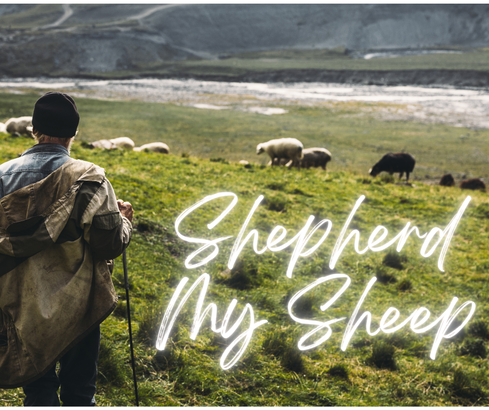
He said to him, “Shepherd My sheep.”

​

Picture
Sheep are mature adults, mature Christians. To shepherd means to not only provide pasture and calm waters, but also protection from thieves and predators. They are ready to grow on more than just milk. As we shepherd our families and those God has placed into our lives, they will need to be led to where they can learn more about God.  They need protection and wisdom from the enemy's lies and deception.  They need to be led to still, quiet places where they can have their soul restored in the Lord's presence. They need to be taught how to be discerning between God's voice and the enemy's voice: 
​

We have much to say about this, but it is hard to make it clear to you because you no longer try to understand. In fact, though by this time you ought to be teachers, you need someone to teach you the elementary truths of God’s word all over again. You need milk, not solid food! Anyone who lives on milk, being still an infant, is not acquainted with the teaching about righteousness. But solid food is for the mature, who by constant use have trained themselves to distinguish good from evil. Heb. 5:11-14
​

Peter was still worldly.  He was still focused on what he could gain out of this for himself.  He was “supposing that Godliness was gain” (1 Tim. 6:5).

When we are raising our children, the goal isn’t just that they feed themselves, clothe themselves and clean up after themselves.  When they are newborns, we do everything for them.  As they grow and starting to eat solid food, we still do much of the work for them.  But the goal is so much more.  We are raising our children to not only provide for themselves, but to be able to provide for a family and their community.  To be a blessing to the world.  That is maturity.

Jesus is telling Simon will need agape-love to shepherd His church.  It is a sacrificial love that lays down one’s life, one’s dreams, one’s success and reputation.  In fighting off predators and protecting the sheep, there is necessary risk that we must accept. As a parent, we understand this.  We know that caring for our kids means that we may need to place ourselves into harm to make sure that our kids are protected.  We know that there will be sleepless nights, long hours, and challenging times trying to provide for them. 

​This is something that is very challenging for us to accept.  It was challenging for Simon, because he loved and cherished his life.  In Matthew 16 The Jewish rulers come to Jesus asking him to prove himself as the Messiah.  Jesus tells them the only sign they will be given is the Sign of Jonah.  Just as Jonah was in the belly of the sea serpent for three days and three nights, so Jesus would be in the grave for three days and three nights before his resurrection.  Jesus was suffer the cross before the life.  The Jewish rulers were looking for a conquering messiah, one who would conquer, decimate and humiliate their enemies, raise them all to power, fame and wealth, and make everything amazing.  This is what Simon also wanted from a Messiah.  As we go on in Matthew 16, Jesus then warns his disciples to be wary of the problem the Pharisees have.  Then in verse 15 he asks them this very important question:  Who do you say that I am? It is Simon's answer that defines his identity:
​

Simon Peter answered and said, “You are the Christ, the Son of the living God.”
Jesus answered and said to him, “Blessed are you, Simon Son of Jonah, for flesh and blood has not revealed this to you, but My Father who is in heaven. And I also say to you that you are Peter (a small pebble or easily moved stone), and on this Rock (a large, cliff-side rock used as a foundation to build structures) I will build My church, and the gates of Hell shall not prevail against it. And I will give you the keys of the kingdom of heaven, and whatever you bind on earth will be bound in heaven, and whatever you loose on earth will be loosed in heaven.”
From that time Jesus began to show to His disciples that He must go to Jerusalem, and suffer many things from the elders and chief priests and scribes, and be killed, and be raised the third day.
Then Peter took Him aside and began to rebuke Him, saying  “Far be it from You, Lord; this shall not happen to You!”
But He turned and said to Peter, “Get behind Me, Satan! You are a stumbling-block to Me, for you are not mindful of the things of God, but the things of men.”
Then Jesus said to His disciples, “If anyone desires to come after Me, let him deny himself, and take up his cross, and follow Me. For whoever desires to save his life will lose it, but whoever loses his life for My sake will find it. For what profit is it to a man if he gains the whole world, and loses his own soul? Or what will a man give in exchange for his soul? For the Son of Man will come in the glory of His Father with His angels, and then He will reward each according to his works. Assuredly, I say to you, there are some standing here who shall not taste death till they see the Son of Man coming in His kingdom.”
 Matthew 16:16-28
​

It was by the Spirit of God that Peter recognized the power of God in the Son of God!  It was by the frailty of his humanity that he resisted the calling to suffering of His same Messiah.  Again, in John 10:11-13, Jesus reminds us of the difference between sharing the gospel for worldly gain vs one taking care of the Church out of agape-love:
​

“I am the good shepherd. The good shepherd lays down his life for the sheep. The hired hand is not the shepherd and does not own the sheep. So when he sees the wolf coming, he abandons the sheep and runs away. Then the wolf attacks the flock and scatters it. The man runs away because he is a hired hand and cares nothing for the sheep. John 10:11-13
​

But Jesus knows that Simon doesn’t have this kind of courage in him.  He knows he’s just a Peter, just a movable, little rock.  So when Jesus is telling Simon Peter to Shepherd His Sheep, he is reminding him of his need to understand his frailty as Peter, not just Simon. Simon would need to depend entirely on the Spirit of God to accomplish the work of shepherding God's people. It would only be on the Rock of Christ that the Church would indeed be built and that not even Hell’s Gates could stand up against the onslaught of the Church of Christ to redeem the world that God loves!

​Simon Peter should not be afraid.  But he is.  He is afraid of the cross.  He is afraid of death.  And this is preventing him from being who he is called to be:  one that shepherds Christ’s church.
​

​
He said to him the third time, “Simon, son of Jonah, do you have affection for  Me?” Peter was grieved because He said to him the third time, “Do you have phileo-affection for Me?”
And he said to Him, “Lord, You know all things; You know that I have phileo-affection for You.”
Jesus said to him, “Feed My sheep.
​

Jesus knows all things.  Yes, he knows that Simon Peter only has an affection at this point.  He needed Simon to know it.  He needed Simon to know the kind of love that was necessary.  He knows us too.  He knows our fears.  He knows our conflicting allegiances.  He knows that we struggle to give up what we cannot keep to gain what we cannot lose. 

He knows it’s hard. 

But if we have even affection for Jesus, we must follow Him by taking up our cross and caring for His people.


Most assuredly, I say to you, when you were younger, you girded yourself and walked where you wished; but when you are old, you will stretch out your hands, and another will gird you and carry you where you do not wish.” This He spoke, signifying by what death he would glorify God. And when He had spoken this, He said to him, “Follow Me.”
​

The very cross Simon ran from would become the death he died.  The fear he faced would be changed into courage by the Power of the Spirit and out of the love that he would be given for God and for the world. Jesus knows this about you too.  The Bible says that God always finishes what He starts.  He will carry us on to maturity and complete the work He has begun in you and in me (Phil 1:6).  Jesus knows this and isn’t afraid that He can’t accomplish this work in us!
​
But what do we do?  I think we are so much like Simon here.  We compare ourselves to others in this process.  When my kids are young, they often want to divert our learning conversations to avoid applying to themselves what they need to do.  "What about her?"  "What about him?"  they ask.  "Don’t they have to do their chores too?"  "Why are they getting to stay up late and I have to go to bed?"  "Why did they get a date and I haven’t yet?"  We look around and wonder what God’s trying to do with someone else.  That’s exactly where Simon goes when the conversation gets uncomfortable:

​

Then Peter, turning around, saw the disciple whom Jesus loved following, who also had leaned on His breast at the supper, and said, “Lord, who is the one who betrays You?” Peter, seeing him, said to Jesus, “But Lord, what about this man?”
Jesus said to him, “If I desire that he remain till I come, what is that to you? You follow Me.”
Then this saying went out among the brethren that this disciple would not die. Yet Jesus did not say to him that he would not die, but, “If I will that he remain till I come, what is that to you?”
​

​Simon was likely also remembering Jesus’ words in Matt 16:28:
​

Assuredly, I say to you, there are some standing here who shall not taste death till they see the Son of Man coming in His kingdom.” Matt 16:28
​

John was the only one of the disciples who, according to church tradition, lived a long life and died naturally.  John was enabled to see the revelation of Jesus’ second coming in the book of revelation. 

Peter sees John following Jesus.  John hadn’t run at the cross.  It was John who brought Simon into the room where Jesus was standing trial.  It was John who stood at the cross, watching Jesus die.  It was John who believed as soon as he saw the empty tomb.  John is already following Jesus.  But Jesus isn’t talking to or about John. He’s talking to Peter.  We do that, don’t we?  Try to distract ourselves with God’s dealings with others.  "What about them, Lord?"  "See how they messed up?"  "What about them, Lord, aren’t you going to ask them to do something hard?" "Your people aren't getting it right." "What about them, Lord, are they going to have to do it too?" 

But Jesus’ response to Simon Peter is the same as to us: If He desires a different outcome for someone else, what is that to us? 

“You, follow Me.”

Have you counted the cost to follow Jesus?  Do you love the Lord your God with all your heart, with all your soul, with all your strength?  Do you love the people of the world as you love yourself? Are we willing to follow Jesus, even to the cross? 

Peter wasn’t ready for any of these things.  He was just a weak, double-minded human who was frail and too small to accomplish the great task that Jesus had assigned for him.  We feel that.  If we are real with ourselves before God, we know we don’t have what it takes to love like God loves, to lay down our lives every day for others, to risk our lives to save our enemies.  But Jesus isn’t asking us to be strong, He is asking us to connect into Him as our Source of Power so that we can walk in His strength, doing His works, and allowing God to use us to build His Church on Jesus Christ, the immovable Rock!  As we will see next week, a Power was coming from God that would give them and us exactly the kind of courage that we need to love God and shepherd His Church.  

As we lean into Jesus’ hard questions for us this week, let’s not get distracted with what God is doing with other people.  Let’s ask the Holy Spirit to show us what things in this world—our families, friends, work, reputation, comfort.

​What are the things that we are clinging to that prevent us from loving God with all our hearts? Are we willing let His Spirit fill us with the power to accomplish what He's called us to do? 

​
References:
​1
Strong's Greek: 4074. Πέτρος (Petros) -- "a stone" or "a boulder," Peter, one of the twelve apostles (biblehub.com)
2Strong's Greek: 3404. μισέω (miseó) -- to hate (biblehub.com)
0 Comments

I Have Seen My Redeemer!

12/18/2022

2 Comments

 
Picture

There was also a prophetess named Anna, the daughter of Phanuel, of the tribe of Asher, who was well along in years. She had been married for seven years, and then was a widow to the age of eighty-four. She never left the temple, but worshiped night and day, fasting and praying. Coming forward at that moment, she gave thanks to God and spoke about the Child to all who were waiting for the redemption of Jerusalem. Luke 2:36-38 ​

      “Daddy’s home!” the high-pitched, jubilant cry of my little sister rent through the air of our larger, middle-class home. Pulling her nose and hands off the panes of the bay window overlooking our driveway, her cry was echoed by less than jubilation. The repeated phrase bore more the sound of a panic-stricken, pubescent middle-school boy. While the fun began with the advent of my father, so did the ensuing scramble of “pick-up time.” It was a time that Mom had tried to instill in us, and was supposed to initiate at 4pm so that my dad could come home to a clean house, a warm dinner, and an excited family waiting to welcome him, grateful for the long hours he had put in at the office. Quite honestly, it was a time that rarely began until we heard the familiar sound of his car in the driveway.  
      Beth reached as high as she could with her chubby fingers and swung the door open toward herself, backing up with it until the opening was wide enough to run through. She rushed out to greet him, heedless of the door standing open, the cold air springing to take advantage of osmosis, or the rush of adrenaline and activity behind her to make preparations. Legs and duplos must we swept off the floor, laundry and toys on the stairs taken up to the rooms, schoolbooks stuffed haphazardly into shelves, sometimes never to be found again, and a multitude of small items that no one knew where they belonged and would find their home in any stray crack or cranny, couch cushion or basket. If the item was too large, it would find its way to the basement ping-pong table, which was conveniently large enough to hold a massive amount of confused items. It is not always beneficial when kids are “helping” to clean, after all.  
      The fun would begin when Dad was home and all the boring work of the day was over. Perhaps he would play games with us, hide and seek in the dark, cards, or wrestle in a tickle battle on the floor. Surely he would read us a missionary story and a chapter from a fiction novel, using all the right voices and sound effects. Undoubtedly, he would pick out his stack of books to read and try to eat his cheerios in peace before bed. That was my favorite time. When everyone was else was gone, it was my turn to find any questions I could come up with to spark a conversation and gain one-on-one attention.  
     My mom used to say that she loved it when Dad would come home, because he would chase the demons away. All the frustration of dealing with us, all the mess and the work, the bad attitudes and the arguments—Dad would come home and make it all better. Every day we waited. Every day we listened for the sounds that meant life would be great again.  
     I imagine that in a very small way, this is a bit of the expectancy of the time in which Anna lived. While our difficulties were vastly more bearable with the love we experienced in our family, the darkness of the oppression that Anna lived under with the Roman occupation and extreme abuse of her rights she likely suffered because of her gender, her social status and her ethnicity would have greatly intensified the longing she and her fellow Israelites would have felt for the coming Redeemer.  
     Here we see a repeat of a name that we may be familiar with from the Old Testament—that of Hannah, the mother of Samuel. In Hebrew, her name is “Channah,” and in Greek it is “Anna.” Her name means to be favored by grace.  A more literal picture of the Hebrew word is that of a benefactor leaning toward someone who is coming with a humble request in order to bless and give to them their needs.  
     Anna’s name is meant to bring to mind the story of her namesake, Hannah, in 1 Samuel 1, who was bereft of children. In her grief, she fasted, prayed, and shed tears with loud groanings “to the one who could rescue” her in her situation, and she “was heard because of her obedience (Heb. 5:7).” Asking for a child, she vowed to dedicated him for a lifetime service as a Nazirite if the Lord would hear her request. Together with her husband, Elkanah, “God is Redeemer,” they kept their vow and dedicated their young son, Samuel, “Heard of God,” for a lifetime of Nazir, or sacred and set apart service to the Lord.  
     Luke tells us that Anna was the daughter of Phanuel, and does not list her husband. Phanuel’s (Peniel) name means “the face of God,” and is meant to bring to mind the story of Jacob wrestling all night with the angel of the Lord in order to blessed by God. At daybreak, Jacob is blessed and given a new name. Realizing at once that he had in fact been wrestling with the Lord Himself, Jacob “called the place Peniel, saying, “It is because I saw God face to face, and yet my life was spared. The sun rose above him as he passed Peniel....(Gen. 32:30-31).” 
     Anna came from the tribe of Asher, which means “happy/blessed,” and “level/straight,” which refers us back to the story of Leah and her wrestling (Gen. 30:8) with her sister for her husband’s love and the favor of God. After giving birth to Asher, Leah named him “happy” or “blessed” because she believed that her happiness would be guaranteed now because she had been given children.  
     Luke informs us further that Anna was “χήρα,” which is to be bereft, sterile, barren, or stripped of inhabitants or riches. While she was a widow in our common vernacular, this word was also used of those who had no provision or protection for themselves, but relied solely on God’s provision for them. It also included women who were single and without family support, or those who had been set apart under a Nazir vow and were, therefore, bereft and dependent upon God for their needs (Ex. 38:8, 1 Sam 2:22). 
      Anna very well may also have served in the same capacity as a ministering woman at the tent of meeting, which likely included Nazirites as well as Kohathite Levitical women serving and ministering (Ezra 2:65-70, Neh. 7:66-73, 1 Chron. 25:5-6). This group of ministering women would have depicted an early form of what would later become the ministering women serving in the church in the order of the “χήρα,” mentioned in Acts 6 and 1 Timothy 5 with its lists of qualifications that rival that of the presbyteroi just mentioned in the book, as well as concluding with the payment given to them, or to those ministering in the word of God, that of double payment. Acts 6 men who were appointed to be sure to wait on tables were likely given the responsibility of administering the payments of currency to these ministering women, since the word for table also carried the idea of banking, and since the Hebraic law and current culture of the day dictated that those who served were to be paid daily.  
     Anna was married for seven years, the Biblical number of completeness. Since she was married a complete amount of time, one would assume that it was surely enough time to have had children of her own. The text, however, shares nothing with us of any children, but rather of her day and night living and ministering in the temple. This indicates that she was childless—bereft in more ways than one. Though the Luke’s account in chapters 1 and 2 show us two other bereft and childless women whom God impossibly blesses with children, one in her old age (Elizabeth) and the other in her youthful virginity (Mary), Anna, whose name would have constantly reminded her of her own hope for children, remained childless.  
     Additionally, being bereft of children after her husband’s death likely would have qualified her for the Levirate law (Deut. 25:5-10), where her deceased spouse’s brother would have been required to redeem her monetarily and then taken her and raised up children for her husband by her. This would ensure that both the widow and the deceased husband would maintain a portion in the land of the Promise. Their name would not be cut off from their people. We find an example of this law as Boaz acted in this capacity as a kinsman-redeemer in the story of Ruth. If Anna had consented to this Levirate arrangement, she would not have remained a widow or bereft, and it may be that though that was available, she instead devoted herself as a Nazirite to wait for her redemption from God, instead. 
 

We must prepare the way for our Redeemer! ​

Picture
     Anna must have thought of the children her namesake had asked for and been given by God. Hannah was “heard of God.” No doubt Anna’s own lifestyle of fasting and prayer included not a few tears for her own lack.  She may not have felt “heard,” and given the fact that she remained single until old age, she likely had no more hope for being “heard of God” in this capacity. So where was God’s favor? Where was His grace on her life? Without children and as a widow, she would have been presumed by others to be cursed for sin of which perhaps only God knew.  And yet Luke makes it plain that she is a godly woman, ministering in the same way we see the apostles “ministering before the Lord” in Acts 13:2 in a liturgical sense.    
     However, just as her predecessor Hannah did not drown herself in sinful pleasures or addictions, but rather poured out her soul in faithful service and ministry to the Lord, we see Anna so doing. We don’t see her remain idle in her sorrow.  
     Instead, we see her invest in others and allow herself to be so filled with God that she regularly prophesied. We see her dedicating herself to the ministry, and spending her days and nights fasting and praying and proclaiming God’s Word. It is highly likely that the very people to whom she had prophesied regularly were many of the very ones whose hearts were waiting expectantly for the “redemption” to come. Just as her descendance from Asher suggests, we see her “preparing the way for the Lord, and making “straight paths for Him.  
     We may find ourselves in a situation similar to Anna.  Do you find a lack somewhere, a bereftness? A removal or stripping of your resources?  Does this cause you pain and grief?   
     What do we do when our resources are removed?  Do we spend our energies out in self-pity, “look anxiously about” us, or desperately search for ourselves the resources we think we must have in order to find ourselves rescued? Or do we start waiting upon the Lord as his servants, with praise, worship, fasting and prophesying the divine message of expectancy to a dark and waiting world? 
 

We must wait expectantly on the Lord!  ​

Picture
     Familiar with her own need and lack of a redeemer for her bereft state, attuned and practiced to the voice of the Holy Spirit, Anna was ready to recognize the Redeemer when she saw Him through the power of the Holy Spirit. Anna knew that God gives his people a more lasting portion eternally, and she was happy to trade physical redemption for spiritual redemption by her Redeemer.  In the midst of Anna’s day-to-day service, she experienced a favor far greater than that for which she may have longed—that of seeing the face of her God and living to tell of it!  
     While this was true of Anna, it is also true of us. As we go about our daily ministry in our homes, our churches and our communities and most especially in our day and night ministry to the Lord Himself, He meets us in our day-to-day with His Living Presence. As we practice listening to the voice of the Spirit and walking in obedience, we become more and more attuned to the words that direct us into the situations He wants to use to bring us favor: 
 

Yet the Lord longs to be gracious to you; therefore, he will rise up to show you compassion. For the Lord is a God of justice. Blessed are all who wait for him! People of Zion, who live in Jerusalem, you will weep no more. How gracious he will be when you cry for help! As soon as he hears, he will answer you. Although the Lord gives you the bread of adversity and the water of affliction, your teachers will be hidden no more; with your own eyes you will see them. Whether you turn to the right or to the left, your ears will hear a voice behind you, saying, “This is the way; walk in it.” Isaiah 30:18-21 
​  

     Through His Word, His Spirit, the spiritual understanding He imparts to us and our situations, He enables us to “see Him” and live to tell about our experiences of His presence! He reveals Himself to us, and gives us the opportunity to participate with Anna in preparing the way of the Lord, of making straight paths for Him! 
    We are never too late, and never too old. As long as we are serving God right where we are, the Divine appointments and opportunities for sharing the good news of the Light of the World will be brought to us.  
     What about us? How can we practice listening and obeying the voice of the Holy Spirit in our daily lives? How have you noticed the encounters becoming sweet and divinely appointed in your day-to-day?  

We must tell the good news! ​

Picture
     After a lifetime of “wrestling” with God night and day, as her father’s name suggests, Anna receives the blessing that showed the favor and grace God had extended to her—that of seeing her Redeemer with her own eyes and living to tell the story! Just as Hannah was enabled to prophesy of the future Messiah’s redemption (1 Sam 2) because she came to the Lord in her bereftness and ministered to the Lord in it, so Anna was enabled to prophesy of her present Messiah’s redemption because she came to the Lord in her bereftness, emptiness, and lack, and ministered to the Lord in it. In the process of their emptiness, God filled them with His Spirit.  God, who is rich in mercy, gave Anna the joyous opportunity to tell all who were waiting for their Redeemer that she had seen Him, and their long wait was over! 
     As we anticipate Christmas morning, we have a red Farmer’s truck with the numbers 1-25 on it. There is a little magnetic snowflake that marks off the days til Christmas has arrived. Above it are filled their stockings, the curvature of candy canes spilling out of the edges and mysterious and some no-so-mysterious bulges sticking out begging to be squeezed and guessed at. A little distance away, misshapen packages lay under our tree. Although the kids are not allowed to handle them, they do seem to keep realigning in strange and different piles. While they each are understandably excited to receive the unknown gifts, their anticipation is greatly increased by the fact that they each also earn and purchase gifts for one another, and they love to watch their siblings open the gifts they themselves have given. They are not only anticipating their own joy, but the joy that comes from bringing joy to people they love.  
      Anna shared the good news of the Redeemer to “all who were waiting for the redemption of Jerusalem.”   In the Greek, the word for waiting is most often used in the “middle” voice, meaning the subject is doing the action herself as well as receiving the benefit of the action. It carries the strong idea of waiting actively, expectantly, “ready and willing to receive all that is hoped for....” Those to whom Anna shared the good news of their redemption were anticipating in an active and eager readiness His long-awaited arrival.  
     While Anna spoke to those actively waiting for their Redeemer to come at the beginning of Luke, Jesus our Redeemer speaks to us at the end of the book, telling us to actively and eagerly wait for His return!  

Picture
     Are we waiting for redemption? What can we be doing today that increases our anticipation and joy? What can we do for others that changes their outlook on what their tomorrow may hold for them? How can we find ways to share the unfailing hope and joy that we have with those who have none? 
     As you anticipate the joy and the sorrows of this Christmas season, with its good and painful memories, its bereavements and its abundance, I pray that you will find joy and delight in the grace and favor that God has given to you through the gift of His Son, Jesus.  As you learn to see the many ways in which He leans toward you in order to bless and give you every "good and perfect gift," may you overflow with a joy that radiates that goodness to the lives you touch!  


2 Comments

40 Days with Goliath - Part 3

6/3/2021

0 Comments


For forty days the Philistine came forward
every morning and evening and 
​
took his stand.

Picture
     This week we went to family camp at a Ranch up in a rural Washington Native American Reservation. It was beautifully situated, with the desert bluffs rising steeply above the river.
     They had many activities for the kids to be entertained, including kayaking, archery and pony riding, but, by far, the most fun were the new puppies.  Fluffy. White. Adorable.  By the end of the weekend, our children were bribing us with promises of chores, training, and sleepless puppy nights.  
     In the end, the child with the most commitments to the worst parts of puppy training got the privilege of having the puppy and naming her--"Confetti."  I wondered how he would handle this much responsibility.  Of all my kids, he can be most distracted.  Having the constant care of a complex live animal may have its challenge for him. 
     It has been amusing to watch him navigate puppy bathroom breaks during the night, barking, and general training.  He has been a diligent owner, though, and the puppy is quickly learning to obey and get along with everyone in the house. 
     In my mind it is perfect training for fatherhood.  I love watching how God takes the little things of our lives, the hard things, the joy-filled experiences, and uses them to shape who He wants us to be for His purposes and our ultimate pleasure!
     We see this in King David's life as well.  The little battles became bigger battles, and with them, bigger victories.  
    In ​Part 1, we studied the place and stance of our fight, and who our Goliaths are. In Part 2, we looked at some of the first problems David encountered before he even had to stand up to his Goliath, and how he rooted himself firmly in his identity and future.  Today, we will focus on how David negotiated closed doors, discrimination, and how to maintain an effective defense in a new battle situation.  
Fight as a Representative


31Now when the words which David spoke were heard, they reported them to Saul;
and he sent for him.
32Then David said to Saul,
“Let no man’s heart fail because of him;
your servant will go and fight with this Philistine.”
​1 Sam. 17:31-32

     Since David was Saul's armor bearer, he would not have been expected to go into war unless King Saul himself was going into battle. Furthermore, David would not have had the authority to fight Goliath without permission from King Saul. At the point of David's assertions to the soldiers, the door was currently closed to the possibility of his serving the people in this way. 

     
When we speak declarative words of victory through Christ, God will make sure that those who have the ability to open doors you need are moved to action. 
​
      
If David had offered to fight as his own representative, for his own glory and achievement, Saul likely would not have allowed him, and God would not have aided Him. David knew that the only way to fight with authority and dominion would be as a spiritual representative for the glory and kingdom of God by serving as Saul's earthly representative.  
     One question we should ask ourselves as we are preparing to fight our spiritual enemies, is “whose kingdom and glory are we pursuing?” Is it our own, or the Lord's? Are we fighting for our own selfish ambitions, or to bless others? (James 4:3) Sometimes there can be subtle differences in our motivations that may seem Godly or unselfish, but in reality are primarily to build something for our own kingdoms and desires that fail to put God's kingdom first over all. 
     If we are representing the mission and desires of the will of God, we will not fail to have His support, resources and aid. 

Tell Our Testimonies 
​

And Saul said to David, “You are not able to go against this Philistine to fight with him; for you are a youth, and he a man of war from his youth.” 
1 Sam. 17:33

​

     "You don't have experience. He has been fighting this fight from the beginning. You are too young, too naive, too weak, too alone to be successful in this fight." We have all heard advice that seems wise, but in reality weakens our confidence in a living God who is really the one who will be fighting our battle on our behalf.
​     For me, this sinks home as I navigate creating a space for my in-laws to live, and what that would look like in our home, with relationships, and with our time and energy resources.  It is a new and rather daunting transition for us, but David's attitude really spoke to my heart to encourage me.  
     Let's take a look at David's response to Saul's assertions of his inadequacy:
 
​

34But David said to Saul, “Your servant used to keep his father’s sheep, and when a lion or a bear came and took a lamb out of the flock, 35I went out after it and struck it, and delivered the lamb from its mouth; and when it arose against me, I caught it by its beard, and struck and killed it. 36Your servant has killed both lion and bear; and this uncircumcised Philistine will be like one of them, seeing he has defied the armies of the living God.” 37Moreover David said, “The Lord, who delivered me from the paw of the lion and from the paw of the bear, He will deliver me from the hand of this Philistine.”
1 Sam. 17:34-37
 
​
​

     David told about his experience. It may not have been giants or war, but he had been faithful to depend on God in the areas that he had been placed. He equated this new battle with the previous battles, and the God who had delivered him before from the lion and bear would be the same God who would deliver him again this time. 
      
When we are preparing for a new battle that we have not faced, with an enemy that seems to have the upper hand in strength, experience, and bravado, we should retell our testimonies for others to hear of how God has proved faithful in our lives in the past. We should retell and meditate on our stories for the good and encouragement of our own hearts. It is not about our strength, talents, or experience, but rather about the same God of armies who lives presently and will fight for us in this next new battle. ​
     In this next season for our family, I may not know everything that may come up or how to deal with each new transition, but I know that God has given us grace and help in each past experience, with new wisdom and energy for every new day.  
​
​Spend Our Normal Days in Watchful Courage 
​
     Previously, David had watched over the sheep of his father to deliver them from predators. He had spent his normal days protecting his father's sheep. Protecting Israel, the flock of God, his heavenly Father, would be no different. His close, personal combat against the lions and bears would have taken great courage. 
     
We often have a deceptive idealic picture of a peaceful, pastoral setting of a shepherd with his sheep. The reality, though, is a constant watching. A guarded alertness, regardless of the immediate appearance of peace. Since a predator would most likely sneak in and attack at an unsuspecting time upon the weakest of the sheep, the shepherd would need to keep his eyes and ears alert, scanning the hills, crevices and hidden places for any sign of attack. 
      
Once an attack ensued, it would call for immediate action, a sprint at full speed toward the lion or bear who would have been running away with the bleeting lamb in its jaws. Overtaking it, David would have struck the predator, causing it to drop its prey in shock and pain.
     Sometimes that would be enough to send it running away. If the predator was more than usually bold or hungry, it would attack David. David's response was not to back down, but to catch the animal by its beard, initiating face to face combat, and striking it until it was dead. It would be an intimate, intense, and adrenaline permeated fight to the death. 
     
Often, though, shepherds were not so careful. The consequences were sadly destructive. If they let down their guards or became distracted, it would be too late for the lamb that would then be carried off. Even if the shepherd managed to fight the predator, the lamb would likely already be torn apart: "...The shepherd snatches from the mouth of the lion two legs or a piece of an ear....”(Amos 3:12) 
     
If we, as we shepherd God's people, our families, and neighbors, are not watching carefully, not on guard, if we are sleeping or wandering, then we may not be fast or close enough to run at the enemy in time. Even a shepherd brave enough to fight would lose the lambs if he were negligent, careless, or distracted.
     Like David's lambs, people are also helpless, in need of under-shepherds to watch and keep guard over them: Like a roaring lion or a charging bear is a wicked ruler over a helpless people. Proverbs 28:15 (NIV)
 Because of this, the Apostle Paul warns Timothy, a youthful pastor/apostle, to be on his guard in caring for the needs of his flock, his church: “But you be watchful in all things, endure afflictions, do the work of an evangelist, fulfill your ministry.” 2 Tim. 4:5 The Apostle Peter mirrors this instruction: “But the end of all things is at hand; therefore be serious and watchful in your prayers;” (1 Peter 4:7) and “Be sober-minded; be watchful. Your adversary the devil prowls around like a roaring lion, seeking someone to devour” (1 Peter 5:8). 
​     
This week I was greatly exhorted and inspired to an increase in watchful prayer by Spurgeon's devotional in Streams in the Desert, June 1 Morning: 

“Perhaps there is no more subtle hindrance to prayer than that of our moods. Nearly everybody has to meet that difficulty at times....What shall we do when moods like this come to us? Wait until we do feel like praying?....If you were in a room that had been tightly closed for some time you would, sooner or later, begin to feel very miserable—so miserable, perhaps, that you would not want to make the effort to open the window, especially if they were difficult to open. But your weakness and listlessness would be proof that you were beginning to need fresh air very desperately—that you would soon be ill without it....When we are listless in prayer, it is the very time when we need most to pray. The only way we can overcome listlessness in anything is to put more of ourselves, not less, into the task...If I feel myself disinclined to pray, then is the time when I need to pray more than ever.” CHARLES H. SPURGEON 

     We become sleepy when we close our windows and doors through prayerlessness and prevent the rich, energizing oxygen of the grace and power of God to enrich our lives. We see this listlessness, this drowsy sleepiness and lack of discernment of the times, come heavily upon the disciples in the Garden of Gethsemane as Jesus went to pray to His Father to prepare for the greatest trial they would yet encounter—His own crucifixion. 
     
Our drowsy lack of discernment of an impending spiritual attack should not determine our watchful alertness in prayer. 
​     
Jesus came to His disciples three times during the course of His prayer time, urging them to stop sleeping and to pray, “so that they would not enter (join in unity into) temptation” Matt 26:41). They must, indeed, suffer the temptation, but watchful prayer would be their means of securing from their heavenly Father all the grace they needed to endure it in the Spirit, with grace and holiness and faithfulness. We do not always know what the next temptation, giant or betrayal may be, so we must be watchful in all things. 

Fight with Spiritual Defenses ​
​

And Saul said to David, “Go, and the Lord be with you!” 38So Saul clothed David with his armor, and he put a bronze helmet on his head; he also clothed him with a coat of mail. 39David fastened his sword to his armor and tried to walk, for he had not tested them. And David said to Saul, “I cannot walk with these, for I have not tested them.”
So David took them off.
 
1 Sam. 17:37-49


     Saul had fought with this armor, but had not even experienced consistent victory using it. The victories that Saul had experienced in the Spirit had taken place before Saul had obtained armor and weaponry. Additionally, Saul was a very tall man, a full head and shoulder taller than his fellow Israelites. As David was both a youth and probably average height, he would not have fit this armor.
     Not only this, but it was a system of defense that he had not used before. 
Rather than enable David, it would only slow him down and create confusion between his muscles and mental coordination where he did have prior experience. The offer of armor was simply another method of distraction brought by the devil in order to entice David to place his trust and defense in the king's armor, rather than in God who would help the weak. 
     
Sometimes leadership or friends may offer well-meaning advice and support, but it is unintentionally unhelpful. It may or may not have worked for them, or perhaps, as in Saul's case, they only thought it was helpful, while it never did change their outcomes. Regardless, whether it's new technology, equipment, systems or mind manipulations, these can have no true value or benefit when they are not a tool given to us by the Holy Spirit.
     Some may try to claim that if you would only teach your children through a certain type of school, 
then they would love Jesus. If you would only get rid of all media, tv, digital devices, then you would not be subject to temptation. If you would restrict your diet to this or that discipline or food or exercise, then you would remain free of disease and physical ailments.
     While these life changes may actually be what God is calling you to personally, more often they may be what God has used as tools in their lives, but have no value intrinsically, in and of themselves, in controlling wrong appetites or in giving delivery and victory, 
     
Only when both given and used through the Holy Spirit in His power and His abundant grace can physical tools be a means to help with victory in any given area. 
     
Instead of focusing on methods and tools, we should focus on the power of the Name of Jesus and the individual way and means that the Lord has used in our past regardless of our physical resources. These methods that the Holy Spirit has used in our lives previously to bring about victory are primarily the ways that He will give us victory over larger and intimidating enemies. In the book of Galatians, the Apostle Paul writes to the Galatians because they are being led astray by the false hope that as Gentiles turning to the obedience and Covenant of the Mosaic Law they would find salvation, rather than through the blood and Covenant of Christ and obedience to the Law of Love:

2This only I want to learn from you: Did you receive the Spirit by the works of the law, or by the hearing of faith? 3Are you so foolish? Having begun in the Spirit, are you now being made perfect by the flesh? 4Have you suffered so many things in vain—if indeed it was in vain? 5Therefore He who supplies the Spirit to you and works miracles among you, does He do it by the works of the law, or by the hearing of faith?— Galatians 3:2-5 

     When we are to face off against a giant that is larger than we have encountered, for which we have but small experience, though indeed, it is experience, however belittled by some, we must continue to fight against these giants with the very same Spirit, authority and grace through which we have had our victories in the past. Do not be fooled by false rules, regulations, technologies, systems, media, popularity, political correct speech or any other tactic that seems in worldly wisdom to be effective, but has no real value in conquering evil in our lives: 
​​

These practices indeed have the appearance [that popularly passes as that] of wisdom in self-made religion and mock humility and severe treatment of the body (asceticism), but are of no value against sinful indulgence [because they do not honor God]. Col 2:23 AMP ​

Rather, as the Apostle Paul stated, 
​

“3For though we live in the flesh, we do not wage war according to the flesh.4The weapons of our warfare are not the weapons of the world. Instead, they have divine power to demolish strongholds.5We tear down arguments and every presumption set up against the knowledge of God; and we take captive every thought to make it obedient to Christ. 2 Cor. 10:3-5 ​

      What about you?  What giants are you currently facing?
    How might you navigate the giants in your life?  In your unique situation, how might you represent your heavenly Father?  Do you believe that He will provide the means and resources you need as you fight for Him?  
   Do you know anyone who is afraid of their giant, who needs to hear your words of encouragement, who needs to hear how God has been faithful to handle your problems in the past?  Who can you share your story with?  
    Perhaps this season has become one where life seems to drag, and prayer and intimate relationship with God seem far away.  How might you pursue a deeper prayer life?  
      Have you encountered any areas where a physical means to fight or fix your problem seems to present itself, but your spirit doesn't have a real peace about pursuing that way of dealing with it?  What other ways have you experienced God helping you might you pursue instead?  
0 Comments

Launch Out Into the Deep

4/21/2021

2 Comments

 
     Simon stood up carefully, pressing his hands into his lower back. He could feel every muscle, tight and cramping, sore from the long night of bending and pulling. Squatting again by the lapping shore-water, he reached down to pick up the fishing net, scrubbing and picking at the lengths of intertwined vegetation.     
     At least the others shared in the tasks, their joint vessels standing empty by the lake shore of Gennesaret. Lake fishing wasn't a one man job, it took a team of people to manage the boat, pull the nets, and clean up after the night.

     This morning was unusual—not in the lack of a catch, that happened often enough, but in the crowd of people watching and thronging around. Several times he found himself motioning small children away from playing with the nets, tangling and tugging on them, making it harder to finish the chore. He wanted to get the job finished and to go home to rest.
     A large shadow fell across his hands in the early morning sunlight, and Simon looked up to see a man, simple and plain, gazing down at him. Even as he did, the people swarmed closer and closer, trampling the nets and pressing into him, pushing and asking questions.
      Simon looked at the growing multitude, and at his boat. Making a quick assessment of the situation, he got up, motioned to the man to climb in, and they set out a little from the shore. If they couldn't finish their job on land, he may as well wait until the crowd dispersed.
     Instead, the man began to teach the crowd, his voice carrying clearly over the water, the people quieting and sitting along the shore. When he was finished, he turned to Simon and said, “Launch out into the deep and let down your nets for a catch.”
     Simon looked at Jesus, his thoughts in a turmoil. He was tired, and Jesus didn't know fishing. He was a master, a rabbi, a teacher of the Law. And they'd already tried-- it just wasn't a good time for fishing. And deep water?  That wasn't where they fished.  Their small boats weren't made well for deep sea fishing. 
    But in that moment, he made a decision. If only to show Jesus that it was pointless, they would go out again.
“Master, we have worked hard all night and caught nothing; but because you say so, I will let down the net.”

    Simon motioned to the others, whose faces mirrored his own frustration and weary defeat. They picked up the oars and set out into the deep water, the waves increasingly swelling and splashing up over the sides. A little water in the boats would be fine, Simon knew. Too much and they would capsize.
     Simon and his partners picked up the large net and lowered it down into the water. Within moments the weight of the net increased and it became more and more difficult to hold on. Simon leaned over the edge, careful to keep the majority of the weight of his lower body within the boat. The ropes began to strain. At the corners, he could see them start to unravel and the cords start to snap.
     Signaling to their partners to come and help, the second boat sidled alongside, and together they heaved the load into both boats, filling them and causing the hulls to sink lower in the water. With the rocking swells, Simon saw the boats begin to take on more water.
     Fear, amazement and a raw sense of insufficiency, more than that--of defilement, gripped Simon's heart. He fell down at Jesus' knees in the boat. “Go away from me, for I am a sinful man, Lord!”
​ 
    Jesus looked at Simon, and knew the magnitude of Simon's heartache and vulnerability. What Simon was now, he would no longer be. A picture of who Simon would become, transformed by Love, seeped into the voice of Jesus, now soft with compassion and hope: “Do not be afraid. From now on you will catch men.” (Luke 5:1-11)
​

Launch out into the deep
​

Picture
     Sometimes it can feel like we have been using all our energy and time fruitlessly—like the thorns and thistles just keep coming, and no matter how hard we try, we come up empty, profitless. It can feel like we are trying to draw full and satisfied people to the Gospel when they feel no hunger or need for it. They aren't attracted to it, and they aren't interested in spending their time hearing. But Jesus, the Master Fisherman, knows just where the “fish” are, and how to draw them.
​

     Often in the gospels, Jesus illustrates a principle first in a parable or symbolic story, and then developes it with further teaching or practical application. In Luke chapter five we see the same pattern. The story of the morning of fishing was meant for us to represent a principle of ministry of sharing the gospel in an effective and harvest producing way.

     Jesus' next three stories show the practical application of going “out into the deep” waters.

     Story one (v. 12-16) starts with a leper who approaches Jesus, needy and hungry for both inner and outer healing. The man has faith, Jesus touches the untouchable, and the man is made clean, both in his body and His spirit.

    The result?


“...the report went around concerning Him all the more; and great multitudes came together to hear, and to be healed by Him of their infirmities. So He Himself often withdrew into the wilderness and prayed. (v. 15-16)

     To launch out into deep waters we must go to places of need.

    It is in the context of Jesus' obedience to go that those hungry for the gospel would approach Him as what could have seemed an interruption or distasteful distraction. As we go we need to stop, help them in their need and share the good news of what Jesus has done with them.
​

      Story 2 (v. 17-26) involves another man, a paralytic, being brought to Jesus with a need, both physical and spiritual, to be forgiven and made functional. This time, his friends are desperate to get to Jesus through the crowd—the paralytic's friends pull away a hole in the roof to lower him down to Jesus. In spite of the criticism of the religious elite, Jesus not only heals the man, but forgives his sin as well.

The result?

“Immediately he rose up before them, took up what he had been lying on, and departed to his own house, glorifying God. And they were all amazed, and they glorified God and were filled with fear, saying, “We have seen strange things today!” (v. 25-26)


     To launch further into deeper waters, we must disciple those who come in an available way.

   As Jesus discipled the people who came to him, those desperate for the gospel would approach Him until they pressed through the busy-ness and crowd of the situation.  Again, what seemed to be an interruption was what His Father wanted in that moment. We need listen to the Spirit and remain flexible  to shift our focus as needed.


     Story number 3 (v. 27-32) revolves around a tax collector, Levi, a sinner and a cheat, who Jesus saw plying his dishonest trade and approached, offering to disciple him. At Levi's subsequent invitation into his life and into his friendship circle, that of other dishonest tax collectors and sinners, Jesus went home with him, shared in Levi's generosity, and engaged in conversation with his friends.

     Jesus was then criticized by the leading religious of His day, the pharisees and scribes, for such defiled behavior. Jesus responded to their criticism: “Those who are well have no need of a physician, but those who are sick. I have not come to call the righteous, but sinners, to repentance.” (v. 31-32)

     The result?

     To launch into the deepest waters, we will be going to those places where the awareness of the spiritual need is already there.  We must see them, and enter into their life.

      This is where some of the greatest harvest is....those who are hungry for the gospel-- the hurting, those acutely aware of their sin and need for forgiveness, those discarded by society, those “poor in spirit,” with an inner and humble sense and urgency about their destitution.  We will find that people are already seeking out the “net.” They are seeking that safety, belonging and wholeness that they may enter into as we point them to Jesus, their savior and healer.


​     And our nets will begin to break.
​

Signal Our Partners
​

Picture
     None of us are physically able to bear alone the burden of responsibility in carrying the gospel to people and discipling them into maturity.

     In Exodus 18, Moses is trying to lead and to judge a nation of millions. When his father-in-law Jethro visited and saw the extent of what he was doing, and that “the people stood before Moses from morning until evening”(v.13) for judgment and instructions, he said, “The thing that you do is not good. Both you and these people who are with you will surely wear yourselves out. For this thing is too much for you; you are not able to perform it by yourself.”
​

     Jethro then gave Moses godly and wise counsel:


"Listen now to my voice; I will give you counsel, and God will be with you: Stand before God for the people, so that you may bring the difficulties to God. And you shall teach them the statutes and the laws, and show them the way in which they must walk and the work they must do. Moreover you shall select from all the people able men, such as fear God, men of truth, hating covetousness; and place such over them....And let them judge the people at all times.... So it will be easier for you, for they will bear the burden with you. If you do this thing, and God so commands you, then you will be able to endure, and all this people will also go to their place in peace.” (v. 17-23)

Picture
     When the nets begin to fill, we need to “signal” our partners in ministry, those who are called to the work of the gospel, and ask for their help. It can be self-gratifying to feel like this is our own ministry, or that we should retain the credit, but that will only result in a net that is broken and a catch that is lost.

     Let's share the work and responsibility, delegate and team task so that the ministry can get done-- His ministry, not ours, for we all serve the same Master and without Him we could do nothing.


Humbly Acknowledge Jesus​


     Peter's humility and willing obedience at this critical juncture is one of those things that marked him for increased ministry—he knew where the credit lay, because he knew his own unworthiness, ignorance and need for Jesus in his own life. His response to Jesus' miracle and nearness was a gut-wrenching longing to get away to a place where he would feel more adequate, more self-equipped and more satisfied in his sin. But he knew that in his sinful inadequacy, he could work all night and catch absolutely nothing.

     Without Jesus, we can do ministry, exhaust ourselves, frustrate our teams, and abandon our families with our time—all for nothing.

     The Simon of the night before felt competent, satisfied and without need of help. The Simon of the morning was shattered, broken, needy and humbled.

     Like Simon, we may feel that after our hard work and long efforts we are exhausted and needy, bewildered and disillusioned. Perhaps we've seen Jesus at work in our lives, but at this point we may worry that we too sinful, too full of inadequacy and too weak for Jesus to call or use us. We may be too scared to be that close to a holy Jesus who calls us to let go of our unrelenting grasp on our possessions, home, relationships and reputations, worried about the potential loss and sacrifice.
​

     With Jesus, the unrelenting toil is over. If we choose to serve Him, he bears the burden of directing where we go, who we speak to, and how we help. He sends us partners along the way. He does the work of cleansing, maturing and making our hearts holy and love-filled for the job ahead. He guarantees the results, because it's all about Him.

    Are you willing to launch out into the deep water with Jesus?  


"Don't be afraid, from now on you will catch men."

Luke 5:10b
Picture
2 Comments

Beside All Waters

4/16/2021

0 Comments


​Happy

are you who sow
beside all waters,

who send out
freely the feet of the ox and the donkey.

Isaiah 32:20

Picture
Picture
         It's springtime in the Canyon.  Our new blueberry plants are set in their rows, and the raspberries are sending up their new canes.  Jeff has been building new cedar planting beds, and our kids are helping to dig out the earth in terraces for the planters to rest.
            Beside my recliner in the living room I have my packets of seeds, and I have been leafing through “The Family Garden Plan” by Melissa K. Norris (from the Pioneering Today podcast), a fellow Santiam Canyon gardening enthusiast who is much more skilled than I am, in the hopes that I might glean from her years of experience. 
           

Picture
     My favorite part is the planning—because I can sit in my recliner with my warm and cozy blanket, hugging a warm cappuccino with a chocolate drizzle.  I am fine with getting the seeds and plants into the ground, but once it's time to weed and water—that's all Jeff.
      Weeding season happily coincides with allergy season.  In fact, I only get a desire to work out in my gardens when it is sunny and warm, something that not a frequent occurrence in our mountainous climate.  I have a haunting suspicion that to be truly successful at gardening I would need be out there rain and shine, cold and warm, working to make sure that each plant has the best shot at bearing fruit later on. 

     While I love the convenience we have in our culture of raised beds, automatic watering systems, and online seed shopping, it doesn't help much in understanding some of Scripture's analogies in planting and harvesting—Scripture's most often used parallel for ministering in the Word of God.
          In Eastern Biblical cultures, they didn't have raised cedar beds and imported topsoil.  Instead, they worked with what they did have—their water systems.  Every year the streams, creeks and rivers would overflow onto their banks with rich topsoil, spilling essential nutrients and water past their normal bounds. The families would take their grain carefully hoarded from the previous year's harvest out to the moist banks, and, using the oxen and donkeys, would plough up the wet dirt with the animals' feet, afterward throwing out the seed onto the wet topsoil.  This would soak the grains and prepare them for more uniform germination.  As the waters subsided, the plants would spring up and have easy access to water and nutritious soil throughout the hot summer months. 
         Those most successful, the ones who would reap the richest most bountiful harvests, were those who would continue to sow beside as many water sources as they could find.  They wouldn't just sow once and be done.  They knew that if you wanted the fullest harvest, you wouldn't “put all your eggs in one basket.”  You would diversify.  You would invest your time, energy and resources into as many places as you could for the most profitable return. 
         Have you ever checked the back of those little seed packets?  It always has a spacing for each plant's optimal production.  However, the garden experts don't always advise following those spacing rules.  It is not that they are inaccurate, but rather that if you sow generously across the entire area, so many more plants will come up that the net result of your harvest will be much greater than if you had sowed sparingly. ​
           For the ministries the Lord has given me, this might mean that I participate in worship with my cello.  When my son falls on the playground and comes to me with a bleeding lip, I hold and comfort him.  When the Lord prompts me to share a verse or song with a friend, I obey.  When the floor in the kitchen at church needs mopped, maybe I can help with that.  If there's a devotional needed for youth group, I can ask the Lord to give me something to share.  It can mean different things at different times, but it is more about being flexible to the leadings of the Holy Spirit than about certain amount of time or involvement. 
          Obviously we have our giftings from the Lord in particular areas, and those areas may see a more natural growth and return, but if there's another place that we can invest, even if it's a smaller rate, it is worth sowing into, because the end result will be all the greater.   
       In Ecclesiastes 11:1-6 there is a passage that continues to help me to persevere in “sowing” in ministry in those times when it seems fruitless or discouraging:
​

“Cast your grain upon the waters;
after many days you will receive a return. 

Invest in seven ventures, yes in eight;
you do not know what disaster may come upon the land.

If the clouds are full of water, they pour rain on the earth. 

Whether a tree falls to the south or to the north,
in the place where it falls, there it will lie.

Whoever watches the wind will not plant;
whoever looks at the clouds will not reap.

As you do not know the path of the wind, or how the body is formed in a mother's womb,
so you cannot understand the work of God, the Maker of all things.

Sow your seed in the morning, and at evening let your hands not be idle,
for you do not know which will succeed, whether this or that,
or whether both will do equally well.”
Ecclesiastes 11:1-6
​
        While these verses speak about many different things, they really are all illustrating a couple of parallel concepts. 
      Our “grain” is whatever the Lord has given us to share with others—talents, finances, knowledge, service. Jesus' parable in Luke 8 tells of the farmer who scatters his seed on the path, the rocks, and the thorny areas as well as the good soil.  While he may harvest with little to no return in some of those soils, the percentage of people, though small, who receive and bear a harvest when they hear the Word of God is multiplied exponentially. The ability to bear more seed and impact “100 times” more in the future is a harvest worth our investment.
       Unlike the farmer though, as servants we cannot see the inside of a person's heart.  “Man looks at the outward appearance, but the Lord looks at the heart.” 1 Sam 16:7.  We may see what looks like hard-heartedness in people, but is only a carefully formed facade meant to self-protect.  We may see what looks like a lack of understanding, but as maturity forms and knowledge increases may come back to them with a Spirit-inspired revelation of insight.  Only God can see beyond the appearance of things. 
​
We must keep casting the gospel everywhere we can find to cast it,
because as seed-casters, we cannot see the heart's condition.


Picture
       It takes a measure of faith to take what we have carefully saved of our time, energies and resources, and “throw it into the mud.”  It's easy to wonder if that investment into people will ever produce anything, especially when many people reject the gospel, or treat us poorly as a result.  Many often consider what we have to share to be of no value, and the sacrifice of what we could have enjoyed for ourselves with that precious resource can seem pointless and discarded. 
      If we look at those discouragements, if we focus on what seem to be failures, than we lose our courage to keep planting.  If we “watch the wind” or “look at the clouds,” we will in turn make fear-based choices that will end up with no reward, no ministry fruit. 
      Only God, who forms and works miracles in secret in the womb, knows what He will do with the seed we cast.   Just as we know that rain-clouds will eventually drop their rain, so we know that if we keep persevering there will end up being a harvest. Just as we can predict where a tree will lay when it starts to fall, so we know that our ministry in the Lord will never be wasted. God intently watches over His Word to make sure that it will accomplish what He intends. (Jer. 1:12, Isa. 55:11)


“There, my dear brothers and sisters, stand firm. Let nothing move you.
Always give yourselves fully to the work of the Lord,
because you know that your labor in the Lord is not in vain.”
1 Cor. 15:58

 
We must keep serving regardless of the conditions and outlook,
because God watches over His own purposes. 

         
Picture
       At our church we are wrapping up our school year schedule of ministry, and moving into a season of rest and minimal work so that we can restore our energies for the next year and spend more family time.  This year, honestly, has been a difficult one to finish out.  Trying to juggle seminary, homeschooling and leadership at the same time has on many occasions drained my energy.  At the end of a particularly challenging season, when we have given and given and feel like there's nothing left to give, it can feel like perhaps we should have saved more.  It can be challenging to continue to throw it all out there and to trust that we will have more again to give later on. 
            My husband owns his own business, and he is always looking for ways to supply his employees with better, faster tools, more efficient vehicles, and sufficient help to get each job finished in a timely and profitable way.   A good and wise owner will always want to supply his workers with what they need to get the job done well. 
            In the same way, our God, who created all things by the Word of His mouth, wants to re-supply and refresh us with all that we need for each new day. So at the end of each day, let's take our empty baskets back to Him and ask for more.  More energy, multiplied time, more help, more resources.


God is invested in His own kingdom as the Lord of the Harvest. 
He will abundantly supply us with what we need to serve Him.


“And God is able to bless you abundantly, so that in all things at all times,
having all that you need, you will abound in every good work. 
As it is written, 'They have freely scattered their gifts to the poor; their righteousness endures .' Now may He who supplies seed to the sower, and bread for food,

supply and multiply the seed you have sown
and increase the harvest of your righteousness.”
2 Corinthians 9:10
Picture
0 Comments
    Picture

    Author

    Halley Faville lives with her husband and children in their mountain home in Oregon. 

    ​As a homeschooling mother of 7 children, she enjoys spending her free time in  language arts, music, art, and outdoor activities.  

    Archives

    August 2025
    August 2024
    May 2024
    April 2024
    February 2024
    October 2023
    June 2023
    December 2022
    October 2022
    June 2022
    April 2022
    March 2022
    December 2021
    November 2021
    October 2021
    September 2021
    August 2021
    July 2021
    June 2021
    May 2021
    April 2021
    March 2021
    January 2021
    December 2020
    November 2020
    October 2020
    August 2020

    Categories

    All
    1 Samuel
    2 Chronicles
    40 Days Of Goliath
    Abraham
    Acts
    Children
    Christmas
    Cross
    David
    Deliverance
    Ecclesiastes
    Eph 5:22-23
    Exodus
    Faith
    Faithfulness
    Fall
    Favor
    Feasts
    Focus
    Fruit Of The Spirit
    Generosity
    Genesis
    Gentleness
    Gideon
    Goodness
    Gospel
    Hannah
    Harvest
    Healing
    Homeschool
    Isaac
    Jehoshaphat
    John
    Joy
    Judges
    Justice
    Kindness
    Kingdom
    Listen
    Live
    Love
    Luke
    Ministry
    Multiplication
    Nativity
    Parenting
    Passover
    Patience
    Peace
    Perseverence
    Power
    Praise
    Prayer
    Promise
    Redeemer
    Relationship
    Repentance
    Resolution
    Reward
    Salvation
    Sanctification
    School
    Strength
    Submission
    Suffering
    Transformation
    Trust
    Truth
    Victory

    RSS Feed

Photos from bangorvineyardshedmedia, JamesInDigital, wildrosetn39
  • Home
  • Halley Faville
  • Jeff Faville
  • Oaks Canyon Youth
    • Youth Sign-Up/Forms
    • How You Can Help!
  • Beth Bearden
  • About
  • Contact
  • Resources
  • Recommended Blogs