Oaks of Glory
  • Home
  • Halley Faville
  • Jeff Faville
  • Oaks Canyon Youth
    • Youth Sign-Up/Forms
    • How You Can Help!
  • Beth Bearden
  • About
  • Contact
  • Resources
  • Recommended Blogs

The Favor of Self-Control (Part 1)

3/3/2022

0 Comments

 
Picture

     Daniel stared down at the plate of meats in front of him, its steam wafting enticingly.  His mouth began to salivate, and his stomach tightened uncontrollably.  Looking up, Daniel stared around him at the other young nobility, conflicting thoughts racing through his head. Surveying the room, he saw each of them reaching hungrily for the plentiful varieties of cheeses, meats, fruits and wine. 
     The richest of the king’s food, from the king’s own table, would now be provided for each of the captives.  Royal heirs of each of their distinct yet conquered lands, they had been hand-selected to serve the great King Nebuchadnezzar of Babylon, the ruling emperor of the farthest reaches of the known world. 
     They had just begun their three-year training period, where they would be trained in all wisdom, magic arts, and languages.  Only those eminently qualified to learn, those without any physical or mental defect, would be qualified to serve the king personally. 
     Daniel’s eyes stopped as he caught the agonized stares of his relatives, Hananiah, Mishael and Azariah.  They too, he thought, must be wondering the same thing he was.  In a land far from home, with false worship, false gods, and cultures that could not conform to all-encompassing worship of Hashem, the one true God, they had each been given new and idolatrous names to reflect what was decided by others to be their new allegiance to Babylon.  His own, Belteshazzar, was meant to change his identity from “God is my judge” to “Bel will protect him.” 
     Daniel looked down again, pondering the effect of his next choice. They had so very little control.  Their time, their food, their career training—it was all decided for them.  Even the possibility of spousal relationships had been removed from their control.  The control over their lives extended to worship, clothing, and even their very lives.  There wasn’t a choice left for them to make, it would seem.
     It was understood that they were to forget their homelands, gods, cultures and families, and become one with the diversity of the melting pot of the world.  Eating from the king’s table, consuming the meat sacrificed to the idols of Babylon, would, in effect, be their own, individual entering the rituals of the pagan rites and becoming one with them through that worship.
In a moment, Daniel knew what he must do. 
     He was Daniel: a worshiper of YHWH, a son of Abraham.  It was a value and identity worth more than any life he could have in Babylon.  He resolved that he would never defile himself with the idols of the nations.  Praying quickly for Hashem’s protection and wisdom, Daniel got up and approached the head of the eunuchs. 
   Smiling at Daniel’s approach, Ashpenaz greeted Daniel warmly, “Belteshazzar!  How can I be of service to you?” 
“Ashpenaz, I appreciate all that you do for us!  We wish to serve you and King Nebuchadnezzar with the best of our abilities, according to what Hashem, God Most High, has given to us.  But as followers of Hashem, we will not have His blessing or wisdom in order to bless the King if we participate in the sacrifice to other gods.  King Nebuchadnezzar will only benefit from Hashem’s wisdom through us in his court if we keep ourselves from other sacrificial worship according to Hashem’s law.”
    As Daniel spoke, he watched Ashpenaz’ face. The smile faded, and anxious creases formed above his eyes.  As Ashpenaz absorbed the information, a look of panic swept over him as he realized both the enormity and impossibility of this situation.  For the king must have the wisdom of all the gods!  But if Belteshazzar and the others refused to eat from the king’s table and grew weak, he, Ashpenaz, would be blamed.  His punishment would be unmerciful and unnegotiable.  He would be killed for dereliction of duty.
    His face ashen, Ashpenaz turned pleading eyes to Daniel, “I am afraid of my lord the king, who has assigned your food and drink. Why should he see you looking worse than the other young men your age? The king would then have my head because of you!”
    Daniel’s face softened with compassion. This man, as much as he seemed to control every aspect of Daniel’s life, was himself a pawn in a much broader and destructive game.  He himself was controlled, not by his own choices, but of that of another. 
     Surely Hashem would not value ceremonial laws above one of His own created people! There must be a way to walk in obedient worship while still caring for others.
     An idea came to Daniel.  “Ashpenaz, Hashem values you and your life and family as well as the king and our people.  He will make a way to bless all of us through our worship of Him.  Please test your servants for ten days: Give us nothing but plant food to eat and water to drink.  Then compare our appearance with that of the young men who eat the royal food and treat your servants in accordance with what you see.” 
    A look of relief spread over Ashpenaz’ features. Smiling again, his eyes gratefully acknowledging the wisdom and care Daniel had shown, he nodded vigorously and agreed to the arrangement. 
 
Excerpt Fictionalized from Daniel 1


ἐγκράτεια 
egkráteia --en, "in the sphere of" and krátos, "dominion, mastery") – properly, dominion within. "Self-control" – proceeding out from within oneself, but not by oneself. True mastery from within. 1
​

Love Resolves in Self-Control

Picture
    As we conclude our series on Galatians 3:22-23, self-control is perhaps, more than any other fruit of the Spirit, the quality I find most difficult to practice. In my mind, it often seems unachievable, illusive, and unquantifiable. 
     Studying the book of Daniel, I found myself really drawn to the principles that the Holy Spirit began to uncover. For me, I think sometimes my struggle with self-control may be in jumping straight to a resolution but neglecting the first two principles that Daniel displays in this passage:  remembering and recognizing.   
     Remember.  One of the fundamental elements of battle over control over our hearts and lives is this issue of identity--who we are.  It is the key to unlocking our God-given heritage and freedom in Christ (Rom. 6).  Daniel was given wisdom by God to understand the nature of using this key to exercise self-control in his choices, but from the very beginning of time, the enemy has called our identities into question. 
    In the garden, the battle over self-control was one of identity—Eve had already been created to be the “mother of all the living--” (Gen. 3:20)  in God’s own image, in His likeness, as His own daughter (Gen. 1:27).  She had been created to reign and have dominion over all of God’s kingdom as nobility (Gen. 1:28). 
    As such, Eve had been given everything she needed for “life and godliness” (2 Pet. 1:3, Gen. 1:29).  Every single fruit-bearing tree was just as desirable and good as was the one tree that could harm her (Gen. 2:9). 
    From the beginning of our creation, we find the elements of our God-given identity and what He has lovingly provided for us in Christ Jesus.  We were created to:
 
Be loved (1 John 1:1-4, 3:1)
Be known by God (Gen. 3:8, 2:22)
Know God (Gen. 3:8)
Resemble God in our spirits (Gen. 1:27)
Reign as kings and queens over God’s creatures (Gen. 1:28
Be blessed (Gen. 1:28)
Multiply (Gen. 1:28)
Have everything good for our needs (Gen. 1:29, 2:9, 2:18)
Be very good in Him (Gen. 1:31)
Be complete in Him (Gen. 1:31, Gen. 2:1-2)
Be favored (1 John 3:21-22, 5:14-15)
 
     It was this identity that the enemy attacked while claiming that Eve was incomplete, insufficient, improperly provided for and unlike God. It was only when her identity and God’s care as being sufficient was put into question that she coveted the wrong tree.  
     In contrast to Eve, the first thing that Daniel did in his love for God was to remember his identity in God.  Though his enemies had tried to remove his identity and to give him a new name, new culture, new worship and new loyalty, Daniel remembered who he was.  Daniel remembered who God had made him to be.  When Daniel chose to retain his Hebrew name, Daniel, or “God is my judge,” 5 he chose faith in God as his king and rewarder above all earthly monarchs.
     Unlike Eve, when Daniel chose to revert to plant-based foods I believe he was returning to the idea of complete dependence upon and provision by God for all his needs.  It was a lifestyle statement that there was nothing lacking in what God had provided.  He had no need for anything more that could be offered, because his relationship with God completed him in his identity and satisfied him fully. 
     This characteristic of satisfaction in God alone reverberated through his entire life and character and permeated his choices in other areas as well.  As we see throughout his story in the book of Daniel, he had no personal craving for ambition or power.  When offered, he declined the prestige, wealth, authority and honor (Dan. 5:17) when it was not in the service of love. 

Picture
     Recognize. There were many things in Daniel’s life that he could not control.  Scholars surmise that it is possible or even likely that he was physically made into a eunuch. 6 Regardless, since there is no record of his being married, we may at least conclude that he was a eunuch in some capacity, even if it was through a commitment to a single life of celibacy. 
     At this juncture in Daniel 1, Daniel had no control over his time, his education, his food, clothing, or even life itself (demonstrated through the dangerous encounters he had, see Dan. 3, 6).  A virtual slave, though an elevated one in the king’s palace, he may easily have felt that self-control was simply not an option for him.           
     Instead, Daniel evaluated what he could control: Firstly, how he self-identified:  throughout the book of Daniel, we always see Daniel self-identifying with the name and identity he had been given by God; his responses; his attitudes; his respectful appeals to authority; his worship; and especially the way he treated others in love (Gal. 5:22-23). None of these were without risk, but they were under his own control.
     Regardless of what we do NOT control, there are always areas we do control. The distinction of Spirit-led self-control in those areas lies in whether we are controlled by sin (Gen. 4:7, Rom. 6:12-16) or choose to follow the Spirit’s leading.  You see, sin will master and control us if we allow it (Gen. 4:7), but the Spirit will never force us.  The Spirit of God is gentle and constraining (2 Cor. 5:14), but since the beginning of Creation He has never been forceful (Gen. 2:9, Deut. 30:19).
     Sometimes the things we think are “self-control” are not as important as the things we don’t realize are included in “self-control.”  We typically think of self-control as diet and exercise.  Sometimes we may extend our thoughts to holding our temper when someone makes us angry, or even not purchasing that new blouse that we would like but know is not in the budget. But self-control really starts with much smaller things. 
     Perhaps income is not under our control to earn, but how we spend what comes in is.  Maybe our health is suffering, and we must spend more time resting than we would like—but our brain is still active.  We can’t always choose who we live with, but how we respond to them is our choice.  Perhaps life is full of suffering on many fronts, but we can still choose to praise and obey God. 
     All day, every day, we have the opportunity to exercise this gift in order to grow in it.  If we intentionally discern-- with the help of the Holy Spirit-- those areas in which God wants us to choose to exercise obedience, He will guide and empower us to grow in those areas! 

Picture
     Resolve. In Daniel’s story we find him making a very inspiring resolution: “But Daniel resolved not to defile himself with the royal food and wine” (Dan. 1:8a).  I don’t know about you, but for me the daily details and decisions to exercise self-control can be overwhelming at times.  In fact, when I measure my conduct and success without the grace of God added in, I always come up short.
     My father-in-law has a great yearly tradition of setting goals: his “new year’s resolutions.”  Without fail, he asks me what mine are. I smile.  I am a planner, but my goals are lofty and unattainable if they are measurable at all.  When I try to set measurable goals with due dates, I find myself consistently “failing” and wanting to give up.  It has made me shy away from those kinds of yearly resolutions for fear of failure. 
     When I was looking into the Hebrew verb for resolve, however, I was excited to discover something that I felt brought Daniel’s actions into a proper perspective.  In the Hebrew, the word for “resolve” that is used is in a Hebrew grammatical imperfect aspect, 2, 3, 4 meaning that Daniel’s resolution was continuously in the process of being acted upon, and was never a finished process.  Though Daniel’s decision to remain faithful only to his God was certainly made or begun at specific point in time, it was also a continuous decision that he would have needed to readdress time and again throughout the course of his time in Babylon.
     For us, this is good news!  Self-control isn’t a one-time proposition that ends in failure every time we neglect to follow through.  Rather, it is a lifestyle of behavior emanating from a continuous decision to keep going back to that core belief. 
     Because the love of Jesus permeates us as we walk in the Spirit, the lifestyle of choices that we put into practice will increasingly reflect the love of God toward others and even toward ourselves.  As we practice these choices, we grow stronger and more discerning about how to use this Spiritual gift in our daily decisions.  The love of Christ becomes the controlling factor underlying our thoughts, attitudes and desires, and spills out continuously in loving choices toward ourselves and others:    ​​

 For the love of Christ controls us, because we have concluded this: that one has died for all, therefore all have died; and he died for all, that those who live might no longer live for themselves but for him who for their sake died and was raised. 2 Cor. 5:14-15     

​      As we remember our identity in Christ, recognize what we have been given to control and resolve continuously to walk in a lifestyle of love (Part 2, coming soon!) and obedience, the favor of God will rest on our lives (Part 3, coming soon!), and our relationship with Him will grow!  I’m excited to see how God will change my habits and lifestyle as I put these principles into practice.  I would love to hear how the Spirit is giving you grace to walk out self-control in your lives!  
0 Comments

The Healing Power of Faith

11/17/2021

0 Comments

 
Picture

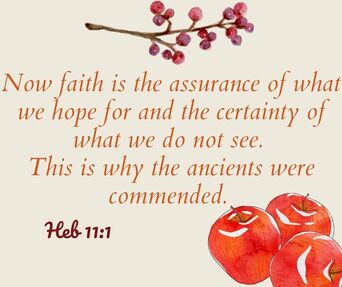
pístis (from peithô, "persuade, be persuaded") – properly, persuasion (be persuaded, come to trust); 
​
faith.
​

    There she was: disheveled, dirty, her hair flying raggedly in the breeze.  She just wouldn't leave them alone.  It felt so frustrating. 
     And there was Jesus just ahead, moving silently along the road, each footstep raising small clouds of dust in the wind.  He was still ignoring her, his silence dramatically different from the crowd and marked by the absence of the slurs and racial epithets of the throng. Of course,  as a rabbi Peter wouldn't have expected any less of Him.  Esteemed rabbis didn't even speak to their own wives in public, but she was a Gentile woman. Jesus' toleration of her insolence without rebuke was angering.  
   Moving through the Gentile areas of what had once belonged to the Chosen People under King Solomon, and still yet was their inheritance by God, they were now walking in the region of Tyre and Sidon. Simon cringed again as she called out, her incessant voice rasping with overuse: “Lord, Son of David, have mercy on me! My daughter is miserably possessed by a demon.”
    Unclean, defiled-- in so many ways.  Like the small street dogs that ranged through the villages, rolling in excrement, eating rotting food. Every kind of Gentile sin marked her from her clothing and jewelry to her lack of a veil, with not even an attempt at keeping the Jewish law given them from God.  How dare she come now in all her perversity and call out the Messianic name of Jesus!  "Son of David"--The Jews' Messiah!  The anger and frustration kept mounting.  

     And still Jesus did not answer a word.

    Feeling a tap on his shoulder, Simon turned to face James and John.  Their eyes sparked as they leaned in to be heard above the crowd: "Peter, you tell Him!  He will listen to you!  You're the one he said had some faith for coming to Him on the water last week. If he listens to anyone, it will be you." 
    Simon wasn't so sure.  A wave of doubt washed over him.  He could clearly remember that stormy night, when he had yelled across the crash of the waves: he had challenged Jesus to tell him to come to Him on the water--if it was really Him.  Even after being invited, even after stepping closer and closer, he had still doubted and failed. 
  Swallowing nervously, Simon summoned his courage and caught up to Jesus, matching his long strides with Jesus' own.  "Master, send her away, for she keeps crying out after us.”         The look came into Jesus' eyes then, a look Simon had grown all too familiar with: a mixture of pain, sorrow, anger and incredulity.   A wave of guilt and shame washed over Simon as a memory came suddenly back to him. A memory of the Master, just yesterday, with them in the field.  Eating the grain. They'd been hungry, and there had been no food.  They'd been sleeping outdoors every night on their way that week.  They themselves had been dirty--it had been a full week since they've had even a foot wash.
    The Pharisees had come and watched them in disgust.  They had demanded that the Master rebuke Simon and the others for not having washed their hands first--they were defiled, unclean. They could be banned from worship at the Temple and synagogues for breaking the rules. 
   Jesus' face had carried that same look then as He had rebuked the Pharisees: “Don’t you see that whatever enters the mouth goes into the stomach and then out of the body? But the things that come out of a person’s mouth come from the heart, and these defile them. For out of the heart come evil thoughts—murder, adultery, sexual immorality, theft, false testimony, slander. These are what defile a person; but eating with unwashed hands does not defile them.” 
   Tight-lipped, Jesus turned away from Simon without responding. Turning and looking toward the woman, her tears trailing in salt down her dirty cheeks, he called out to her, “I was sent only to the lost sheep of the house of Israel.”
    Simon could see the waves of first pain, desperation and then determination spread over the woman's face. 
    The woman came to Jesus. The crowd fell deathly silent.  Simon could hear the breeze whistling through the shrubs behind them. Kneeling before Jesus in the dirt, she demanded persistently, “Lord, help me!” 
     All eyes followed the speakers back and forth, breaths held in.  Jesus looked up from the woman at the crowd.  Looking at Simon, the Master replied to the woman: “It is not right to take the children’s bread and toss it to the dogs.”
     Pain welled up in Simon's heart at His words.  That's exactly what he had asked for. It's how he had felt.  It just sounded so terribly callous coming from the Master's mouth. The desperation in the woman's face flashed back to his mind.      But undaunted the woman was speaking again, lowering herself to even the worst of insults, lowering her body yet further to the ground: “Yes, Lord,” she said, “but even the dogs eat the crumbs that fall from their master’s table.”
    Jesus' face broke into a wide grin as He threw back His head and laughed, His expression exultant: “O woman, your faith is great! Let it be done for you as you desire.” 
   Simon watched her face, now radiantly beautiful as she stood shakily to her feet, thanking the Master profusely before running off into the distance.

   "Your faith is great," Jesus had said. Incredibly, Simon realized with a sudden understanding, it had taken a greater faith to come to Jesus through a hostile crowd, facing the shame and insults, than to walk on water after being invited to come!  Simon had thought he had passed such a great test--doing the impossible, walking on the water. 
​   But the greater honor of a larger test had been reserved for this Gentile woman.  She had believed after being rejected and reviled. She had pursued Jesus after being turned away.  Simon's test had won him some modicum of respect among the disciples, but the woman's faith was one that brought redemption and healing to her household, transforming her very nature through one radical word from the Master.   

"And her daughter was healed at that very moment."
​Matt 15:28

Great Faith
chooses suffering, disgrace, and pilgrimage to seek and find Jesus

​

Picture
   In so many ways, this concept drives counter to what we hope for in life.  I don't know about you, but I have always craved peace, security, stability, warmth, good food, the respect of my friends and family, and a home to delight in.  I'm sure this woman desired all of these as well With the Syro-Phoenician woman, however, it was undoubtedly her great love for her daughter that gave her the motivation to choose this painful and rewarding path.
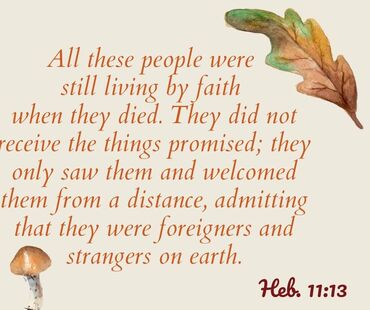
     As we read In Hebrews chapter 11, we see a long chapter full of faith elders, heroes of the faith, both men and women, who are the "great cloud of witnesses" who have gone before us.  They witness to the transformation and salvation of lives through supernatural faith in God through Jesus.  In reading through the list, we see many examples of exciting faith adventures of which many of us are all too familiar--Abraham and Sarah, Moses, Noah, Joseph, Rahab and so many others. 
    Some stories, more than others, seem victorious and glorious, full of honor and heroism, and marked by a rise to wealth and power.  Others not so much.  If we read through some of their stories in the Old Testament, though, we come to find that suffering, disgrace and pilgrimage mark all of their stories in painful and profound ways. 
    Abraham, the first pilgrim, was called an "Ibri," (a Hebrew) because it means to "pass over," referring to the River that he had to pass over from his old life into a new life.  He went from a stable home, a planned future, and of pursuing whatever his appetites wanted to wandering as a stranger in a foreign land, totally reliant on God's protection and provision. 
   Moses too, had to "pass over" the Red Sea, rejecting the old life of promised and planned power in the kingdom of Pharaoh, and choosing instead to "suffer disgrace with God's people" (v. 25).
     For true Israelites, those that are Israelites through faith and not through physical descent (Rom. 3:28-30), we must all "pass over" from death into life, from our old way of seeking empty appetites, to a new life of being continuously satisfied in God, from enjoying "the pleasure of sin for a season (Heb. 11:25), to choosing rather to suffer disgrace and a metaphorical "homelessness" that comes with being a follower of Jesus, who "had no place to lay his head" (Matt. 8:20).

Picture
    The Apostles Paul urges us in this way, "What I mean, brothers and sisters, is that the time is short. From now on those who have wives should live as if they do not; those who mourn, as if they did not; those who are happy, as if they were not; those who buy something, as if it were not theirs to keep; those who use the things of the world, as if not engrossed in them. For this world in its present form is passing away" (1 Corinthians 7:29-31). 
    Paul is not saying that we should necessarily leave these things physically, but that each of them should be dedicated to the Lord's use in a way that He may have full control over our hearts and choices.  We should be free to serve the Lord without being entangled with items.  
​

Great Faith
​is unafraid and unhindered by the power and scorn of others

​

Picture
     Have you ever had a time where you were praying for something you knew was in the will of God, and yet saw no answers?  I certainly have.  In fact, many of the larger answers to prayer in my life have been after years of praying--fervently.  And still I have many others that I am still waiting on--and praying for.  
    God is a good father.  Not only does He want to give us good things, He also knows the best timing for these gifts.  Many times the ways or means that we would have chosen are not the best, and don't accomplish as full or complete a victory as God would desire for us. 
    Often too, the things we would choose to accomplish our goals--in our lives, in our spouse's, friends' or children's lives--are not actually building but rather shortcutting the system that the Lord is using to build that character quality into our lives.  More and more now I pray for not a specific action from God, though I do still ask for those, but rather specific character qualities and transformation in our souls, and leave just how He wants to do that to God Himself.  
     Usually, there are these same obstacles in our way:  people of influence or power that could make our lives harder (Pharaoh, King Herod, Pilate--a boss, a co-worker, a spouse or child).  They have a semblance of power over us because they can make manipulative or derogatory remarks.  They may have the power to slander or gossip about us to others.  Perhaps they may sabotage our efforts, or make our work more difficult. Even worse, sometimes they may try to physically or emotionally abuse us, like the demon did to the Syro-Phoenician's daughter.  
     But when we know that our all-powerful God can transform and change our lives, bring healing and restoration and save us from all evil, the ugly power that tries to block our efforts to reach the Lord becomes a small problem that the Master can easily choose to override.  This is what the woman knew about Jesus.  
    Jesus put it this way: “So do not be afraid of them, for there is nothing concealed that will not be disclosed, or hidden that will not be made known. What I tell you in the dark, speak in the daylight; what is whispered in your ear, proclaim from the roofs. Do not be afraid of those who kill the body but cannot kill the soul. Rather, be afraid of the One who can destroy both soul and body in hell. Are not two sparrows sold for a penny? Yet not one of them will fall to the ground outside your Father’s care. And even the very hairs of your head are all numbered. So don’t be afraid; you are worth more than many sparrows. (Matt. 10:26-31) 
​

Great Faith
perseveres because we see the nature of the invisible God through spiritual eyes
​

Picture

    In chapter 9, the sinful and forgiven tax collector Matthew gives us a crucial clue into Jesus' purpose in ministry: to show mercy and give healing and cleansing to the heart-sick, regardless of their outward appearance and physical birth or works: 

    While Jesus was having dinner at Matthew’s house, many tax collectors and sinners came and ate with him and his disciples. When the Pharisees saw this, they asked his disciples, “Why does your teacher eat with tax collectors and sinners?” On hearing this, Jesus said, “It is not the healthy who need a doctor, but the sick. But go and learn what this means: ‘I desire mercy, not sacrifice.’  For I have not come to call the righteous, but sinners” (Matt 9:10-13).
     In fact, Matthew doesn't reflect on Jesus' Old Testament quote once, but twice.  In the passage of chapter 12, where the Pharisees are condemning the disciples for eating on the poor person's gathering of grain from the field on the Sabbath, Jesus once again quotes this phrase: "If you had known what these words mean, ‘I desire mercy, not sacrifice,’ you would not have condemned the innocent."  Matt 12:7
     A commonly used literary device in both the Old and New Testaments, as well as being commonly used in other ancient documents, is that of chiasm:  To build arguments and themes underscoring and leading to establish a main idea, and then retracing that point back with symmetrical arguments and themes to the conclusion. 
    In the book of Matthew, Jesus' teaching on defilement coupled with the visual demonstration of the Syro-Phoenician woman is at the very point of the chiasmic theme of the entire gospel:  Defilement and faith are a matter of the heart, not the outward appearance, and Jesus is here to heal and cleanse anyone who comes to Him in persevering faith.  

     This woman knew something in the very core of her being about Jesus that not even His disciples had fully comprehended:  That He was merciful and compassionate to all who sought Him. I don't really understand how she knew this.  Her genuine certainty that the Lord would help her goes past my own experience. 
     My experience is much more like Peter's: growing up in a Godly household, I have lived my whole life knowing that I was invited.  Stepping out on the water with Jesus in life's scary situations seems huge already to me. 
    But believing that He cares and hears and will answer my prayers when He seems to be ignoring me--and most especially when I hear the voice of the enemy telling me how unworthy I am, how my failure as a wife, a mother, a friend, a minister, has disqualified me from His help--those are the times when it is hardest to persevere and believe that He will help me.  
     But as we get to know Him intimately through His word, through prayer and conversations, through listening to His voice and receiving His good and gracious gifts, the more we get to know His true nature: that He never leaves or forsakes us; that He is full of compassion, gracious and abounding in mercy; and that He has "plans to prosper and not to harm us, plans to give us hope and a future" (Jer. 29:11).  Based on our relationship with Him, we can know that we will be heard.  
    As you and I grow in maturity in the Lord, we will find that our relationship with the Lord determines what we believe of Him rather than the circumstances surrounding our requests.  We will place less confidence in what we can see with our eyes and more in what we can see with our spirits:  That God is continuously working all things for our good (Rom 8:28).

Great Faith
welcomes the sanctifying and healing Spirit of God over our households
​

Picture
    When Jesus had given her the word, she got up and went home because she knew that her prayer was answered and her daughter was healed without having yet seen it.  We never see her again in the gospels. 
   But we have a clue about the result of her encounter with Jesus.  Her daughter was healed by the Lord as a result of her desire: a desire which mirrored the Lord's desire for them.
    Contrary to what seemed to be, the Lord Himself desired to give her compassion, mercy, relationship and wholeness. Her very faith, the inbirthed persuasion given to her from the Lord, enabled her to desire what the Lord Himself desired for her and for her daughter.  
     When we walk in faith because we love others like He loves, then we will desire the very things that He desires for them, because through faith our inner nature is transformed to become like His.  So we may boldly come to His throne in our time of need in order to receive His mercy and grace for our needs, knowing with confidence that He hears us (Heb. 4:16).  
   What situation do you face today that requires a faith from God that defies your situation?  What steps will you take to seek God against all odds?  


You need to persevere so
that when you have done the will of God,
you will receive what he has promised.
  For,

“In just a little while,
    he who is coming will come
    and will not delay.”

 And,

“But my righteous one will live by faith.
    And I take no pleasure
    in the one who shrinks back.”

 But we do not belong to those who shrink back and are destroyed, but to those who have faith and are saved.
​(Heb. 10:37-39)


0 Comments

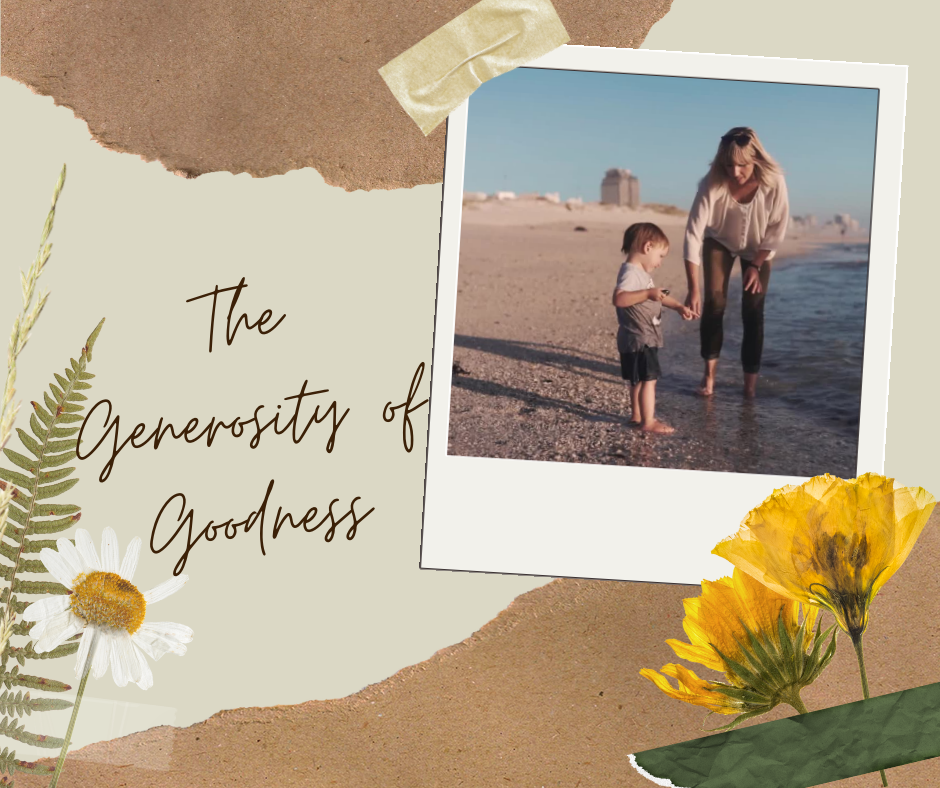
The Generosity of Goodness

10/10/2021

1 Comment

 
Picture

agathós – inherently (intrinsically) good;
goodness in a believer’s life describes what 
originates from God and is 
empowered by Him in their life, through faith,
​by participating in the divine nature of Christ.
 ​

     Shaul pulled his tunic over his head, his arms leaden, and his heart heavy.  His empty stomach cramped with hunger. Opening the woven reed basket, Shaul pulled out the last piece of bread and placed it on the table.  Looking over at his wife and children, still sleeping on the floor and huddling together for warmth, he walked over to them, crouched down, and pulled their blanket just a little higher.  The days were getting shorter, and the nights chillier.  Winter would soon be coming, but without work there would be no food.   
     Closing the door of their home softly behind him, he briskly started his daily walk to the marketplace.  Every day it had been the same.  He had waited all day long for work, but it was always someone else who was hired.  A sickening feeling of desperation washed over him as he thought about going home empty handed yet again.
   
  As 
Shaul reached the crowded marketplace, the workers for hire section teemed with jobless men pressing forward. Straining to see who they were reaching toward, he saw the man get down from the cart—tall, well dressed in fine robes with rings on his fingers.  His hair and beard were perfectly trimmed, and his eyes shone with health and vigor.   
    “A denarius to work in my vineyard today!  I need ten men,” the master called out. Men surged forward into the cart, filling it before 
Shaul had time to process the information.  A denarius would last him a week with his family!1 It was too good to be true—and now he was too late.  In spite of himself, he could feel tears painfully welling up as he watched the cart jostle its way out of the marketplace and out to the rolling countryside.   
     
Shaul.  His mother had named him appropriately.  It meant to ask, beg—even to demand of God.  Always last, always waiting.  Like one untimely born.  He had been doing nothing but that since he had lost his job last year.  And today it had been all three in turns: his angry, frustrated, and pain-filled soul cries silently pleading with a God who didn’t seem to hear.
   
As the day wore on, the master of the vineyard returned again and again, and each time 
Shaul was unable to get to the cart first.  The master had changed his agreement these later times: “Whatever is right I will give you,” he kept saying.  Around him, the marketplace workers emptied, while he and just a few others waited through the day, hungry and tired. 
     The sun was close to going down. The eleventh hour.  There would be no more work today.  
Shaul turned, defeated, to go home. And then he heard the cart behind him, creaking one more time on the uneven stones. Shaul turned back to see the master sitting on the cart.
     Looking down at 
Sha’al, he asked the remaining men, “why have you remained standing here all day?”  “Because no one has hired us,”
Shaul responded, hope rising achingly in his heart. Whatever he received, it might be enough to bring home food for dinner. The master replied, ”You also come work in my vineyard, and whatever is right you will receive.”


********************************** 
   
Shaul pulled out the silver coin again, fingering it wonderingly.  A denarius.  A denarius for only an hour of work.  An hour for a week’s worth of food!  It was crazy.  There was no way that the master could make enough profit with generosity like that.  It was too good.
   But when the first workers had seen how generous the master had been, they had been angry, 
assuming that they should receive more.  
Shaul would never forget the master’s response: “Friend, I am doing you no wrong. Did you not agree with me for a denarius? Take what is yours and go your way.” The master had looked at Shaul then: “I wish to give to this last man the same as to you. Is it not lawful for me to do what I wish with my own things? Or is your eye evil because I am good?”
   
 
Putting the coin back into his bag, 
Shaul​ reached for the door of his home, the sound of little running feet reaching his ears, and “Daddy’s home!” filling his heart with joy.


Adapted from Matt 20:1-16 

Picture
     Goodness.  God is good. An inherent, interior state of goodness that permeates the entire being of only One.    
     There is only One who is good originally, whose outflow of goodness permeates the universe and affects all who exist in it.  God gives to all generously (James 1:5).  Everything good is a gift from Him, and He never changes in giving good gifts to mankind. (James 1:17)  
      What is more, this goodness of God is given without partiality to both the evil and the righteous, because the intrinsic nature of God’s goodness overflows at all times to all (Matt. 5:45), regardless of another person’s actions. True goodness is not something that is a trade or a compensurate relationship—it is a gift given regardless of service rendered and not because of an obligation.  
     In the generosity of goodness in a service relationship, it is a gift that so far exceeds the service of another that it nullifies the obligatory value of the rendered work.  In other words, even when we serve God back, there is no way that His goodness is an obligation to us, because it far outweighs whatever we could possibly give Him!
 

     This goodness of the nature of God had to be without favoritism, because not one of us could have ever deserved or earned His favor and gifts!  Not one of us was righteous, not one of us did good, because our inner nature was overcome by sin. Try as we might, inevitably our gifts were still given with mixed motivations of perceived benefit to ourselves.   
     But God’s not like that.  Instead, while we were completely caught up and dead in our sins, that is when God gave the perfectly good gift of His Son.  A gift that couldn’t be repaid, couldn’t be earned, and couldn’t be demanded:  
 

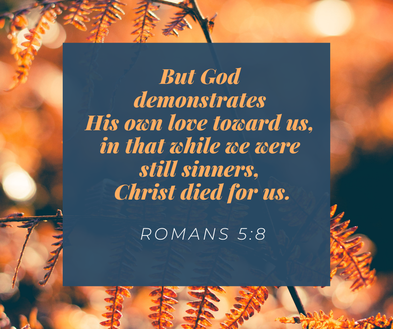
For when we were still without strength, in due time Christ died for the ungodly. For scarcely for a righteous man will one die; yet perhaps for a good man (or cause) someone would even dare to die. But God demonstrates His own love toward us, in that while we were still sinners, Christ died for us. Romans 5:6-8 ​

     The only way we can be good is to become part of Jesus through faith.  He changes our inner being through a rebirth in the Holy Spirit to become part of His divine nature as we remain in Him.  It is only then that the fruit of God’s goodness through us will become a natural and increasing outflow of the inner change that has happened intrinsically in our hearts, and originated from God Himself.     
     But we have a choice.  We can take the blessing and undeserved favor of God, and spend it only on ourselves, refusing to allow God’s goodness to change us and remake us through His Spirit.   
    This is the choice a young ruler made.  He wanted eternal life, and he saw the goodness of God in Jesus.  He wanted that goodness for himself, but the radical heart change necessary to have it didn’t seem worth it in his temporarily focused mind:  

 ​

Now as He was going out on the road, one came running,
knelt before Him, and asked Him,
Good Teacher, what shall I do that I may inherit eternal life?” 
18So Jesus said to him, “Why do you call Me good? No one is good but One, that is, God. 19You know the commandments: ‘Do not commit adultery,’ ‘Do not murder,’ ‘Do not steal,’ ‘Do not bear false witness,’ ‘Do not defraud,’ ‘Honor your father and your mother.’” 
20And he answered and said to Him, “Teacher, all these things I have kept from my youth.” 
21Then Jesus, looking at him, loved him, and said to him, “One thing you lack: Go your way, sell whatever you have and give to the poor, and you will have treasure in heaven; and come, take up the cross, and follow Me.” 
22But he was sad at this word, and went away sorrowful,
​for he had great possessions. 
Mark 10:18-22 
 
​

    The rich young ruler was sad, for he was not good.  He did not have that inherent goodness that desires to give to all richly and generously, regardless of their status or ability to give back.  Instead, what he possessed was a self-originated righteousness that would never be enough.  At Jesus’ words, he realized the choice he would need to make: he counted what he thought was the cost, and decided that retaining what he had for himself was worth more than becoming a child of God for eternity.   
     He thought Jesus was asking him to pay for eternal life.  He thought that it would cost him all he had and that he would be left impoverished. He didn’t understand the paradox of generosity that to give away is to receive (Acts 20:35).  Jesus wasn't asking anything for himself from the man--Jesus was pointing out the difference between the goodness the ruler thought he possessed in his following of the commandments against the goodness of others' living that summed up Jesus' own intrinsic goodness. Jesus emphasized this paradox of participating in His goodness in this way:  
 ​

Then Jesus said to His disciples, “If anyone desires to come after Me, let him deny himself, and take up his cross, and follow Me. 25For whoever desires to save his life will lose it, but whoever loses his life for My sake will find it. 26For what profit is it to a man if he gains the whole world, and loses his own soul? Or what will a man give in exchange for his soul? 27For the Son of Man will come in the glory of His Father with His angels, and then He will reward each according to his works.” Matt 16:24-27 ​

Picture
     It’s a paradox—that what seems like losing our lives for Christ and for others will result in the greatest over-flowing, abundant, lavish and inexhaustible richness to life that could never be found any other way!  God’s goodness is generous---He always gives more than we could ever give away!   
    Generosity has the idea of liberality, lavishness, and magnanimity. It is open-handedness, unselfish, and indulgent.  It is prodigal in its nature.  It is plentiful, large, abundant, ample, profuse, and opulent in its richness.   
    In Malachi 3:10, God holds out His hands to His people, then stingy and stinting, pleading with them to test His goodness and generosity to them by giving willingly and cheerfully to the needs of others through trust in His ability to more than amply care for them: “...Test me in this,” says the LORD Almighty, “and see if I will not throw open the floodgates of heaven and pour out so much blessing that there will not be room enough to store it.” 
    God’s generosity cannot be outgiven.  Rather, we show our trust in His unfailingly good generosity by our response—that of freely giving what we have freely been given (Matt. 10:8).  God’s generous goodness may seem like it costs us as we give away freely of ourselves, but in reality it lavishly pours into us as we pour out His goodness out of our new rebirth in Christ.

     Maybe this kind of intrinsic goodness, the kind that seeks no benefit to oneself, seems outside your reach.  Maybe you always thought you were a “good” person, but find that each of your motivations for being good lead back to yourself: Our reasons for being friendly to certain people that we think more able to return our friendship; Working hard for a good employer to earn their praise or appreciation; Serving our children so that they will be happy and love us back; being sweet and giving gifts in a romantic relationship.   
     Even trying to earn eternal life by following all the rules or doing all the good things is still self-motivated and completely useless in generating the eternal life and transformation that only Christ can give.   
     If you find yourself in this position where, like the rich young ruler your good deeds are not really good, but just efforts made ultimately for yourself--if you say, ‘I am rich; I have acquired wealth and do not need a thing,” but you do not realize that you are wretched, pitiful, poor, blind and naked,” because your efforts at goodness cannot cover your need, then Jesus counsels you to come to Him so that you can become rich; to receive from Him “white clothes to wear, so you can cover your shameful nakedness, and salve to put on your eyes, so you can see” (Rev. 3:17-18).  Receive the transformational gift of rebirth through Jesus, and let His goodness permeate your whole spirit!
     Out of our new and transformed spirit in Christ, His Spirit then begins to show us those ways in which our motivations do not align with His. I find myself there sometimes when I want to do a good thing—and then find my motivations to be self-centered. If we really let Him examine our heart motivations, we easily find that, while not wrong or evil, many of these actions certainly cannot fall into the true definition of generous goodness that is completely unself-oriented.   
     Today, as we listen to the Holy Spirit and let Him examine our hidden motivations, let’s ask for God’s goodness to transform our motivations from within.  Let’s ask for His goodness to flow out of us to those who will never deserve it: to all those to whom we can give without expecting anything back.   
    And when we serve with His goodness, let’s remember it’s only for an hour.  His favor lasts a lifetime of eternity.  ​
1Halverson, T. (2020, March 14). Was the denarius a daily wage? A note on the parable of the two debtors in luke 7:40–43: The Interpreter Foundation. The Interpreter Foundation | Increasing understanding of scripture one article at a time. Retrieved October 5, 2021, from https://journal.interpreterfoundation.org/was-the-denarius-a-daily-wage-a-note-on-the-parable-of-the-two-debtors-in-luke-740-43/. ​
1 Comment

The Saving Work of Kindness

9/22/2021

0 Comments

 
Picture

xrēstótēs 
​ "useful, profitable") kindness that is also serviceable; ("useful kindness") refers to meeting real needs, in God's way, in His timing (fashion).

   The traveler stopped in his tracks, staring.  Pushing his donkey back, he assessed the situation quickly.  The man’s inert body lay there, blood pooling in the dry, dusty road.  His bruises, laying claim to every area of his body, had taken on rich shades of purple and blue.  His dry, parched lips were cracked and lacerated. 
     A conflict of emotions broiled inwardly as the traveler debated his choice.  He could walk away now--others certainly had.  Despised and rejected, abused and mocked by the very man who lay before him, the traveler had every reason to walk on.  But the more he looked at the injured man, the greater the compassion that welled up inside of him.  In an instant he made a choice. 
   Striding quickly over to the man, the traveler led his protesting donkey forward. Reaching into his saddlebags to take out his oil flask and wine skin, he knelt down poured first the cleansing wine and then the soothing oil generously over the wounds. He then quickly tore pieces of cloth from his own tunic to bind the man’s still spilling blood. Finally, taking off his outer tunic, he covered the man's stripped body.  Bracing himself, he gently lifted up the wounded man’s body and laid him over his own donkey.
    They would need a place to sleep.  While alone the traveler may have saved money sleeping outside.  But there was no way this man could survive in the cold desert night air.  Making a decision, the traveler led the donkey the few miles left to the nearest inn. The host greeted him, taking instant stock of the situation. 
     The night was long, and many times the traveler had to get up and care for the moaning man, giving him drinks of water, changing his bandages, checking on his wounds.  Feverish and delirious, it took all his energy to help the man pull through the fever.  The traveler looked wearily for the rising of the sun, anxious for a respite. 
     At daybreak, the fever broke, and the injured man began to sleep the deep and unbroken sleep of one who is healing. Exhausted, the traveler packed up his few belongings.  Stepping out of the dark room, he blinked wearily, his eyes bloodshot and smarting. 
      Looking around, he found the innkeeper. Pulling out his bag of coins, he quickly counted what he had available.  Two days’ worth of work.  It had been enough to last him for eight days of traveling food.  But even this wouldn’t be enough to care for the extensive injuries and extended stay.  There was no other way around it, however. 
    Handing over the money, he gave instructions for the care and healing of the Jewish man.  He gave the innkeeper assurances of further payment for costs that might be incurred before his return.
   As he turned away and walked out of the inn, his stomach empty and protesting, he pulled himself up onto his donkey and turned her home—home to Samaria.            

​Adaption of Luke 10:25-37

At one time we too were foolish, disobedient, deceived and enslaved by all kinds of passions and pleasures. We lived in malice and envy, being hated and hating one another. But when the kindness and love of God our Savior appeared, He saved us, not because of righteous things we had done, but because of his mercy. He saved us through the washing of rebirth and renewal by the Holy Spirit, whom He poured out on us generously through Jesus Christ our Savior, so that, having been justified by his grace, we might become heirs having the hope of eternal life. This is a trustworthy saying. And I want you to stress these things, so that those who have trusted in God may be careful to devote themselves to doing what is good. These things are excellent and profitable for everyone. Titus 3:3-8
Picture
    What is kindness?  It has always baffled me a bit.  Kindness, goodness…gentleness.  It all seems like kind of the same thing.  To me, kindness seemed like being polite in the grocery checkout line.  Kindness was a hug when a friend was down.
       But kindness is so much more than that.  In fact, I would say now that kindness is a fruit of the Spirit that cannot be lived out without the grace of God through the help of the Holy Spirit. 
       Kindness, according to Strong’s, is a useful fruit of the Spirit that truly takes care of the real needs of others. Kindness meets “real needs, in God’s way, in His timing.” 
       Kindness, as we enter into the Divine nature of God, always calls us to a measure of giving that is more than we feel we have to give.  It asks us to go beyond the simple to the extraordinary, from the natural to the supernatural.  It demands that we give to people what they truly need, even when it isn’t what they want, and to give without being paid back. 
    We used to be difficult to show kindness to.  Our attitudes, our actions, our expressions—all were focused on self-gratification and pleasure.  This overflowed out of our sinful hearts to others, on others, abusing, hurting, and creating schisms in our relationships. 

Picture


Kindness leads to repentance

Picture
     ​Praise God, He didn’t leave us in our mess!  God reached to meet our needs when we were still His hostile enemies.  He didn’t wait for us to clean up, shape up, or fix up ourselves.  He knew we had no power or strength to do that without His Spirit. So He joined us in the middle of our mess, and made a way out for us. 
     He poured on the cleansing wine to sanctify and make us holy through the cleansing power of the Holy Spirit.  He generously poured on the healing oil to make us whole and complete again through the comforting power of the Holy Spirit.  He covered our shame with His own robe of rightousness:  

For when we were still without strength, in due time Christ died for the ungodly. For scarcely for a righteous man will one die; yet perhaps for a good [man/cause] someone would even dare to die. But God demonstrates His own love toward us, in that while we were still sinners, Christ died for us. Much more then, having now been justified by His blood, we shall be saved from wrath through Him. For if when we were enemies we were reconciled to God through the death of His Son, much more, having been reconciled, we shall be saved by His life. Rom. 5:6-10
     As much, though, as God came down into our mess, God’s kindness was never intended to leave us in our mess.  God’s kindness is intended to bring repentance—a complete change of heart and mind to think like God thinks, to take action like He acts:
​Don’t you see how wonderfully kind, tolerant, and patient God is with you?
​Does this mean nothing to you?
Can’t you see that his kindness is intended to turn you from your sin?
Rom. 2:4 NLT
     If we stay in our sin and refuse to extend kindness to others, but instead rely on our old patterns of selfishness and self-gratification, then we are despising rather than entering into the kindness of God for salvation.  If we simply say to ourselves, “sure, I’d love to have free salvation,” but never repent, we become like the filthy clad man invited to the wedding in Jesus’ parable, who wanted eternal life without repentance and Christ’s righteousness.  If we tear off His tunic and reject His gift of righteousness through His blood, then we are still left in our own shame.
     Before we can enter into the power of the Spirit to change our behavior, we need to first enter into repentance, which includes a life and mindset change to agree with God about our behaviors and our need for a complete change of spirit--a new creation.  Only then can we cooperate with the Spirit’s sanctifying and cleansing power in our lives to enable us to overflow in good works of kindness to others at all times:
Therefore, if anyone cleanses himself from what is dishonorable, he will be a vessel for honorable use, set apart as holy, useful to the master of the house, ready for every good work. 2 Tim. 2:21 ESV
Picture

People without Jesus need kindness

.    Kindness calls us to care for those who don’t deserve our care, or even have purposefully acted in evil ways against us. These attributes of foolishness, disobedience, malice, envy and hate are all great indicators of the need of a person, once in days gone by the very attributes of our own perverted identity, are tell-tale signs of to whom we should extend kindness. 
      It is to these that Christ Jesus calls us to overflow with Divine kindness to meet their needs:
“You have heard that it was said, ‘You shall love your neighbor and hate your enemy.’ But I say to you, love your enemies, bless those who curse you, do good to those who hate you, and pray for those who spitefully use you and persecute you, that you may be sons of your Father in heaven; for He makes His sun rise on the evil and on the good, and sends rain on the just and on the unjust. For if you love those who love you, what reward have you? Do not even the tax collectors do the same? And if you greet your brethren only, what do you do more than others? Do not even the tax collectors do so? Therefore you shall be perfect, just as your Father in heaven is perfect. Matt. 5:44-48
     It’s likely that we won’t need to search very far to find people that are difficult, that are unkind to us, and that require supernatural grace for us to meet their needs in love and sincerity.  We may not even have to walk outside our homes.  Perhaps during Covid shut-ins, even extending kindness to our family members or extended relatives seemed like an out-of-reach impossibility.  Maybe being kind to other church members who see pandemic responses or political viewpoints differently than we do may seem like a stretch past the reasonable imagination. 
     But Jesus calls us to an extreme:  that, like our Heavenly Father, we actively look for and meet the needs of not just those we like or care for, but anyone down to the most vengeful enemy.  That person that refuses to wear a mask down the aisle.  The man who lied about us to take over our place in the company.  The woman who gossiped about us and caused us to lose precious friendships.  The spouse who refuses to take responsibility for their family. 
     When we feel that people are mistreating us, we should remember that it is precisely those wrong actions that we used to practice in our own past.  Rather than practice avoidance of those people, perhaps we should look at their actions as indications of a need that God would like us to fill. 
     Sometimes, instead of simply walking away, we can pray that God would open our eyes to ways that a particular person may need something that we can care for.  It might be an encouraging note, or a meal.  Maybe they need a bill paid, or a ride.  They could be overwhelmed with homework with their child and might need some tutoring. 
     Above all, they need to hear of the hope and kindness of Jesus to save them from their hurtful cycles of sin and to meet their needs with His own Divine kindness.  
Picture

We have an abundance for meeting people’s
true needs with kindness

Picture
     I don’t know about you, but this doesn’t usually feel true.  Often I start the day tired and overwhelmed with needs just from my own family and work.  The process of caring for the needs of others we don’t even feel a natural affection for may sound like it extends past our natural resources.  And this is absolutely true.
     The kindness and actions that God calls us to are past our natural resources.  This form of kindness requires us to rely on the all-sufficiency of God to multiply our resources of time, energy, love and finances to fill the needs around us.
    It’s not natural, it’s Divine:  

As His divine power has given to us all things that pertain to life and godliness, through the knowledge of Him who called us by glory and virtue.
2 Peter 1:3
 
   Let’s ask God today to give us eyes to see the wounded. To deepen our love for others. To multiply our time, energy and resources. To give us opportunities to show kindness to those who need it. 
    Today, let’s pour the wine and oil. Today, let’s bind their wounds.  Today, let’s point them to Jesus’ gift of righteousness.
     Today, let’s overflow. ​
0 Comments

The Completing Work of Patience

8/26/2021

0 Comments

 
Picture

     King Belshazzar stood trembling violently, his face ashen, his finger pointing eerily to the wall. He stared at the handwriting where, just moments ago the letters, large and imposing, had been etched into the plaster. 
     All night long they had feasted, Belshazzar with his nobles, his wives and concubines. A thousand and more, drinking, celebrating the vastness of the empire over which he ruled.  As they drank, it had come to him…he should toast the gods who had given him this success! He could earn their continued favor, and what better way to do that than with the goblets from the temple of the God they had conquered! 
     He had ordered that they bring out the golden goblets, and he and his thousand nobles had praised the gods of gold, silver, bronze, iron, wood and stone, and offered them tribute—perhaps they would receive this work and grant him more favor and complete his kingdom.

    Suddenly, the fingers of a hand had appeared and written on the wall while Belshazzar watched, his stomach churning and his face draining of its blood. 
     No one could tell him what the words even meant.  The queen had suggested a man, Daniel, a Jew.  She said he had the spirit of the holy gods residing in him.  She said he was insightful, intelligent, and wise as the gods.  That he possessed the power to understand deep puzzles and riddles, and to interpret dreams. 
     And now, there the man stood: confident, quiet, and filled with the wisdom of the aged.  Then Daniel answered the king, “You may keep your gifts for yourself and give your rewards to someone else. Nevertheless, I will read the writing for the king and tell him what it means.
  “Your Majesty, the Most High God gave your father Nebuchadnezzar sovereignty and greatness and glory and splendor. Because of the high position he gave him, all the nations and peoples of every language dreaded and feared him. Those the king wanted to put to death, he put to death; those he wanted to spare, he spared; those he wanted to promote, he promoted; and those he wanted to humble, he humbled. But when his heart became arrogant and hardened with pride, he was deposed from his royal throne and stripped of his glory. He was driven away from people and given the mind of an animal; he lived with the wild donkeys and ate grass like the ox; and his body was drenched with the dew of heaven, until he acknowledged that the Most High God is sovereign over all kingdoms on earth and sets over them anyone he wishes.
      “But you, Belshazzar, his son, have not humbled yourself, though you knew all this. Instead, you have set yourself up against the Lord of heaven. You had the goblets from his temple brought to you, and you and your nobles, your wives and your concubines drank wine from them. You praised the gods of silver and gold, of bronze, iron, wood and stone, which cannot see or hear or understand. But you did not honor the God who holds in his hand your very breath and owns all your ways. Therefore he sent the hand that wrote the inscription.

 “This is the inscription that was written:

                   MENE, MENE, TEKEL, PARSIN

 “Here is what these words mean:

     Mene: God has numbered the days of your reign and brought it to an end.

     Tekel: You have been weighed on the scales and found wanting.
      Peres: Your kingdom is divided and given to the Medes and Persians.”


     “Mene.”  It was fifty shekels. Fifty shekels on one side of the balances, and fifty on the other side.  “Tekel,” a shekel on the first side, but yet on the other side of the scale only an “upharsin”-divided, split—a mere half shekel.  He had come up short by just a half shekel.  No matter what he had done to please the gods, no matter the tribute he had brought, the victories he had won, the amassed wealth, power, fame and women, Belshazzar knew in that moment that he had come up short in the only test that would ever matter, in the eyes of the only One who could ever truly judge. 

    That very night Belshazzar, king of the Babylonians, was slain.   

​ὑπομονή:
A steadfast remaining in obedience under the authority of God. 
 
TThe Greek word for patience (G5281 hypomonḗ) is sometimes translated as perseverance, or endurance.  It is a cognate of two Greek words: "hypo," meaning under, often meaning "under authority" of someone working directly as a subordinate; and "Mone," which means to remain, abide, dwell, live. Together, and in a Biblical context, it means to remain or abide under the authority of God in obedience.  

​
       In the final analysis of his life, it didn’t matter how much Belshazzar worked to get favor, without Jesus he had fallen short. 
     While this is tragic, the good news is that it doesn't have to end this way!  Through the Holy Spirit that God gives us when we receive Jesus as our Savior and Lord, we can receive a precious gift that enables us to always measure up. 

     This gift is patience. 

     Patience is not merely speaking nicely to my kids when they are grabbing at my legs during dinner time.  It’s not a mere politeness of talking, or even merely waiting for something longer than I'd like. 

      Let’s take a deeper look at a passage in Scripture that tell us what it really does mean, and about the beautiful end result of this gift of patience: 
​
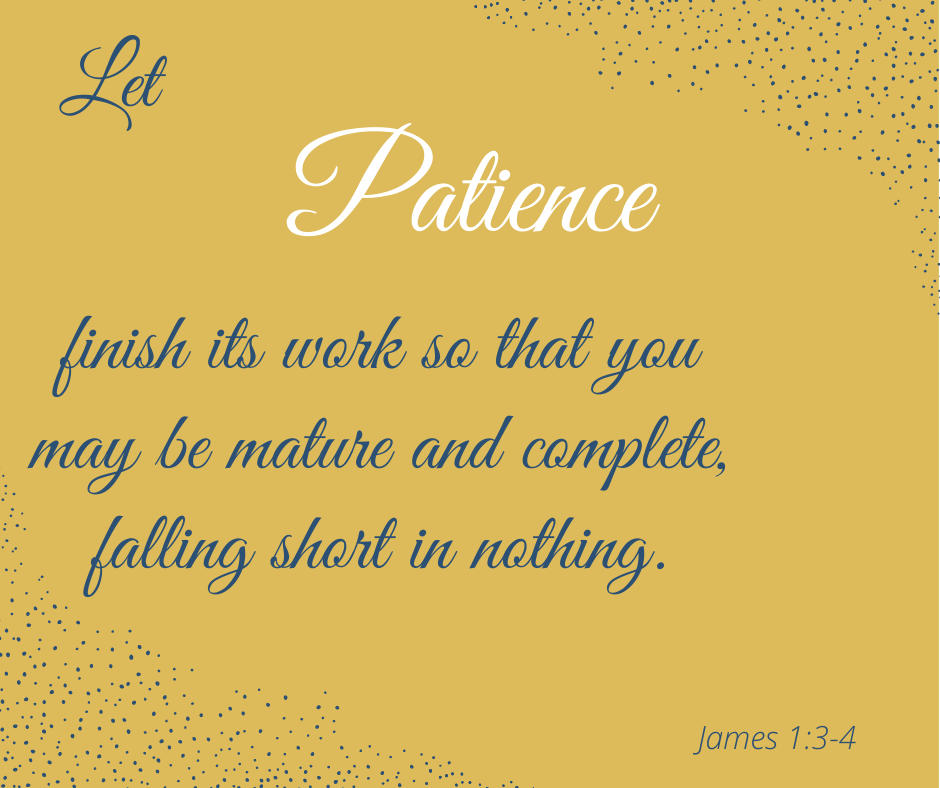
“Consider it pure joy, my brothers and sisters, whenever you face trials of many kinds, because you know that the testing of your faith produces patience. Let patience finish its work so that you may be mature and complete,
​not lacking anything.”

​ James 1:2-4

     Now, when we study translated passages, we must understand that while it is convenient and helpful to translate an ancient language word for word in English, the translation process is not and cannot be that simple.  Languages do not have a perfect word scope and definition for each word in an original language.  Instead, the range of meaning in the original word may be substituted for a range of words within the English, which is ultimately better understood with a deeper study into the meaning behind each word. 
     For instance, the Greek meaning of the word “testing” in this passage has more of the idea of a testing of the genuineness of something, perhaps of gold, or a precious stone, to see if it is real or a substituted fake, in order to obtain the approval of the expert. 
    Similarly, the words for mature and complete used in this passage, can seem repetitive or redundant in English, but a look into their Greek counterparts is anything but: “mature” comes from the same root word that we use for telescopic, and indicates a stage by stage lengthening or developing until at full capacity for usefulness, while the word for “complete” indicates a divinely appointed wholeness by allotment (the casting of the lot: used in ancient times to divide generational inheritance lands or to determine the will of God). 
     Finally, the word for “lack” denotes the idea of making choices, such as leaving behind, or abandonment, that cause one to fall short of a standard.  It applies to a race that was never completed, as well as the self-choice of an abandonment of a goal. 
​ 
Picture
     Without Christ we fall short.  When tested, we cannot meet the standards and requirements of holiness and submission to God.         With Christ, we will be found in Him, with nothing lacking in our patience endurance  sovereignty of the Lord God as we remain in submissive obedience!  

     Something that I find intriguing in my study of ancient literature, is that in ancient writings the authors did not follow a linear outline like we do in western or modern cultures.  Rather, they followed a chiastic structure, that is, a structure that makes a point, and then illustrates that point in a sort of V pattern (think of the flight structure of geese), with the main crux of the argument or message being in the center, and then backtracking its steps of logic through to the beginning again.  Chiasm is a fascinating study, but more importantly, it is an aid to see better the flow of thought and emphasis that the author originally intended:
   
  1. Joy—Rejoicing in God’s favor toward us
    1. Trials 
      1. Testing/proving of our faith
        1. Produces through a finished work
          1. Patience—Abiding submission under God’s authority
          2. Patience-- Abiding submission under God’s authority
        2. Produces through a finished work
      2. A finished maturity of character and usefulness
      3. A whole restored person in God’s will and inheritance
    2. Believer's faith fully approved!

    
Picture
   From the chiastic structure of the verses outlined below, what is the at the point of the V?  Patience!  And the end result is a faith in the finished work of Christ that is so genuine that God, our Creator and Judge, approves and delights in it!
     But you know, God never left us with just a command.  

     Instead, He Himself demonstrated to us what remaining in submission, the action of patience, looks like: 

​

During the days of Jesus’ life on earth, he offered up prayers and petitions with fervent cries and tears to the one who could save him from death, and he was heard because of his reverent submission. Son though he was, he learned obedience from what he suffered and, once made perfect [mature], he became the source of eternal salvation for all who obey him....”
​Heb. 5:7-9
​

     Even though Jesus had the rights of a Son, that did not exempt Him from testing and hardship as a Son. Because Jesus demonstrated patience, because He made Himself entirely submissive to the will of His Father, he became both the source of salvation for all who submit themselves to His Lordship and the source of power and grace to submit in patience to His Lordship
   
      Without Jesus, we cannot measure up.  Our works will never balance the scales.

     Through faith in Jesus, the Holy Spirit uses trials—tests of temptation to go outside of obeying God’s authority in our lives—to do the WORK for us, with a full, complete, finished, end point. 
     The end point is patience---perseverence—endurance.  It is living in submission to the will of God and remaining under his authority—all the way until we meet Jesus face to face. 
   In turn, this patience produces (works) with the same finishing, completing properties to fully and completely bring us to maturity in Christ, from stage to stage, ever growing into the image of Jesus until we are at optimum capacity for usefulness to share God’s love with the world. 
     Patience ALSO produces (works) to bring our spirit, our soul, and our body into complete wholeness and healing until we are restored completely in God’s will and the inheritance He has marked out for us. 
  

Picture
And the joyous end result?     
    
​     Because of the completing work of God's gift of patience, we will not fail or fall short of God's approval. 


     As we are tested, we will “come forth as gold,” (Job 23:10) fulfilling the entire standard of obedience and submission, and finding ourselves both proved and approved as God's children!


                                               May your faith come forth as gold! 

     I want to invite you to join me in this personalized prayer:
​

 “Father, I choose to consider it a happy experience that You so favor and delight in me whenever I have hard tests of submission!  Why? Because I know that these tests will prove the genuineness of my faith so that I may be approved by You at the end!  I ask in Jesus' Name that this proving of my faith would work in me a definite and absolute patience that remains in constant submission to Your authority in my life. 
     I now choose to let this patience finish doing that work in me, so that I may go through the necessary stages of maturity in order to be fully mature, phase by phase, stage by stage, until I can function at a full-strength capacity and effectiveness as I serve You, Lord.  As I choose to allow patience to  finish its work in me, I ask that You would cause me to be completely whole--fully everything that You created me to be and in line to fully receive my allotted inheritance with Christ in heaven.  With these two qualities that you are giving me, maturity and completeness, I thank you that I will not come short in any way of meeting Your standard or in failing the test of my faith’s genuineness, but will rather be fully approved by God through the atoning blood of Jesus.” 
 

0 Comments

The Confidence of Peace

8/11/2021

1 Comment

 
Picture

Peace:
eirḗnē from eirō, "to join, tie together into a whole") – properly, wholeness, i.e. when all essential parts are joined together; peace (God's gift of wholeness). 1
​

     Isaac stood, watching in awe as they--his once hostile enemies—walked home across the dusty valley.  Just yesterday, they had been divided.  Strife and turmoil had dogged his steps. 
    After the death of his father Abraham, Isaac had begun to travel in the nomadic life with their extensive flocks and herds, migrating through the land of Canaan.  Directing his servants to reopen the wells dug by his father, they had found water.
     But there they had been--the neighboring Philistines--watching their progress just until the water had been pulled up, cool, and clear, from deep in the ground.  They had immediately insisted the newly found water to be their own. 
      Hot, dry, dusty, and thirsty—feelings of anger and frustration battling within him--Isaac had turned away from the fight.  Naming the well, Esek, or “Dispute,” he redirected his team to the next well site his father had dug. 
     But this the Philistines too, had watched and then disputed.  With mounting frustration, as well as an increased need for water and irrigation for the land, Isaac turned once again from the fight over his rights and poured out his need before the God who alone could provide for his needs.  He had called that well, Sitnah:  “Opposition.” 
     It wasn’t until the third well that the Philistines had left him alone.  Rehoboth.  “Room. There would be room enough in the land to dwell side by side without fighting. 
     But God wasn’t done. 
     The Promise that God had given his father had yet to be walked out.  He was the child of the Promise.  And then again, God had promised him His help when Isaac had started out on this journey.  Where was that help now?  Isaac wrestled with a Promise that didn’t seem to have its basis in his circumstances.    
     That night the Lord God had appeared to him: “I am the God of your father Abraham. Do not be afraid, for I am with you; I will bless you and will increase the number of your descendants for the sake of my servant Abraham (v. 24).”
     The next morning, Isaac had gotten up, built an altar, and worshipped. 
      And dug a well. 
    As the water dripped from the ladle, Isaac's attention was drawn by a movement in the distance.
      And then he saw them. Just when he thought he had moved on.  Just when he thought that he could be done with dealing with their strife and theft—there they were again, armed, intimidating, and dauntless.  King Abimelek.  His personal adviser.  And Phicol—the military commander. 
     Summoning his courage, Isaac had drawn on the Promise.  The Promise of peace with God.   Of wholeness.  Of relationship.  Of a Divine Plan that no one could steal from him. 
     Stepping forward, Isaac had confronted his enemies with the truth: “Why have you come to me, since you were hostile to me and sent me away?” 
     They had answered, “We saw clearly that the Lord was with you; so we said, ‘There ought to be a sworn agreement between us’—between us and you. Let us make a treaty with you that you will do us no harm, just as we did not harm you but always treated you well and sent you away peacefully. And now you are blessed by the Lord (v. 27-29).”
      Isaac’s heart roiled at their words.  Hadn’t harmed him?  Treated him well?  Sent him away peacefully!  Keeping his face controlled, he had sorted through their words and his own emotions.  There were, perhaps, things of which Abimalek hadn’t been aware.  In his mind, the words of God to him had kept speaking: “Do not be afraid.  I am with you.  I will bless you….”
  In that moment Isaac had made a decision.  He didn’t need their agreement about their actions.  He didn’t need to depend on their choices to be at peace.  He could choose peace because of the gift God had given him—because peace is a gift.  And it’s meant to be given away. 
     Turning, Isaac followed his decision with swift action.  Directing his stunned servants, Isaac had ordered them to prepare a feast for their enemies. 
     Now, as he gazed off into the distance, the dust of their retreat lifting lazily in the slight breeze, Isaac wondered at the ways of God.  A God who could take enemies, and prepare a feast for them.  A God who could turn strife into peace.  A God who could create a covenant bond between those who once were at war, and make them united. 
     The next moment, Isaac’s meditations were cut off—his servants were coming back with a message:  “We’ve found water!”
     And he named it Sheba—the well of the "seven”.  The covenant was completed, the work was done. 
      It was finished.
  
~Fictionalized account of Gen. 26:17-33

     Eirene.  Peace.  It is the binding together of that which was once fractured.  Divided.  At war. 
 
     Jesus is the one who came to bring “peace on earth to those on whom His favor rests” (Luke 2:14).  In Matthew 10:34-36, Jesus explains that this peace with God and others is not for the world—those who refuse to come to Him to find peace will continue in strife: “Do not think that I came to bring peace on earth…..A man’s enemies will be the members of his own household.” 
     In contrast, though, those who come to God to be made whole by Him through Jesus Christ, will have no more strife and enmity between them and God---or between them and others.  Regardless of the choices of others, we can be at peace with them because the gift of peace with God is enough both overflow our cup to bless others:

​

​Never repay evil for evil to anyone. Respect what is right in the sight of all people. 18If possible, so far as it depends on you, be at peace with all people. Never take your own revenge, beloved, but leave room for the wrath of God, for it is written: “VENGEANCE IS MINE, I WILL REPAY,” says the Lord. “BUT IF YOUR ENEMY IS HUNGRY, FEED HIM; IF HE IS THIRSTY, GIVE HIM A DRINK; FOR IN SO DOING YOU WILL HEAP BURNING COALS ON HIS HEAD.” Do not be overcome by evil, but overcome evil with good.
Romans 12:17-21

     
     What was once divided and fractured can and will be made whole and healed in Him.  He will give us friendship for enmity, healing for brokenness, relationship for those estranged.
     It all hinges on Jesus.  He is our peace.  
​

"Remember that at that time you were separate from Christ, excluded from citizenship in Israel and foreigners to the covenants of the promise, without hope and without God in the world. But now in Christ Jesus you who once were far away have been brought near by the blood of Christ.

For he himself is our peace, who has made the two groups one and has destroyed the barrier, the dividing wall of hostility, 
by setting aside in his flesh the law with its commands and regulations.

His purpose was to create in himself one new humanity out of the two, thus making peace, and in one body to reconcile both of them to God through the cross, by which he put to death their hostility. 

He came and preached peace to you who were far away and peace to those who were near. 

For through him we both have access to the Father by one Spirit."
​
​Ephesians 2:12-18

     While our enemies will not always come to peace with us, and loving others certainly comes at a high cost of sacrifice, there is a reward for those who “seek peace and pursue it” (1 Pet. 3:11). 

       Its effect in us is a quietness and confidence forever. 

     A quietness(2) that is restful and undisturbed by the chaos and frustration of people who are constantly trying to grab for their rights, scrambling over the rights of others to lay claim to a prosperity that can never buy their freedom from anxiety, fear, anger, and hatred. A quiet rest that allows us to not strive after what we need, but simple to serve Jesus with a trust that He will in His turn and perfect timing provide all that we need.    
     A confidence(3) that is a based in the security of the absolute place of refuge that is Jesus Christ.  In this place of confidence, we know that, though people can take from us physically, they can never take from us the hope of eternal reward in Christ Jesus.  This physical life is not the end. 

     The Resurrection will last forever.

     So what are your wells? 

     What are the rights that you have worked for, even deserve, that you may place in God’s hands and from which you may walk away? 
     Who are those people who have tangled with you over what you know should have been yours, and how can you bless them with the free gifts of peace and fellowship? 
 
Picture
1 Comment

The Strength of Joy

7/28/2021

0 Comments

 
Picture

What is Joy?  

     In the Greek, the word is xairo, which is a cognate based on the word, “xaris,” which is the word for grace.  Grace is God’s “favorable leaning toward” us to deal with us in His kindness and goodness.  It's not something we can ear or deserve; rather, it is a free gift of God to us based on Christ's death. “Xairo,” then, means to be glad and delight in God’s favor and goodness that we never earned or deserved.
​  
 
     I like to think of it this way:   
 
Picture
     Joy is a beautiful mystery.  It co-exists with painful sorrow. In fact, present sorrow is the basis for joy because it is only through present work that we obtain future reward.  
      Some Christians believe that joy is not happiness: that joy is only a mental or spiritual decision.  I think that perhaps they believe this because the circumstances in which we are called to be joyful are so grief inducing.  It is the idea that we can only experience one emotion at a time.  
 
     There are other Christians who say you should only feel happy because of what Jesus has done. That any other sad emotion would be a lack of character, a wrong attitude, a lack of Christ-likeness.  Conversely, there are Christians who believe that, as Christ was the Man of Sorrows, so we should be sorrowful.  This is the mystery!   
     While Joy is a decision, we can sometimes be mistaken in the idea that we cannot be both happy about what will come and simultaneously sad about the painful and present circumstances which bring the good benefit.  But because God created us to be like Him, He has created us with the ability to experience multiple emotions at the same time. Paul said that he himself was “sorrowful, yet always rejoicing!” (2 Cor. 6:10) 
     I don’t enjoy being pregnant.  I don’t enjoy the joint pain, the morning sickness, the heartburn, the weight gain, the constant fatigue, and the painful labor.  I don’t enjoy the insomnia before the birth, or the waking up constantly after.  I didn’t enjoy the c-section, or the ear-splitting newborn cries through the long nights.  I didn’t enjoy the process of healing.   
     But I can tell you this: after having six biological children, I can’t help but smile with absolute delight when I get a positive pregnancy test!  I can’t help but get a rush of happy adrenaline when I feel that first contraction hit.  For me, the prospect of having a child for the rest of eternity, whether through miscarriage or a live birth, far outweighs the pain and suffering of the pregnancy, birth, and child-raising that is to come.  It is a joy that cannot be taken away.  
Picture
     It is HOPE that enables us to have this happy joy.  Paul stated that we are to be “joyful in hope, patient in affliction” (Rom. 12:12a).  He reminded us that “we do not sorrow as others do, who have no hope” (1 Thess. 4:13).  Though we experience every bit of pain and suffering that our counterparts in the world experience, even our sorrow is not the same as the world’s.  We know it isn’t the end.  We know that these painful circumstances produce immeasurable good in our lives (Rom. 8:28).    
      We are in the long process of a kitchen remodel due to the Beatchie Creek fires. Severely limited in our budget, it is still very much in the beginning stages, though it has been nine months.
​        In my mind’s eye, I have envisioned many times what it will look like, down to every detail.  I imagine what I will do in that kitchen.  Vases of wildflowers from the hill.  Morning coffees with Jeff.  Cooking with my son, Cyrus.  Family gathered.  Laughter.  Relationships formed and maintained. An oasis for the weary.  A place where the word of God is shared.   A place of hope, light, rest, and refreshing.  
 
     What does fixing my thoughts in joy on the finish do? 
Picture
       When I know that this trial, this season, is producing a wonderful thing for me and for those I care about, it produces the strength to continue to complete each part of the task in front of me. 
     As we work through our remodel, there are many small and large tasks to complete.  It can feel overwhelming if I sink into the them.  Each day there is another small piece to finish. Each task really represents a multitude of smaller tasks.   
   I was talking about this with my mom (if I’m honest, it probably sounded more like complaining. 😉 ) and she gently reminded me that this would not be for the rest of my life.  In the scheme of things, a year spent in remodeling would be followed by many years of enjoyment.  She reminded me to keep putting my perspective on the hope of the end result, not on the present.   
     That perspective, though only an earthly and shallow one—it's just a kitchen—helps me to get up each day and work a little more on its completion.   


     Focusing on the hope at the end gives us the strength to work a little more with Jesus every day until the completion of our life.  


     Friends, this life is momentary.  It is fleeting.  From the perspective of eternity, life's timeline doesn’t even make it on the page.  We need to look “unto Jesus, who for the joy set before Him endured the cross, scorning its shame” (Heb. 12:2).  
​


    Looking away from all else to the joy of the Lord produces a happiness that cannot be mitigated or reduced by our present circumstances. 

...............Read the previous blog in the Fruit of the Spirit Series: "The Harvest of Love"

Picture

0 Comments

The Harvest of Love

7/8/2021

0 Comments


Those who sow in tears shall reap with
Shouts of Joy!
Psalm 126:5 ESV

   One night I had a dream. In my dream, I was in a large house, full of family and friends. As I walked around this house, I was trying to find ways to share Jesus with them; loving them, having conversations, talking about what the Lord was doing in my life, sharing my story.
     At some point, I looked in my wallet, and noticed that some investments I had been spending into had multiplied. One in particular, in just a few short months, had tripled. I got excited! I started thinking about all the ways I could save money in other areas, coffee, food, outings...and funnel that money into this one investment. If this investment was so very profitable, it would be well worth my time and money to put as much in now as I could!
     As I woke up from my dream, I could still feel the excitement. My mind was still churning with ways I could save, ways I could invest more. And then as the dream receded and I realized it was only a dream, the realization began to come to me that it was more. That that investment that was multiplying so quickly-- not ready yet for harvest, but very ready for growth-- that investment was the gospel and people.

     Sharing my story. Loving people.

   I realized if I could save my time, energy, resources, and funnel them into people: relationships, serving, discipling, teaching, then that investment would be the most important and valuable investment I could ever make in my life. It would have the most return, and bring the most joy.
But these investments, they come with a price, don't they? If I took my money away from coffee, it would mean that I couldn't have that coffee that day. If I took the money from what would have been our vacation to invest in a return later, then we would miss out on disneyland, or camping, or other fun, right? Now, coffee and vacations are great, and we would love to have them. But some investments cost more.
     Sometimes the investments of love for Jesus and others cost us much more. Tears, grief, sorrow. We may lose friends because we love them enough to tell them truth that they need to hear. We might be rejected by the ones we are trying to help.
     In foster care, which many of you may have experienced, the heartbreak can be very real and painful. You know you must fully open your heart and love these children, because they desperately need love. Love that does not hold back. Love that does not put up a shield. Love that opens wide (2 Cor. 6:11-13). But you know they may reject your love. They may be torn away from you. There are no guarantees, and as often as not, or perhaps more, your heart is broken, and the pain may be carried for a lifetime.

      This love that Jesus calls us to is painful. It's a cross. It's suffering.

     People joke that you shouldn't pray for patience, because then God will send you difficult experiences that require you to grow in patience. I think they pick patience out from the group of the fruit of the Spirit, because there is a feeling that joy is more of an easy, happy feeling. That love is a natural affection for others. That peace is just given. But each of these characteristics of the fruit of the Spirit are born and grow through suffering.
     Just like with patience, our love for people grows when we have difficult people to love—when it costs us something because our love is not being returned.
     There have been really difficult people in my life, where, honestly, my attitudes were really sour. I found that the feeling of natural affection just wasn't there for that person. I found that the only way to show love for that person was to go daily back into my room and cry out to Jesus to give me His love for that person; to give me the grace to show them love when I didn't feel it. I cried out to Him to change my hard, selfish heart.
      Jesus heard my cries, and gradually my heart became softer, more loving, more gentle. Over time, some relationships became beautiful and such a blessing to me. That outcome, however, hasn't always happen. Sometimes I have loved, and my heart has been broken.

      We love most when we love those who may never give love back.

     Jesus said it this way:

“If you love those who love you, what credit is that to you? Even sinners love those who love them. And if you do good to those who are good to you, what credit is that to you? Even sinners do that. And if you lend to those from whom you expect repayment, what credit is that to you? Even sinners lend to sinners, expecting to be repaid in full. 
But love your enemies, do good to them,
and lend to them without expecting to get anything back.

Then your reward will be great, and you will be children of the Most High,
​because he is kind to the ungrateful and wicked. 
Be merciful, just as your Father is merciful. 
Luke 6:32-36


     Have you ever experienced the sacrificial love of others into your life? How did that change your life and heart? How did that experience inspire you to give love in the same way you had received it (without expectation of repayment by them)? 

     What experiences of costly or painful love have you had that brought a harvest of joy? What life changes have you seen that were worth the costly investment? 

       How can you love in a way that would cost you something small? 
     
     How could you love in a way that may bring potential tears, heartache, and suffering for Jesus' sake?

     As we invest in love, we will find that the next fruit of the Spirit—Joy—becomes a natural follow-up. When you know that what you are doing will, by God's unbreakable promise, bring life, healing and beauty to you and to others, then even in the midst of the painful relationship or circumstance, even as you carry your cross, you can look forward with joy to the reward and harvest that will be waiting: "Looking unto Jesus, the author and finisher of our faith, who for the joy that was set before Him endured the cross, despising the shame, and has sat down at the right hand of the throne of God.” Heb. 12:2

..................Read the next blog in the Fruit of the Spirit series: "The Strength of Joy"
​

     ”If I speak in the tongues of men or of angels, but do not have love, I am only a resounding gong or a clanging cymbal. If I have the gift of prophecy and can fathom all mysteries and all knowledge, and if I have a faith that can move mountains, but do not have love, I am nothing. If I give all I possess to the poor and give over my body to hardship that I may boast, but do not have love, I gain nothing.
     "Love is patient, love is kind. It does not envy, it does not boast, it is not proud. It does not dishonor others, it is not self-seeking, it is not easily angered, it keeps no record of wrongs. Love does not delight in evil but rejoices with the truth. It always protects, always trusts, always hopes, always perseveres.
     "Love never fails. But where there are prophecies, they will cease; where there are tongues, they will be stilled; where there is knowledge, it will pass away. For we know in part and we prophesy in part, but when completeness comes, what is in part disappears. When I was a child, I talked like a child, I thought like a child, I reasoned like a child. When I became a man, I put the ways of childhood behind me. For now we see only a reflection as in a mirror; then we shall see face to face. Now I know in part; then I shall know fully, even as I am fully known.
      "And now these three remain: faith, hope and love. But the greatest of these is LOVE.
                                                                         1 Corinthians 13

Picture
0 Comments
    Picture

    Author

    Halley Faville lives with her husband and children in their mountain home in Oregon. 

    ​As a homeschooling mother of 7 children, she enjoys spending her free time in  language arts, music, art, and outdoor activities.  

    Archives

    August 2025
    August 2024
    May 2024
    April 2024
    February 2024
    October 2023
    June 2023
    December 2022
    October 2022
    June 2022
    April 2022
    March 2022
    December 2021
    November 2021
    October 2021
    September 2021
    August 2021
    July 2021
    June 2021
    May 2021
    April 2021
    March 2021
    January 2021
    December 2020
    November 2020
    October 2020
    August 2020

    Categories

    All
    1 Samuel
    2 Chronicles
    40 Days Of Goliath
    Abraham
    Acts
    Children
    Christmas
    Cross
    David
    Deliverance
    Ecclesiastes
    Eph 5:22-23
    Exodus
    Faith
    Faithfulness
    Fall
    Favor
    Feasts
    Focus
    Fruit Of The Spirit
    Generosity
    Genesis
    Gentleness
    Gideon
    Goodness
    Gospel
    Hannah
    Harvest
    Healing
    Homeschool
    Isaac
    Jehoshaphat
    John
    Joy
    Judges
    Justice
    Kindness
    Kingdom
    Listen
    Live
    Love
    Luke
    Ministry
    Multiplication
    Nativity
    Parenting
    Passover
    Patience
    Peace
    Perseverence
    Power
    Praise
    Prayer
    Promise
    Redeemer
    Relationship
    Repentance
    Resolution
    Reward
    Salvation
    Sanctification
    School
    Strength
    Submission
    Suffering
    Transformation
    Trust
    Truth
    Victory

    RSS Feed

Photos from bangorvineyardshedmedia, JamesInDigital, wildrosetn39
  • Home
  • Halley Faville
  • Jeff Faville
  • Oaks Canyon Youth
    • Youth Sign-Up/Forms
    • How You Can Help!
  • Beth Bearden
  • About
  • Contact
  • Resources
  • Recommended Blogs