Oaks of Glory
  • Home
  • Halley Faville
  • Jeff Faville
  • Oaks Canyon Youth
    • Youth Sign-Up/Forms
    • How You Can Help!
  • Beth Bearden
  • About
  • Contact
  • Resources
  • Recommended Blogs

The Generosity of Goodness

10/10/2021

1 Comment

 
Picture

agathós – inherently (intrinsically) good;
goodness in a believer’s life describes what 
originates from God and is 
empowered by Him in their life, through faith,
​by participating in the divine nature of Christ.
 ​

     Shaul pulled his tunic over his head, his arms leaden, and his heart heavy.  His empty stomach cramped with hunger. Opening the woven reed basket, Shaul pulled out the last piece of bread and placed it on the table.  Looking over at his wife and children, still sleeping on the floor and huddling together for warmth, he walked over to them, crouched down, and pulled their blanket just a little higher.  The days were getting shorter, and the nights chillier.  Winter would soon be coming, but without work there would be no food.   
     Closing the door of their home softly behind him, he briskly started his daily walk to the marketplace.  Every day it had been the same.  He had waited all day long for work, but it was always someone else who was hired.  A sickening feeling of desperation washed over him as he thought about going home empty handed yet again.
   
  As 
Shaul reached the crowded marketplace, the workers for hire section teemed with jobless men pressing forward. Straining to see who they were reaching toward, he saw the man get down from the cart—tall, well dressed in fine robes with rings on his fingers.  His hair and beard were perfectly trimmed, and his eyes shone with health and vigor.   
    “A denarius to work in my vineyard today!  I need ten men,” the master called out. Men surged forward into the cart, filling it before 
Shaul had time to process the information.  A denarius would last him a week with his family!1 It was too good to be true—and now he was too late.  In spite of himself, he could feel tears painfully welling up as he watched the cart jostle its way out of the marketplace and out to the rolling countryside.   
     
Shaul.  His mother had named him appropriately.  It meant to ask, beg—even to demand of God.  Always last, always waiting.  Like one untimely born.  He had been doing nothing but that since he had lost his job last year.  And today it had been all three in turns: his angry, frustrated, and pain-filled soul cries silently pleading with a God who didn’t seem to hear.
   
As the day wore on, the master of the vineyard returned again and again, and each time 
Shaul was unable to get to the cart first.  The master had changed his agreement these later times: “Whatever is right I will give you,” he kept saying.  Around him, the marketplace workers emptied, while he and just a few others waited through the day, hungry and tired. 
     The sun was close to going down. The eleventh hour.  There would be no more work today.  
Shaul turned, defeated, to go home. And then he heard the cart behind him, creaking one more time on the uneven stones. Shaul turned back to see the master sitting on the cart.
     Looking down at 
Sha’al, he asked the remaining men, “why have you remained standing here all day?”  “Because no one has hired us,”
Shaul responded, hope rising achingly in his heart. Whatever he received, it might be enough to bring home food for dinner. The master replied, ”You also come work in my vineyard, and whatever is right you will receive.”


********************************** 
   
Shaul pulled out the silver coin again, fingering it wonderingly.  A denarius.  A denarius for only an hour of work.  An hour for a week’s worth of food!  It was crazy.  There was no way that the master could make enough profit with generosity like that.  It was too good.
   But when the first workers had seen how generous the master had been, they had been angry, 
assuming that they should receive more.  
Shaul would never forget the master’s response: “Friend, I am doing you no wrong. Did you not agree with me for a denarius? Take what is yours and go your way.” The master had looked at Shaul then: “I wish to give to this last man the same as to you. Is it not lawful for me to do what I wish with my own things? Or is your eye evil because I am good?”
   
 
Putting the coin back into his bag, 
Shaul​ reached for the door of his home, the sound of little running feet reaching his ears, and “Daddy’s home!” filling his heart with joy.


Adapted from Matt 20:1-16 

Picture
     Goodness.  God is good. An inherent, interior state of goodness that permeates the entire being of only One.    
     There is only One who is good originally, whose outflow of goodness permeates the universe and affects all who exist in it.  God gives to all generously (James 1:5).  Everything good is a gift from Him, and He never changes in giving good gifts to mankind. (James 1:17)  
      What is more, this goodness of God is given without partiality to both the evil and the righteous, because the intrinsic nature of God’s goodness overflows at all times to all (Matt. 5:45), regardless of another person’s actions. True goodness is not something that is a trade or a compensurate relationship—it is a gift given regardless of service rendered and not because of an obligation.  
     In the generosity of goodness in a service relationship, it is a gift that so far exceeds the service of another that it nullifies the obligatory value of the rendered work.  In other words, even when we serve God back, there is no way that His goodness is an obligation to us, because it far outweighs whatever we could possibly give Him!
 

     This goodness of the nature of God had to be without favoritism, because not one of us could have ever deserved or earned His favor and gifts!  Not one of us was righteous, not one of us did good, because our inner nature was overcome by sin. Try as we might, inevitably our gifts were still given with mixed motivations of perceived benefit to ourselves.   
     But God’s not like that.  Instead, while we were completely caught up and dead in our sins, that is when God gave the perfectly good gift of His Son.  A gift that couldn’t be repaid, couldn’t be earned, and couldn’t be demanded:  
 

For when we were still without strength, in due time Christ died for the ungodly. For scarcely for a righteous man will one die; yet perhaps for a good man (or cause) someone would even dare to die. But God demonstrates His own love toward us, in that while we were still sinners, Christ died for us. Romans 5:6-8 ​

     The only way we can be good is to become part of Jesus through faith.  He changes our inner being through a rebirth in the Holy Spirit to become part of His divine nature as we remain in Him.  It is only then that the fruit of God’s goodness through us will become a natural and increasing outflow of the inner change that has happened intrinsically in our hearts, and originated from God Himself.     
     But we have a choice.  We can take the blessing and undeserved favor of God, and spend it only on ourselves, refusing to allow God’s goodness to change us and remake us through His Spirit.   
    This is the choice a young ruler made.  He wanted eternal life, and he saw the goodness of God in Jesus.  He wanted that goodness for himself, but the radical heart change necessary to have it didn’t seem worth it in his temporarily focused mind:  

 ​

Now as He was going out on the road, one came running,
knelt before Him, and asked Him,
Good Teacher, what shall I do that I may inherit eternal life?” 
18So Jesus said to him, “Why do you call Me good? No one is good but One, that is, God. 19You know the commandments: ‘Do not commit adultery,’ ‘Do not murder,’ ‘Do not steal,’ ‘Do not bear false witness,’ ‘Do not defraud,’ ‘Honor your father and your mother.’” 
20And he answered and said to Him, “Teacher, all these things I have kept from my youth.” 
21Then Jesus, looking at him, loved him, and said to him, “One thing you lack: Go your way, sell whatever you have and give to the poor, and you will have treasure in heaven; and come, take up the cross, and follow Me.” 
22But he was sad at this word, and went away sorrowful,
​for he had great possessions. 
Mark 10:18-22 
 
​

    The rich young ruler was sad, for he was not good.  He did not have that inherent goodness that desires to give to all richly and generously, regardless of their status or ability to give back.  Instead, what he possessed was a self-originated righteousness that would never be enough.  At Jesus’ words, he realized the choice he would need to make: he counted what he thought was the cost, and decided that retaining what he had for himself was worth more than becoming a child of God for eternity.   
     He thought Jesus was asking him to pay for eternal life.  He thought that it would cost him all he had and that he would be left impoverished. He didn’t understand the paradox of generosity that to give away is to receive (Acts 20:35).  Jesus wasn't asking anything for himself from the man--Jesus was pointing out the difference between the goodness the ruler thought he possessed in his following of the commandments against the goodness of others' living that summed up Jesus' own intrinsic goodness. Jesus emphasized this paradox of participating in His goodness in this way:  
 ​

Then Jesus said to His disciples, “If anyone desires to come after Me, let him deny himself, and take up his cross, and follow Me. 25For whoever desires to save his life will lose it, but whoever loses his life for My sake will find it. 26For what profit is it to a man if he gains the whole world, and loses his own soul? Or what will a man give in exchange for his soul? 27For the Son of Man will come in the glory of His Father with His angels, and then He will reward each according to his works.” Matt 16:24-27 ​

Picture
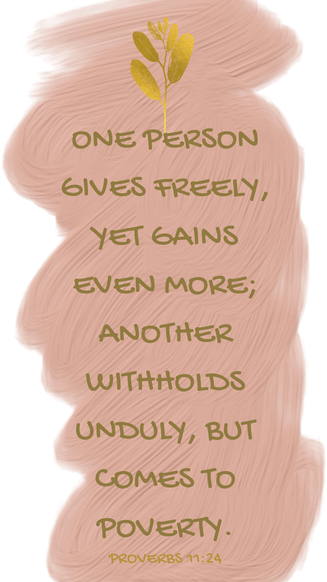
     It’s a paradox—that what seems like losing our lives for Christ and for others will result in the greatest over-flowing, abundant, lavish and inexhaustible richness to life that could never be found any other way!  God’s goodness is generous---He always gives more than we could ever give away!   
    Generosity has the idea of liberality, lavishness, and magnanimity. It is open-handedness, unselfish, and indulgent.  It is prodigal in its nature.  It is plentiful, large, abundant, ample, profuse, and opulent in its richness.   
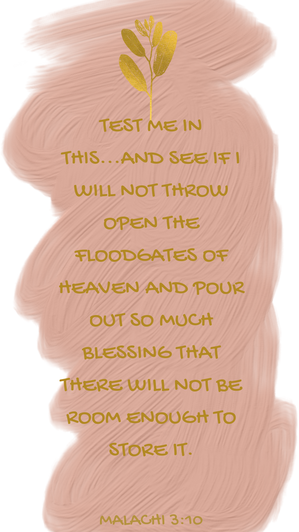
    In Malachi 3:10, God holds out His hands to His people, then stingy and stinting, pleading with them to test His goodness and generosity to them by giving willingly and cheerfully to the needs of others through trust in His ability to more than amply care for them: “...Test me in this,” says the LORD Almighty, “and see if I will not throw open the floodgates of heaven and pour out so much blessing that there will not be room enough to store it.” 
    God’s generosity cannot be outgiven.  Rather, we show our trust in His unfailingly good generosity by our response—that of freely giving what we have freely been given (Matt. 10:8).  God’s generous goodness may seem like it costs us as we give away freely of ourselves, but in reality it lavishly pours into us as we pour out His goodness out of our new rebirth in Christ.

     Maybe this kind of intrinsic goodness, the kind that seeks no benefit to oneself, seems outside your reach.  Maybe you always thought you were a “good” person, but find that each of your motivations for being good lead back to yourself: Our reasons for being friendly to certain people that we think more able to return our friendship; Working hard for a good employer to earn their praise or appreciation; Serving our children so that they will be happy and love us back; being sweet and giving gifts in a romantic relationship.   
     Even trying to earn eternal life by following all the rules or doing all the good things is still self-motivated and completely useless in generating the eternal life and transformation that only Christ can give.   
     If you find yourself in this position where, like the rich young ruler your good deeds are not really good, but just efforts made ultimately for yourself--if you say, ‘I am rich; I have acquired wealth and do not need a thing,” but you do not realize that you are wretched, pitiful, poor, blind and naked,” because your efforts at goodness cannot cover your need, then Jesus counsels you to come to Him so that you can become rich; to receive from Him “white clothes to wear, so you can cover your shameful nakedness, and salve to put on your eyes, so you can see” (Rev. 3:17-18).  Receive the transformational gift of rebirth through Jesus, and let His goodness permeate your whole spirit!
     Out of our new and transformed spirit in Christ, His Spirit then begins to show us those ways in which our motivations do not align with His. I find myself there sometimes when I want to do a good thing—and then find my motivations to be self-centered. If we really let Him examine our heart motivations, we easily find that, while not wrong or evil, many of these actions certainly cannot fall into the true definition of generous goodness that is completely unself-oriented.   
     Today, as we listen to the Holy Spirit and let Him examine our hidden motivations, let’s ask for God’s goodness to transform our motivations from within.  Let’s ask for His goodness to flow out of us to those who will never deserve it: to all those to whom we can give without expecting anything back.   
    And when we serve with His goodness, let’s remember it’s only for an hour.  His favor lasts a lifetime of eternity.  ​
1Halverson, T. (2020, March 14). Was the denarius a daily wage? A note on the parable of the two debtors in luke 7:40–43: The Interpreter Foundation. The Interpreter Foundation | Increasing understanding of scripture one article at a time. Retrieved October 5, 2021, from https://journal.interpreterfoundation.org/was-the-denarius-a-daily-wage-a-note-on-the-parable-of-the-two-debtors-in-luke-740-43/. ​
1 Comment
Beth
10/17/2021 12:52:59 pm

Beautifully written, Halley.

Reply


Leave a Reply.

    Picture

    Author

    Halley Faville lives with her husband and children in their mountain home in Oregon. 

    ​As a homeschooling mother of 7 children, she enjoys spending her free time in  language arts, music, art, and outdoor activities.  

    Archives

    August 2025
    August 2024
    May 2024
    April 2024
    February 2024
    October 2023
    June 2023
    December 2022
    October 2022
    June 2022
    April 2022
    March 2022
    December 2021
    November 2021
    October 2021
    September 2021
    August 2021
    July 2021
    June 2021
    May 2021
    April 2021
    March 2021
    January 2021
    December 2020
    November 2020
    October 2020
    August 2020

    Categories

    All
    1 Samuel
    2 Chronicles
    40 Days Of Goliath
    Abraham
    Acts
    Children
    Christmas
    Cross
    David
    Deliverance
    Ecclesiastes
    Eph 5:22-23
    Exodus
    Faith
    Faithfulness
    Fall
    Favor
    Feasts
    Focus
    Fruit Of The Spirit
    Generosity
    Genesis
    Gentleness
    Gideon
    Goodness
    Gospel
    Hannah
    Harvest
    Healing
    Homeschool
    Isaac
    Jehoshaphat
    John
    Joy
    Judges
    Justice
    Kindness
    Kingdom
    Listen
    Live
    Love
    Luke
    Ministry
    Multiplication
    Nativity
    Parenting
    Passover
    Patience
    Peace
    Perseverence
    Power
    Praise
    Prayer
    Promise
    Redeemer
    Relationship
    Repentance
    Resolution
    Reward
    Salvation
    Sanctification
    School
    Strength
    Submission
    Suffering
    Transformation
    Trust
    Truth
    Victory

    RSS Feed

Photos from bangorvineyardshedmedia, JamesInDigital, wildrosetn39
  • Home
  • Halley Faville
  • Jeff Faville
  • Oaks Canyon Youth
    • Youth Sign-Up/Forms
    • How You Can Help!
  • Beth Bearden
  • About
  • Contact
  • Resources
  • Recommended Blogs