Oaks of Glory
  • Home
  • Halley Faville
  • Jeff Faville
  • Oaks Canyon Youth
    • Youth Sign-Up/Forms
    • How You Can Help!
  • Beth Bearden
  • About
  • Contact
  • Resources
  • Recommended Blogs

You, Follow Me!

4/20/2024

0 Comments

 
Picture
We have a lot of kids.  If you might believe it, sometimes it's hard for me to concentrate, get work done, or rest well in our home. :) But I still need to be present and available.  So Jeff built me a little cottage as a retreat. I love going out there and looking at the trees, listening to the wind and the water in the creek.  God restores my soul there. 

For a while my daughters lived in the cottage while our parents were living with us.  After they were able to move into other rooms again, the cottage was left cold, empty and uninviting.  Of the many things needed out there, the top concern I had was heat!  I searched the internet for the perfect heater.  I love to read and have a lot of books, so I wanted it to have bookshelves attached.  After some time, I found a little, white electric fireplace with bookshelves on either side.  It was delightful!  I could go out there with a cup of tea and enjoy watching the fake flames dance around.  It was great-- until two weeks later the fireplace stopped working. 

Oh, the flames still danced, it still looked like it worked, but there was no power to the heat element.  All it could do was look pretty.  It couldn't function in any purposeful way to chase away the cold in that little room.  It needed to be connected to a genuine source of real power.  


So when they had eaten breakfast, Jesus said to Simon Peter, “Simon, son of Jonah, do you love Me more than these?” John 21:15
​

We must hear and 0bey by agape-loving God.


In John 21, John introduces us to Jesus’ commissioning of His disciples on His third appearance to them after His resurrection. The disciples had just gone out fishing, mirroring their original calling by Jesus. Now, after breakfast, Jesus has three questions for Peter, and three questions for us.  "Do you love Me?"

John, the author of this gospel, refers to Peter as Simon Peter. His original name was Simon.  It is the same name as Simeon, and comes from the Hebrew verb, “shama:” to hear and obey.
​
The Shama was the commandment of God which the Israelites would recite first in the morning and last at night every day of their existence, which Jesus claimed to be the Greatest Commandment:
​

“Hear, O Israel: The Lord our God, the Lord is one! You shall love the Lord your God with all your heart, with all your soul, and with all your strength. Deut. 6:4-5


This was Simon’s name.  He carried this around with him daily.  He was to hear and obey God out of gratitude for God hearing his cries for salvation.   

But John reminds us that Simon has another name, “Peter.”  Why? 

​To understand Simon Peter’s second name, we need to go back to the beginning of the book, to John 1:40-42.  Andrew had just been at John the Baptist’s Jordan River baptism, where John the Baptist identified Jesus as the Messiah when the Holy Spirit came upon Jesus as a dove and remained.  He announced Jesus as the Lamb of God who would “take away the sin of the world!” It was then that Andrew went and got Simon and told him that he had found the Messiah and brought him to Jesus.
​

Now when Jesus looked at him, He said, “You are Simon the son of Jonah. You shall be called Cephas (Peter)” (which is translated, A Rock). John 1:40-42

 
But here in this passage Jesus specifically refers only to his original name.  Why?  We will get to that in a bit, but for now we also need to see that Jesus keeps referring to Simon as the son of Jonah. 

Jonah means “Dove.” 

But there is also another story of Jonah.  It is the story of a prophet that God commands to go to his enemies to tell them of God’s pending judgment who wanted God’s grace for himself, but not for his enemies. The story ends with us as the readers not being told whether Jonah ever allows God to change his heart.

Simon is a son of Jonah.  He is frail, weak and full of false bravado.  He hears God, he receives God’s grace for his three times’ denial of Jesus and every other wicked thing he had done—but he still doesn’t want to give God’s grace to the evil Gentiles, like the Romans, who had taken over his country and abused them.

Next Week we will start a series in the Book of Acts, and we will find that twice God uses this story with Jesus in John 21, in the story of the Acts of the Spirit in the birth of the Church.  Simon will truly be Simon son of Jonah, with a redemptive ending!

So Jesus asks the question, “Simon, son of Jonah, do you love Me more than these?”

More specifically, Jesus asks “do you have agape-love for me?”  This is God’s sacrificial love for us.  God so agape-loved the world that while we were still sinners, living in hostile rebellion to God, He gave His only, beloved Son to die to redeem us. That is the agape-love of God.  “Simon, son of Jonah, do you agape-love me more than these?


We must agape-love God more than anything in the world.

“More than these.” To whom or what is Jesus referring?

To find out, we need to go back to Jesus’ original calling of Simon Peter in Luke 5:1-11. Jesus had just spoken to the multitude from inside Simon’s boat.  Afterward, He tells Simon to put the boat out into the water to catch, and Simon, after protesting that he had tried all night and caught nothing, hears and obeys Jesus.  They catch such a great amount of fish that their nets begin to break.  In Simon’s awe of this miracle, he falls down at Jesus’ knees in repentance and fear, proclaiming, “go away from me, Lord, I am a sinful man!”
​

 And Jesus said to Simon, “Do not be afraid. From now on you will catch men.” So when they had brought their boats to land, they forsook all and followed Him. Luke 5:10-11


​Back in John 21, we must remember, Jesus had just risen from the dead.  Where does Peter go? Fishing. Jesus’ renewed calling of Simon Peter in John 21 recalls his realization of his sinfulness and the grace given to him.  Jesus had originally told him not to be afraid.  Simon, however, had been very afraid at the cross, to the point where he denied Jesus three times.  So after Jesus’ death Peter goes back to fishing, because it’s what he knows, what he loves, what is safe, and what provides him the life that he wants: one of success and safety. 

There is a grammatical structure in the Greek that point to what Jesus is talking about with his phrase “more than these” in both accounts. In the Greek, these words “all” and “more than these” grammatically end the same as the object to which they are referring. In Peter’s original calling, when they “forsook all,” the grammar indicates that the “all” is referring back to the boats. In John 21, “more than these” is also referring to the fishing, to the fish and to his livelihood from this career.  The antecedent, the words earlier referenced are the “so many great fish, 153 of them.”  Jesus is asking him, “Do you agape-love me more than you love fishing?  More than you love this boat, this net, this job, this income, this world?” 
​
Jesus clarifies this further in Luke 14:25:

​

Now great multitudes went with Him. And He turned and said to them, “If anyone comes to Me and does not hate his father and mother, wife and children, brothers and sisters, yes, and his own life also, he cannot be My disciple. And whoever does not bear his cross and come after Me cannot be My disciple. For which of you, intending to build a tower, does not sit down first and count the cost, whether he has enough to finish it— lest, after he has laid the foundation, and is not able to finish, all who see it begin to mock him, saying, ‘This man began to build and was not able to finish’? Or what king, going to make war against another king, does not sit down first and consider whether he is able with ten thousand to meet him who comes against him with twenty thousand? Or else, while the other is still a great way off, he sends a delegation and asks conditions of peace. So likewise, whoever of you does not forsake all that he has cannot be My disciple. Luke 14:12-14, 25-33
​

Back in John 21, Simon’s response to Jesus’ question, Do you agape-love me more than these” is sad and unsatisfactory. He has no power over fear. Simon said to Him, “Yes, Lord; You know that I have phileo-affection for You.”

Peter has a self-awareness. He doesn’t use agape-love, he uses “affection.”  He loved Jesus like he might his brother or his family.  To agape-love God means to love Him more than anything else.  It is a comparison word, and by comparison our love for Him should be so much more than anything else in this world that people might consider the natural love we have for people who are close to us to be in comparison a hatred.  That is the difference between the agape-love of God and the phileo-affection that Simon has for Jesus. 
​

If we love Jesus, we must Shepherd His Church. 

Picture
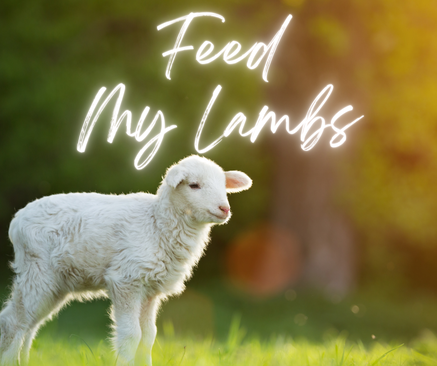
"Jesus said to Simon, 'Feed My Lambs."
 
Jesus had just called His disciples “children” at the beginning of their encounter with Him.  To feed a sheep means to give it nourishment.  To feed a lamb is to give it milk, because it is not yet ready for solid food.  Milk is the Word of God, but it is the easy word of God.  The gospel, the commands, the elemental principles of God’s word.  “As newborn babes,” 2 Peter 2:2 tells us, we are to “desire the pure milk of the word, that you may grow thereby.” 

This command to Simon is part of The Shama:


“Hear, O Israel: The Lord our God, the Lord is one! You shall love the Lord your God with all your heart, with all your soul, and with all your strength.
“And these words which I command you today shall be in your heart. You shall teach them diligently to your children and shall talk of them when you sit in your house, when you walk by the way, when you lie down, and when you rise up.
Deut. 6:4-7

If we agape-love Jesus, we will feed those new to Jesus, the little children who are new to the faith, the milk of the Word of God as they grow.  We will spend our waking hours looking for opportunities to share with them who God is, what His nature is, and how we can follow Him better. 
​
Milk is for the immature, for the worldly, those not taking the steps of walking in the Spirit. 

Paul talks to the Corinthian Church in 1 Cor. 3:1-3 about their pettinesses and sinful, worldly lifestyles as Christians and challenges them:

​

Brothers and sisters, I could not address you as people who live by the Spirit but as people who are still worldly—mere infants in Christ. I gave you milk, not solid food, for you were not yet ready for it. Indeed, you are still not ready. You are still worldly. For since there is jealousy and quarreling among you, are you not worldly? 1 cor. 3:1-3
​

Simon was still a “child” because he was still focusing on the world and what he could get out of it.  Jesus was calling him to maturity, to forsaking the world and preparing to live out his calling in a way that would no longer just focus on his own need for grace, but also for the world’s need for salvation. 
​

Jesus said to him again a second time, “Simon, son of Jonah, do you agape-love Me?”

He said to Him, “Yes, Lord; You know that I have affection for You.”
​

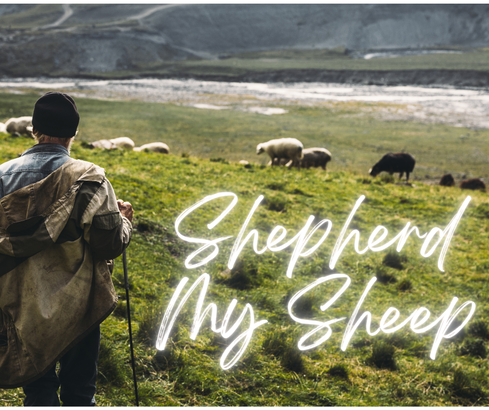
He said to him, “Shepherd My sheep.”

​

Picture
Sheep are mature adults, mature Christians. To shepherd means to not only provide pasture and calm waters, but also protection from thieves and predators. They are ready to grow on more than just milk. As we shepherd our families and those God has placed into our lives, they will need to be led to where they can learn more about God.  They need protection and wisdom from the enemy's lies and deception.  They need to be led to still, quiet places where they can have their soul restored in the Lord's presence. They need to be taught how to be discerning between God's voice and the enemy's voice: 
​

We have much to say about this, but it is hard to make it clear to you because you no longer try to understand. In fact, though by this time you ought to be teachers, you need someone to teach you the elementary truths of God’s word all over again. You need milk, not solid food! Anyone who lives on milk, being still an infant, is not acquainted with the teaching about righteousness. But solid food is for the mature, who by constant use have trained themselves to distinguish good from evil. Heb. 5:11-14
​

Peter was still worldly.  He was still focused on what he could gain out of this for himself.  He was “supposing that Godliness was gain” (1 Tim. 6:5).

When we are raising our children, the goal isn’t just that they feed themselves, clothe themselves and clean up after themselves.  When they are newborns, we do everything for them.  As they grow and starting to eat solid food, we still do much of the work for them.  But the goal is so much more.  We are raising our children to not only provide for themselves, but to be able to provide for a family and their community.  To be a blessing to the world.  That is maturity.

Jesus is telling Simon will need agape-love to shepherd His church.  It is a sacrificial love that lays down one’s life, one’s dreams, one’s success and reputation.  In fighting off predators and protecting the sheep, there is necessary risk that we must accept. As a parent, we understand this.  We know that caring for our kids means that we may need to place ourselves into harm to make sure that our kids are protected.  We know that there will be sleepless nights, long hours, and challenging times trying to provide for them. 

​This is something that is very challenging for us to accept.  It was challenging for Simon, because he loved and cherished his life.  In Matthew 16 The Jewish rulers come to Jesus asking him to prove himself as the Messiah.  Jesus tells them the only sign they will be given is the Sign of Jonah.  Just as Jonah was in the belly of the sea serpent for three days and three nights, so Jesus would be in the grave for three days and three nights before his resurrection.  Jesus was suffer the cross before the life.  The Jewish rulers were looking for a conquering messiah, one who would conquer, decimate and humiliate their enemies, raise them all to power, fame and wealth, and make everything amazing.  This is what Simon also wanted from a Messiah.  As we go on in Matthew 16, Jesus then warns his disciples to be wary of the problem the Pharisees have.  Then in verse 15 he asks them this very important question:  Who do you say that I am? It is Simon's answer that defines his identity:
​

Simon Peter answered and said, “You are the Christ, the Son of the living God.”
Jesus answered and said to him, “Blessed are you, Simon Son of Jonah, for flesh and blood has not revealed this to you, but My Father who is in heaven. And I also say to you that you are Peter (a small pebble or easily moved stone), and on this Rock (a large, cliff-side rock used as a foundation to build structures) I will build My church, and the gates of Hell shall not prevail against it. And I will give you the keys of the kingdom of heaven, and whatever you bind on earth will be bound in heaven, and whatever you loose on earth will be loosed in heaven.”
From that time Jesus began to show to His disciples that He must go to Jerusalem, and suffer many things from the elders and chief priests and scribes, and be killed, and be raised the third day.
Then Peter took Him aside and began to rebuke Him, saying  “Far be it from You, Lord; this shall not happen to You!”
But He turned and said to Peter, “Get behind Me, Satan! You are a stumbling-block to Me, for you are not mindful of the things of God, but the things of men.”
Then Jesus said to His disciples, “If anyone desires to come after Me, let him deny himself, and take up his cross, and follow Me. For whoever desires to save his life will lose it, but whoever loses his life for My sake will find it. For what profit is it to a man if he gains the whole world, and loses his own soul? Or what will a man give in exchange for his soul? For the Son of Man will come in the glory of His Father with His angels, and then He will reward each according to his works. Assuredly, I say to you, there are some standing here who shall not taste death till they see the Son of Man coming in His kingdom.”
 Matthew 16:16-28
​

It was by the Spirit of God that Peter recognized the power of God in the Son of God!  It was by the frailty of his humanity that he resisted the calling to suffering of His same Messiah.  Again, in John 10:11-13, Jesus reminds us of the difference between sharing the gospel for worldly gain vs one taking care of the Church out of agape-love:
​

“I am the good shepherd. The good shepherd lays down his life for the sheep. The hired hand is not the shepherd and does not own the sheep. So when he sees the wolf coming, he abandons the sheep and runs away. Then the wolf attacks the flock and scatters it. The man runs away because he is a hired hand and cares nothing for the sheep. John 10:11-13
​

But Jesus knows that Simon doesn’t have this kind of courage in him.  He knows he’s just a Peter, just a movable, little rock.  So when Jesus is telling Simon Peter to Shepherd His Sheep, he is reminding him of his need to understand his frailty as Peter, not just Simon. Simon would need to depend entirely on the Spirit of God to accomplish the work of shepherding God's people. It would only be on the Rock of Christ that the Church would indeed be built and that not even Hell’s Gates could stand up against the onslaught of the Church of Christ to redeem the world that God loves!

​Simon Peter should not be afraid.  But he is.  He is afraid of the cross.  He is afraid of death.  And this is preventing him from being who he is called to be:  one that shepherds Christ’s church.
​

​
He said to him the third time, “Simon, son of Jonah, do you have affection for  Me?” Peter was grieved because He said to him the third time, “Do you have phileo-affection for Me?”
And he said to Him, “Lord, You know all things; You know that I have phileo-affection for You.”
Jesus said to him, “Feed My sheep.
​

Jesus knows all things.  Yes, he knows that Simon Peter only has an affection at this point.  He needed Simon to know it.  He needed Simon to know the kind of love that was necessary.  He knows us too.  He knows our fears.  He knows our conflicting allegiances.  He knows that we struggle to give up what we cannot keep to gain what we cannot lose. 

He knows it’s hard. 

But if we have even affection for Jesus, we must follow Him by taking up our cross and caring for His people.


Most assuredly, I say to you, when you were younger, you girded yourself and walked where you wished; but when you are old, you will stretch out your hands, and another will gird you and carry you where you do not wish.” This He spoke, signifying by what death he would glorify God. And when He had spoken this, He said to him, “Follow Me.”
​

The very cross Simon ran from would become the death he died.  The fear he faced would be changed into courage by the Power of the Spirit and out of the love that he would be given for God and for the world. Jesus knows this about you too.  The Bible says that God always finishes what He starts.  He will carry us on to maturity and complete the work He has begun in you and in me (Phil 1:6).  Jesus knows this and isn’t afraid that He can’t accomplish this work in us!
​
But what do we do?  I think we are so much like Simon here.  We compare ourselves to others in this process.  When my kids are young, they often want to divert our learning conversations to avoid applying to themselves what they need to do.  "What about her?"  "What about him?"  they ask.  "Don’t they have to do their chores too?"  "Why are they getting to stay up late and I have to go to bed?"  "Why did they get a date and I haven’t yet?"  We look around and wonder what God’s trying to do with someone else.  That’s exactly where Simon goes when the conversation gets uncomfortable:

​

Then Peter, turning around, saw the disciple whom Jesus loved following, who also had leaned on His breast at the supper, and said, “Lord, who is the one who betrays You?” Peter, seeing him, said to Jesus, “But Lord, what about this man?”
Jesus said to him, “If I desire that he remain till I come, what is that to you? You follow Me.”
Then this saying went out among the brethren that this disciple would not die. Yet Jesus did not say to him that he would not die, but, “If I will that he remain till I come, what is that to you?”
​

​Simon was likely also remembering Jesus’ words in Matt 16:28:
​

Assuredly, I say to you, there are some standing here who shall not taste death till they see the Son of Man coming in His kingdom.” Matt 16:28
​

John was the only one of the disciples who, according to church tradition, lived a long life and died naturally.  John was enabled to see the revelation of Jesus’ second coming in the book of revelation. 

Peter sees John following Jesus.  John hadn’t run at the cross.  It was John who brought Simon into the room where Jesus was standing trial.  It was John who stood at the cross, watching Jesus die.  It was John who believed as soon as he saw the empty tomb.  John is already following Jesus.  But Jesus isn’t talking to or about John. He’s talking to Peter.  We do that, don’t we?  Try to distract ourselves with God’s dealings with others.  "What about them, Lord?"  "See how they messed up?"  "What about them, Lord, aren’t you going to ask them to do something hard?" "Your people aren't getting it right." "What about them, Lord, are they going to have to do it too?" 

But Jesus’ response to Simon Peter is the same as to us: If He desires a different outcome for someone else, what is that to us? 

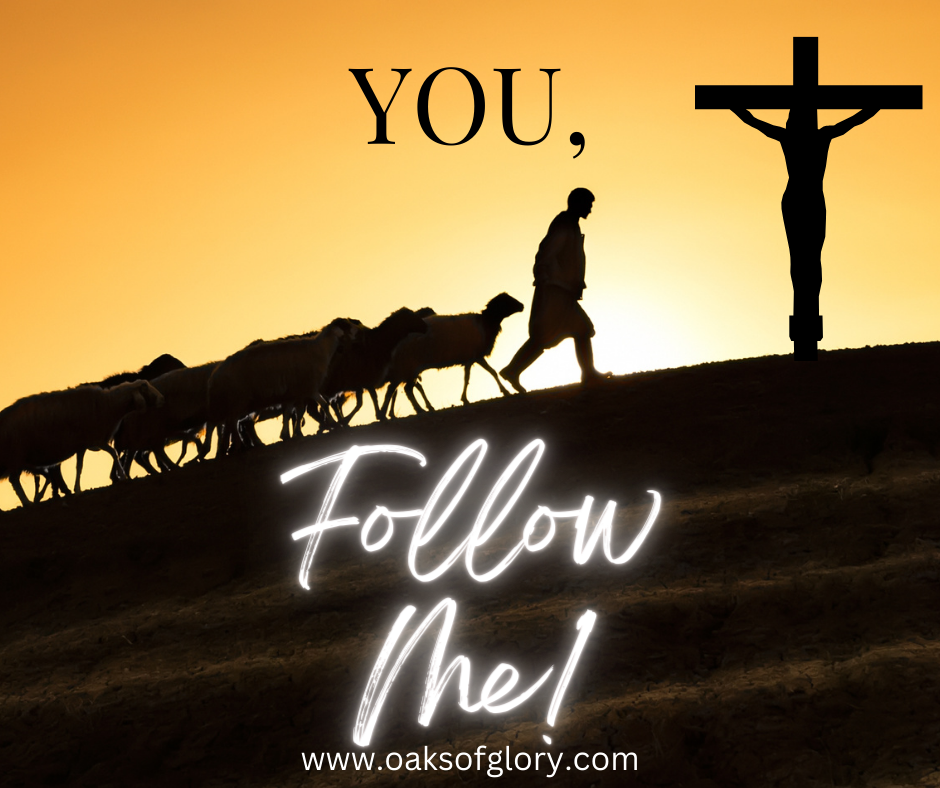
“You, follow Me.”

Have you counted the cost to follow Jesus?  Do you love the Lord your God with all your heart, with all your soul, with all your strength?  Do you love the people of the world as you love yourself? Are we willing to follow Jesus, even to the cross? 

Peter wasn’t ready for any of these things.  He was just a weak, double-minded human who was frail and too small to accomplish the great task that Jesus had assigned for him.  We feel that.  If we are real with ourselves before God, we know we don’t have what it takes to love like God loves, to lay down our lives every day for others, to risk our lives to save our enemies.  But Jesus isn’t asking us to be strong, He is asking us to connect into Him as our Source of Power so that we can walk in His strength, doing His works, and allowing God to use us to build His Church on Jesus Christ, the immovable Rock!  As we will see next week, a Power was coming from God that would give them and us exactly the kind of courage that we need to love God and shepherd His Church.  

As we lean into Jesus’ hard questions for us this week, let’s not get distracted with what God is doing with other people.  Let’s ask the Holy Spirit to show us what things in this world—our families, friends, work, reputation, comfort.

​What are the things that we are clinging to that prevent us from loving God with all our hearts? Are we willing let His Spirit fill us with the power to accomplish what He's called us to do? 

​
References:
​1
Strong's Greek: 4074. Πέτρος (Petros) -- "a stone" or "a boulder," Peter, one of the twelve apostles (biblehub.com)
2Strong's Greek: 3404. μισέω (miseó) -- to hate (biblehub.com)
0 Comments


Leave a Reply.

    Picture

    Author

    Halley Faville lives with her husband and children in their mountain home in Oregon. 

    ​As a homeschooling mother of 7 children, she enjoys spending her free time in  language arts, music, art, and outdoor activities.  

    Archives

    August 2025
    August 2024
    May 2024
    April 2024
    February 2024
    October 2023
    June 2023
    December 2022
    October 2022
    June 2022
    April 2022
    March 2022
    December 2021
    November 2021
    October 2021
    September 2021
    August 2021
    July 2021
    June 2021
    May 2021
    April 2021
    March 2021
    January 2021
    December 2020
    November 2020
    October 2020
    August 2020

    Categories

    All
    1 Samuel
    2 Chronicles
    40 Days Of Goliath
    Abraham
    Acts
    Children
    Christmas
    Cross
    David
    Deliverance
    Ecclesiastes
    Eph 5:22-23
    Exodus
    Faith
    Faithfulness
    Fall
    Favor
    Feasts
    Focus
    Fruit Of The Spirit
    Generosity
    Genesis
    Gentleness
    Gideon
    Goodness
    Gospel
    Hannah
    Harvest
    Healing
    Homeschool
    Isaac
    Jehoshaphat
    John
    Joy
    Judges
    Justice
    Kindness
    Kingdom
    Listen
    Live
    Love
    Luke
    Ministry
    Multiplication
    Nativity
    Parenting
    Passover
    Patience
    Peace
    Perseverence
    Power
    Praise
    Prayer
    Promise
    Redeemer
    Relationship
    Repentance
    Resolution
    Reward
    Salvation
    Sanctification
    School
    Strength
    Submission
    Suffering
    Transformation
    Trust
    Truth
    Victory

    RSS Feed

Photos from bangorvineyardshedmedia, JamesInDigital, wildrosetn39
  • Home
  • Halley Faville
  • Jeff Faville
  • Oaks Canyon Youth
    • Youth Sign-Up/Forms
    • How You Can Help!
  • Beth Bearden
  • About
  • Contact
  • Resources
  • Recommended Blogs